Introduction
You are filling out a college application, you type in your GPA, and then you hit a confusing field: “GPA scale.” Should you write 4.0? 5.0? Should you convert your grades? Many students guess, and some get it wrong.
This guide explains what GPA scale reporting means, why colleges ask for it, how to find the right answer on your transcript and how to fill it in correctly on the Common App and other applications.
- The GPA scale is the highest GPA possible at your school, such as 4.0, 5.0 or 100.
- Report the scale your school uses; do not convert your GPA yourself.
- Colleges use the scale to read your GPA in context.
Table of Contents
What Is GPA Scale Reporting?
GPA scale reporting is the part of an application where you state the maximum value of the grading scale your school uses. It tells admissions readers how to interpret your GPA. A 3.8 means something very different on a 4.0 scale than on a 5.0 scale.
Most US applications ask three related questions: your cumulative GPA, your GPA scale and whether your GPA is weighted or unweighted. Together they give colleges an accurate picture without forcing every school into the same system.
- GPA: your number, for example 3.65.
- GPA scale: the top of the range, for example 4.0.
- Weighting: whether honors, AP or IB classes earn extra points.
How Does GPA Scale Reporting Work?
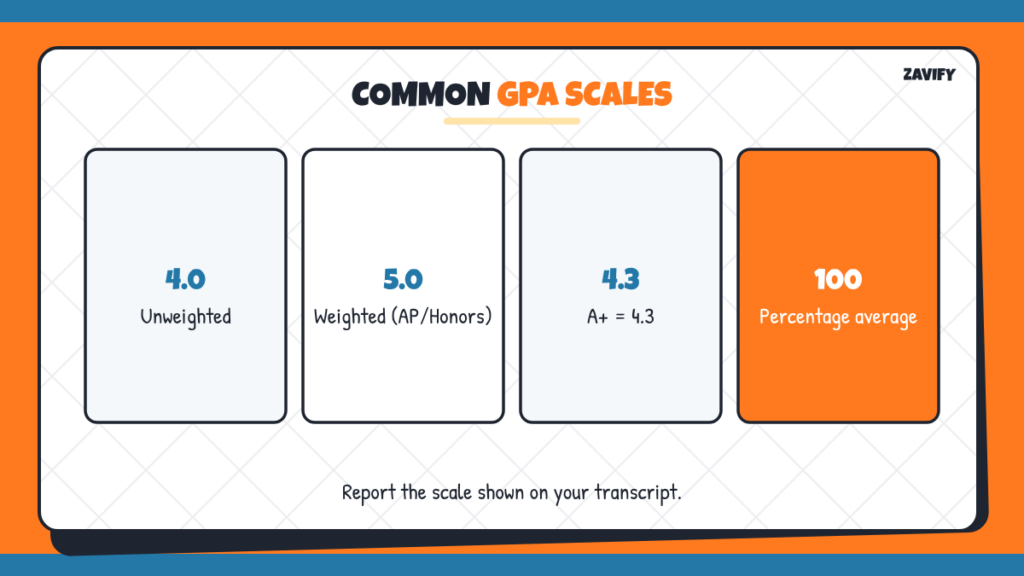
Here are the most common GPA scales you will see in US high schools:
| GPA Scale | How It Works | Example GPA |
|---|---|---|
| 4.0 (unweighted) | A = 4, B = 3, C = 2, D = 1, F = 0 | 3.6 / 4.0 |
| 5.0 (weighted) | Honors or AP classes can earn up to 5 points | 4.3 / 5.0 |
| 4.3 or 4.33 | An A+ earns 4.3 points | 3.9 / 4.3 |
| 6.0 or higher (weighted) | Some districts give extra points for advanced courses | 5.1 / 6.0 |
| 100-point | Average of percentage grades | 91 / 100 |
Admissions offices then recalculate or interpret your GPA using your transcript and the school profile your counselor sends. That is why you never need to convert your GPA yourself.
How to Find Your GPA Scale
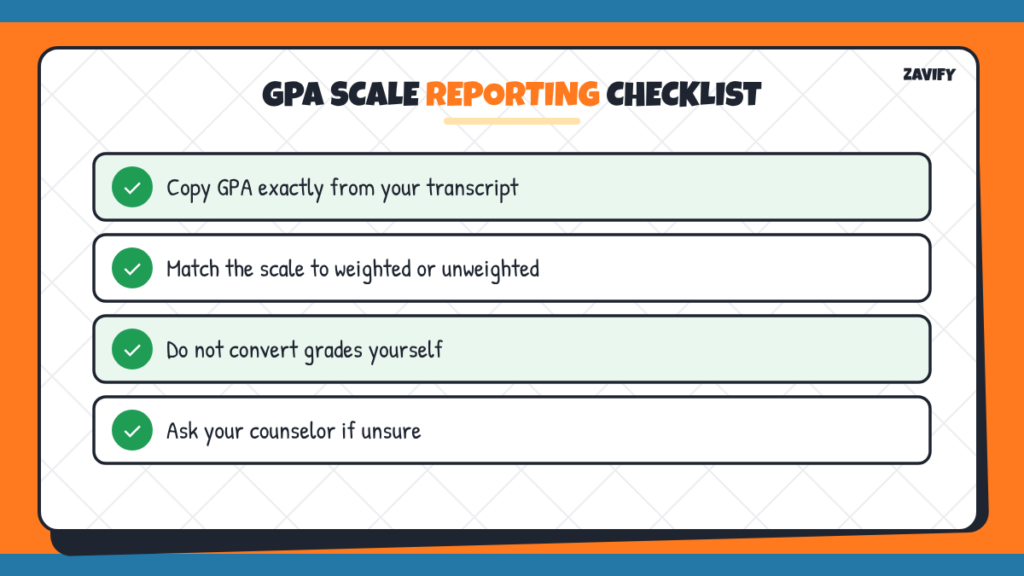
Follow these steps to report your GPA scale correctly:
- 1. Look at your transcript. It is the best source for GPA scale reporting. Many transcripts state the scale, for example “GPA 3.72 / 4.00.”
- 2. Check your school profile. Your counselor sends this document to colleges; it explains the grading and weighting system.
- 3. Ask your school counselor. This is the fastest way to be sure.
- 4. Match weighted and unweighted. If you report a weighted GPA, report the weighted scale (such as 5.0).
- 5. Use the official number. Copy exactly what your school reports, with the same decimal places.
GPA Scale Reporting on the Common App
On the Common App, the Education section asks for your cumulative GPA, the GPA scale and whether the GPA is weighted or unweighted. The scale is chosen from a drop-down list (for example 4, 5, 6, 10 or 100). If your school does not calculate a GPA at all, you can usually indicate that instead of inventing one.
Some university systems use their own applications and calculate GPA themselves from the grades you enter, using only certain courses. In those cases, follow that application’s instructions closely rather than copying your school’s GPA.
Weighted vs Unweighted GPA Scale
| Feature | Unweighted | Weighted |
|---|---|---|
| Usual scale | 4.0 | 5.0 (sometimes higher) |
| Extra points for AP/honors | No | Yes |
| Example of an A in AP Biology | 4.0 | 5.0 |
| What colleges see | Pure grade performance | Grades plus course difficulty |
For GPA scale reporting, colleges see both your grades and the difficulty of your classes on your transcript, so neither version is “better.” Report what your school reports. To understand your numbers, try our high school GPA calculator or the weighted grade calculator.
International Students and GPA Scale Reporting
For GPA scale reporting by international students: if your school uses a 10-point CGPA, percentages or another system, report your grades exactly as your school records them and select the matching scale, or “none” if the scale is not listed. Do not convert to a US 4.0 GPA unless the application specifically asks you to. Some universities ask for a credential evaluation from a service such as WES. Our study abroad GPA converter gives an estimate for planning only.
Example: Reporting Your GPA
Here is GPA scale reporting in practice. Jordan’s transcript shows “Weighted GPA: 4.21 (5.0 scale)” and “Unweighted GPA: 3.78 (4.0 scale).” The application asks for one GPA. Jordan reports 4.21, selects a scale of 5 and marks it as weighted. If the application asked for an unweighted GPA, Jordan would report 3.78 on a scale of 4. Either way, the counselor’s school profile explains how the numbers were calculated.
What Colleges Do With Your GPA Scale
Once your application arrives, admissions offices place your GPA in the context of your school. Many recalculate a standard GPA using only core academic courses, such as English, math, science, social studies and world languages, and they may remove or add weighting according to their own rules. Some public university systems publish exactly how they do this. That is why GPA scale reporting is about accuracy, not about making your number look bigger.
Your counselor’s school profile is a key part of this process. It explains how your school calculates GPA, what the grade distribution looks like and which advanced courses are offered. Readers use it to understand whether a 3.9 at your school is typical or exceptional.
GPA Scale Reporting for Scholarships and Jobs
Scholarship forms and job applications sometimes ask for a GPA on a 4.0 scale even if your school uses another system. Read the instructions carefully, because GPA scale reporting rules differ between forms. If they ask for an unweighted 4.0 GPA, report that number if your transcript shows it. If your school only provides a weighted GPA, report it with its scale and add a short note. Honest, clearly labeled numbers are always better than a guess.
Quick Checklist Before You Submit
- Your GPA matches your transcript exactly.
- The scale matches the GPA type (weighted or unweighted).
- You used the same decimal places as your school.
- You did not convert international grades unless asked.
- Your counselor knows which GPA you reported.
Common GPA Scale Reporting Mistakes
- Reporting a weighted GPA with an unweighted scale, such as 4.4 / 4.0.
- Converting your GPA to a 4.0 scale yourself.
- Rounding up, for example 3.67 to 3.7.
- Guessing instead of checking the transcript or asking a counselor.
- Leaving the field blank when your school does report a GPA.
Why Colleges Care About the GPA Scale
Admissions officers read applications from thousands of high schools, each with its own grading rules. A clear GPA scale helps them compare fairly. They also look at your course rigor, grade trends and class rank where available. Accurate GPA scale reporting builds trust; a mismatch between your application and your transcript can cause delays or questions.
Frequently Asked Questions
What is GPA scale reporting?
Stating the highest possible GPA on your school’s scale, such as 4.0 or 5.0, so colleges can read your GPA correctly.
What GPA scale should I put on the Common App?
The scale shown on your transcript or school profile. If unsure, ask your counselor.
Should I report weighted or unweighted GPA?
Report what your school reports, and select the matching scale and weighting.
What if my school has no GPA?
Indicate that your school does not calculate a GPA, if the option exists. Do not create your own.
Do colleges recalculate GPA?
Many do, using their own rules and the courses on your transcript.
Is a 4.0 on a 5.0 scale good?
It is solid, roughly a B+ to A- average with some advanced classes, but context from your transcript matters.
Conclusion
GPA scale reporting simply tells colleges how to read your GPA. Find the scale on your transcript, match weighted with weighted, copy the official numbers and ask your counselor if anything is unclear.
For more help, read our guides on how to calculate GPA and the letter grade scale.