Formula: GPA = Σ (Grade Point × Credits) / Σ Credits
📐 Formula
GPA = Σ (Grade Point × Credits) / Σ Credits- Enter each of your courses with its letter grade and credit hours.
- Grades are mapped to the US 4.0 plus/minus scale (A = 4.0, A- = 3.7, B+ = 3.3, and so on).
- Each grade point is multiplied by the course’s credits, summed, and divided by your total credits to give your weighted GPA.
🎓 College GPA Standards (4.0 Scale)
The 4.0 scale is the standard grading system in the United States and at many international universities. Each letter grade maps to a grade point — an A is worth 4.0, a B is worth 3.0, an F is worth 0 — and your GPA is the credit-weighted average of those points across all your courses.
Credits matter because they typically represent the number of weekly hours a course meets. That means a 4-credit course impacts your GPA twice as much as a 2-credit elective, so your performance in heavier core classes carries far more weight than the same grade in a light elective.
💡 Pro Tip for College Students
Before relying on any GPA figure, check your institution’s grading policy. Many colleges use a Plus/Minus system, where an A- counts as 3.7 and a B+ counts as 3.3 rather than a flat 4.0 or 3.0. This calculator supports the full plus/minus scale, so selecting the exact grades from your transcript ensures the result matches your official records.
How to Calculate College GPA
A college GPA calculator weights every class by its credit hours. You can do the same by hand in four steps:
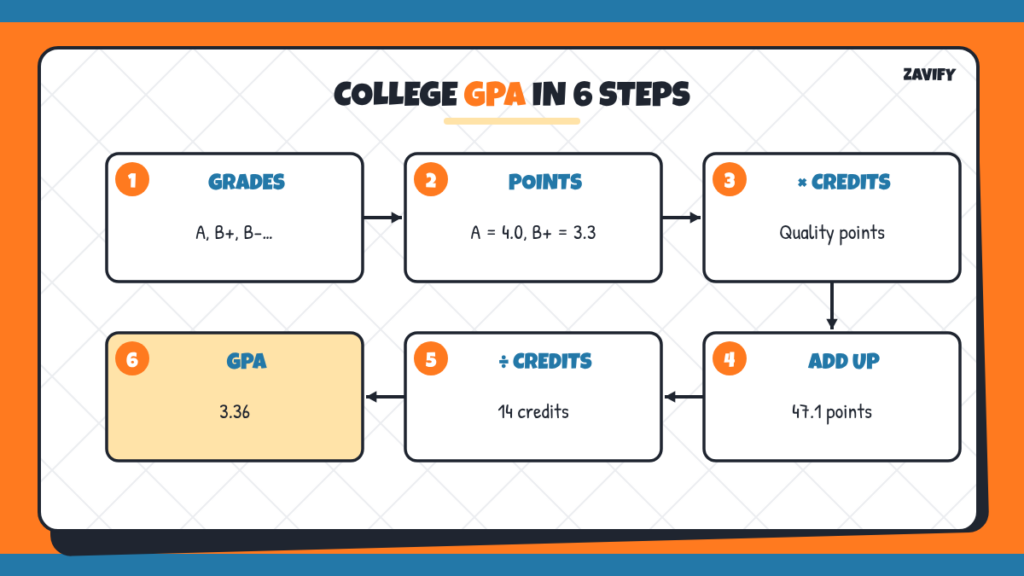
- Convert each letter grade to grade points (A = 4.0, A- = 3.7, B+ = 3.3 and so on).
- Multiply the grade points by the class’s credit hours to get quality points.
- Add up all the quality points.
- Divide by the total credit hours you attempted.
| Class | Credits | Grade | Points | Quality Points |
|---|---|---|---|---|
| Biology with lab | 4 | B+ | 3.3 | 13.2 |
| English Composition | 3 | A | 4.0 | 12.0 |
| Calculus I | 4 | B- | 2.7 | 10.8 |
| Psychology | 3 | A- | 3.7 | 11.1 |
| Total | 14 | 47.1 |
Semester GPA = 47.1 ÷ 14 = 3.36.
Semester GPA vs Cumulative GPA
Your cumulative GPA combines every semester, weighted by credits. A student with a 3.0 over 30 credits who earns a 3.6 over 15 new credits has (90 + 54) ÷ 45 = 3.20 cumulative. The more credits you have, the slower your cumulative GPA moves, so strong early semesters help most. Plan ahead with our cumulative GPA calculator.
What Counts in Your College GPA
- Counts: letter-graded courses at your college.
- Usually not counted: pass/fail courses, withdrawals (W) and most transfer credits.
- Repeats: many colleges replace or average the old grade when you retake a course; check your catalog.
Keep at least a 2.0 cumulative GPA to stay in good standing and keep federal aid; see Federal Student Aid’s eligibility rules. Our guide to what a 3.0 GPA means explains common cutoffs for jobs and grad school.
❓ Frequently Asked Questions
What is a good college GPA?
A 3.0 is usually the minimum for passing, while 3.5+ is considered excellent for competitive graduate programs and high-tier jobs.
Is a 4.0 GPA common in college?
No — a 4.0 requires earning an A in every subject across your entire degree, which makes it rare and highly respected.
How do credits work in GPA?
GPA = Sum(Grade Points × Credits) / Sum(Total Credits), so higher-credit courses weigh more heavily in the final average.
How do I calculate my college GPA?
Multiply each grade’s points by the class credits, add the results and divide by total credits.
Do pass/fail classes affect college GPA?
Usually not. They earn credit but are left out of the GPA calculation at most colleges.
Can I raise my college GPA quickly?
Early on, yes. After 60 or more credits, each new semester moves your cumulative GPA only a little.