Introduction
A 3.0 is one of the most common GPAs in the United States. It is also one of the most misunderstood: some students think it is great, others think it closes doors. The truth is in between, and it depends on your goals.
This guide explains what a 3.0 GPA means, its letter grade and percentage, how it compares nationally, what it means for college admissions and scholarships, and practical steps to raise it.
- A 3.0 GPA equals a B average, roughly 83–86%.
- It is close to the average GPA of US high school graduates.
- Many colleges accept a 3.0, but selective schools expect more.
3.0 GPA at a Glance
| Question | Answer |
|---|---|
| Letter grade | B average (a B is worth exactly 3.0 grade points) |
| Percentage | About 83–86% on most US grading scales (75% with the simple GPA ÷ 4 × 100 method) |
| Is it good? | It is about the commonly cited US average: solid, but not standout |
| Where it opens doors | Meets the 3.0 minimum that many scholarships, internships and master’s programs list |
| Fastest way up | A few A grades next term move a 3.0 noticeably; see the table below |
| Calculate yours | Use our cumulative GPA calculator |
Weighted vs Unweighted 3.0 GPA
On an unweighted 4.0 scale, a 3.0 is a straight B average. On a weighted 5.0 scale, where honors and AP classes earn extra points, a 3.0 may hide lower grades in harder classes, so colleges often recalculate it. Always say which scale you are reporting. Read more in weighted vs unweighted GPA.
Is a 3.0 GPA Good Enough for Grad School?
A 3.0 meets the minimum GPA many master’s programs publish, so you can usually apply. Because it sits at the cutoff rather than above it, the rest of your application matters more: test scores where required, relevant experience, recommendation letters and a strong upward grade trend. Competitive programs typically expect higher GPAs, so check each program’s published class profile.
Related reads: 3.4 GPA, 3.5 GPA, how to raise your GPA and our credit-based GPA calculator.
Introduction
A 3.0 is one of the most common GPAs in the United States. It is also one of the most misunderstood: some students think it is great, others think it closes doors. The truth is in between, and it depends on your goals.
This guide explains what a 3.0 GPA means, its letter grade and percentage, how it compares nationally, what it means for college admissions and scholarships, and practical steps to raise it.
- A 3.0 GPA equals a B average, roughly 83–86%.
- It is close to the average GPA of US high school graduates.
- Many colleges accept a 3.0, but selective schools expect more.
Table of Contents
What Is a 3.0 GPA?
On the standard unweighted 4.0 scale, a 3.0 GPA means your grades average out to a B. You might have all Bs, or a mix such as As and Cs that averages to 3.0. In percentage terms, a B usually covers 80–89%, and a straight B sits around 83–86% on common charts.
If your school uses a weighted 5.0 scale, a 3.0 means something weaker, closer to a C+ or B- average after extra points. Always check whether your GPA is weighted or unweighted.
- Letter grade: B.
- Percentage: about 83–86% (B range 80–89%).
- Unweighted scale: 3.0 out of 4.0, or 75% of the maximum.
How Does a 3.0 GPA Compare?
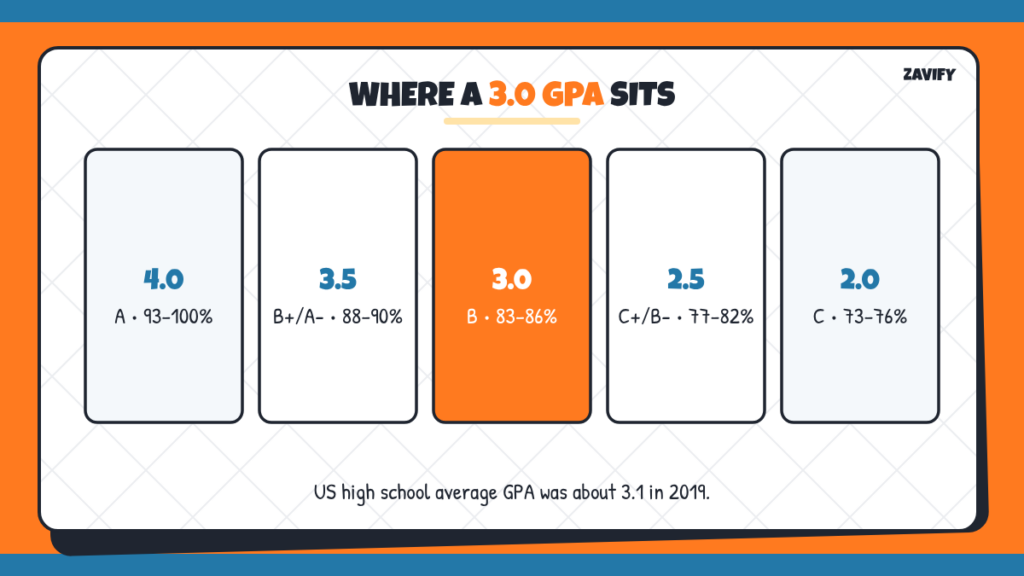
| GPA | Letter Grade | Approx. Percentage | How It Looks |
|---|---|---|---|
| 4.0 | A | 93–100% | Excellent |
| 3.5 | B+/A- | 87–92% | Very good |
| 3.0 | B | 83–86% | Solid, around average |
| 2.5 | C+/B- | 77–82% | Below average |
| 2.0 | C | 73–76% | Minimum for good standing in college |
According to the National Center for Education Statistics’ High School Transcript Study, the average GPA of US public high school graduates in 2019 was about 3.1. So a 3.0 is very close to average. The National Assessment Governing Board’s summary of the study has the details.
Is a 3.0 GPA Good?
It depends on what you want to do next:
- Graduating high school: yes, comfortably.
- Community college: yes; most have open admission.
- Many state universities: often yes, many list 3.0 as a typical minimum or competitive range.
- Highly selective colleges: usually not enough on its own; admitted students often average 3.7–4.0 unweighted.
- College GPA for jobs and internships: many employers use 3.0 as a screening cutoff.
- Graduate school: 3.0 is a common minimum for master’s programs.
What a 3.0 GPA Means in College
In college, a 3.0 is a respectable GPA. It keeps you in good academic standing, usually qualifies you for most majors and meets the GPA cutoff for many internships, scholarships and graduate programs. Honors programs and the most competitive employers often look for a 3.5 or higher.
Example: How a 3.0 Is Calculated
A student takes four classes worth 3 credits each and earns an A, a B, a B and a C. Points: A = 4, B = 3, B = 3, C = 2. Each is multiplied by 3 credits: 12 + 9 + 9 + 6 = 36 quality points. Divided by 12 credits, the GPA is exactly 3.0. Try it yourself with our college GPA calculator.
How to Raise a 3.0 GPA
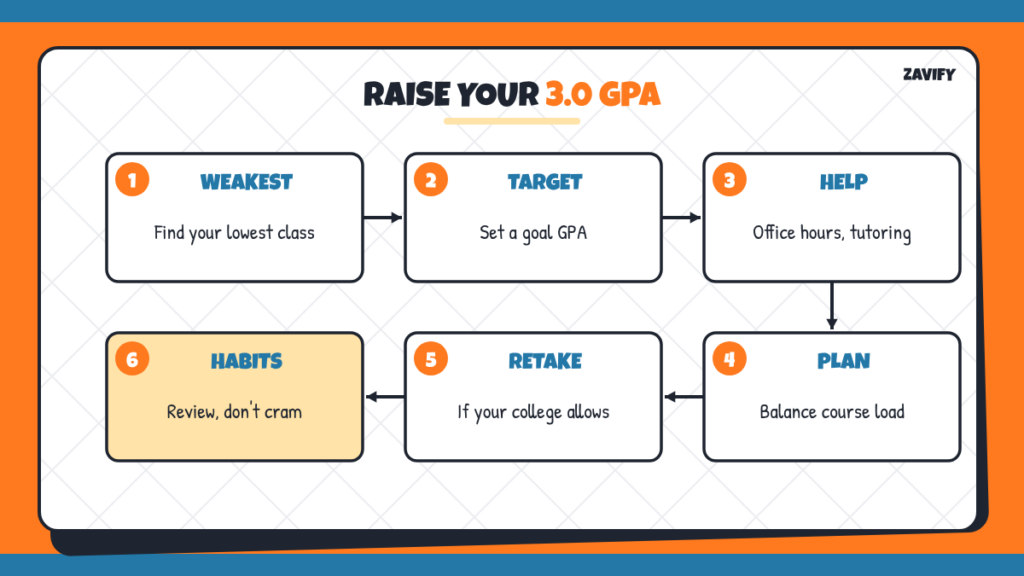
- 1. Find your weakest class. Raising one C to a B often helps most.
- 2. Calculate your target. Our required GPA calculator shows the grades you need to reach a 3.3 or 3.5.
- 3. Use office hours and tutoring. Small improvements add up.
- 4. Plan your course load. Balance hard classes across semesters.
- 5. Retake if allowed. Many colleges replace a low grade when you retake a course.
- 6. Build strong study habits. Spaced practice and regular review beat cramming.
Remember that early semesters weigh heavily. The more credits you have, the slower your cumulative GPA moves, so improving early pays off.
How Much Can You Raise It?
| Current GPA (credits) | Next Semester (15 credits) | New Cumulative GPA |
|---|---|---|
| 3.0 (30 credits) | 3.5 | 3.17 |
| 3.0 (30 credits) | 4.0 | 3.33 |
| 3.0 (60 credits) | 3.5 | 3.10 |
| 3.0 (60 credits) | 4.0 | 3.20 |
These figures show why steady effort over several semesters matters more than one perfect term. Use our cumulative GPA calculator to plan.
Colleges and a 3.0 GPA
Admissions decisions look at more than GPA. A 3.0 with an upward trend, challenging classes, strong essays and meaningful activities can be competitive at many colleges. If test scores are optional, a strong essay and recommendations become even more important. Look at each college’s admitted student profile to see where you fit.
3.0 GPA in High School vs College
A 3.0 in high school and a 3.0 in college are not quite the same. High school grades often include more homework and participation points, while college grades depend heavily on a few exams and projects. Many students see their GPA dip in the first year of college, so a college 3.0 is often a stronger result than it sounds. Employers and graduate programs know this and usually treat a 3.0 college GPA as a reasonable baseline.
Scholarships With a 3.0 GPA
Many scholarships set 3.0 as the minimum GPA. These include awards from local organizations, community foundations, employers and some state programs. Because many applicants sit right around this line, your essay, activities and financial need often decide who wins. Keeping your GPA at or above 3.0 keeps these opportunities open, and some renewable scholarships require you to stay above it every year.
If your GPA drops slightly below 3.0, look for awards based on leadership, community service, specific majors or first-generation status, which often weigh GPA less heavily.
What a 3.0 GPA Says About You
A 3.0 shows that you consistently meet expectations and do solid work. Pair it with evidence of growth, such as better grades in harder classes, strong projects or work experience, and it becomes part of a convincing story rather than a limit.
Common Mistakes
- Comparing a weighted GPA with an unweighted average.
- Assuming a 3.0 rules out good colleges.
- Ignoring upward trends, which colleges value.
- Trying to fix GPA in the final semester only.
Frequently Asked Questions
What is a 3.0 GPA in letter grade?
A B average on the 4.0 scale.
What percentage is a 3.0 GPA?
About 83–86% on common US charts, within the 80–89% B range.
Is a 3.0 GPA good in high school?
It is close to average and acceptable for many colleges, though not for the most selective ones.
Is a 3.0 GPA good in college?
Yes. It meets common cutoffs for internships, jobs and many graduate programs.
Can I get into college with a 3.0 GPA?
Yes. Many public universities and most community colleges accept students with a 3.0.
How long does it take to raise a 3.0 to a 3.5?
Usually several semesters of high grades, depending on how many credits you already have.
Conclusion
A 3.0 GPA is a solid B average that keeps many options open. It may not stand out at the most selective schools, but with an upward trend and strong applications it can take you a long way.
Know your numbers, set a target and improve steadily. For related guides, see 3.5 GPA to percentage and our letter grade scale.