Introduction
High school students often see two GPAs on their transcript and wonder which one is “real.” One might be a 3.6 and the other a 4.2. Both are accurate. They just measure your grades in different ways.
Understanding weighted vs unweighted GPA matters most when you start comparing yourself with college admission profiles, scholarship requirements and classmates. This guide explains both scales in plain language, shows how colleges read them and walks you through calculating each one in nine steps.
- Unweighted GPA: every class on the same 0–4.0 scale.
- Weighted GPA: extra points for honors, AP or IB classes.
- Colleges often recalculate your grades their own way.
Table of Contents
What Is Weighted vs Unweighted GPA?
An unweighted GPA treats every class equally. An A is worth 4.0 whether it comes from AP Calculus or a regular study hall. The maximum is 4.0.
A weighted GPA gives extra credit for harder classes. A common system adds 0.5 points for honors classes and 1.0 point for AP, IB or dual enrollment classes, so an A in an AP class counts as 5.0. That is why weighted GPAs can go above 4.0.
- Unweighted: shows how well you did in your classes.
- Weighted: shows how well you did and how hard your classes were.
- Both: come from the same letter grades.
How Does Weighted vs Unweighted GPA Work?
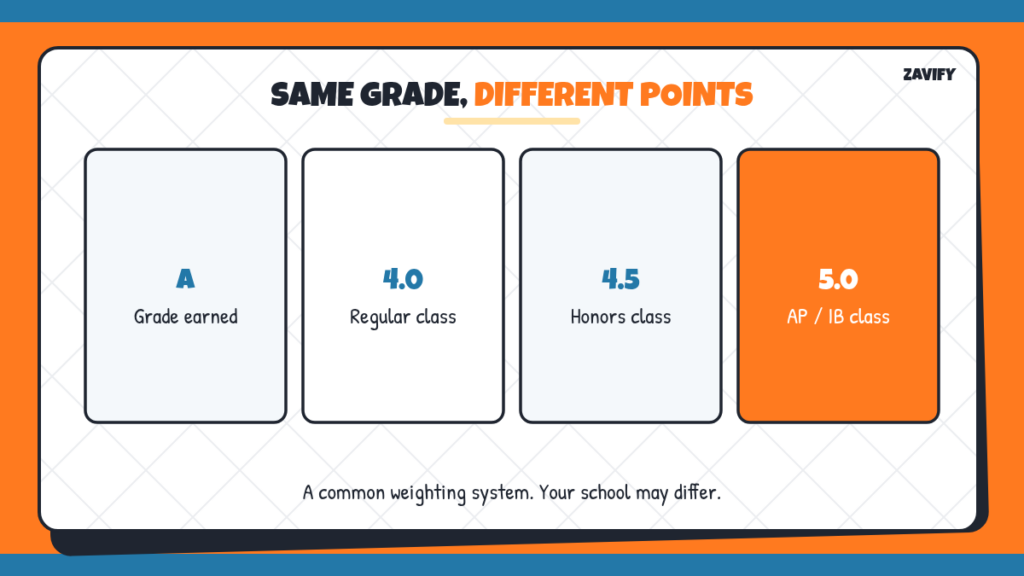
Here is how weighted vs unweighted GPA scales convert the same grades, using a common weighting system:
| Letter Grade | Regular Class | Honors Class | AP / IB Class |
|---|---|---|---|
| A | 4.0 | 4.5 | 5.0 |
| B | 3.0 | 3.5 | 4.0 |
| C | 2.0 | 2.5 | 3.0 |
| D | 1.0 | 1.5 | 2.0 |
| F | 0.0 | 0.0 | 0.0 |
Your school may use different bonuses. Some add 1.0 for honors as well as AP, some cap weighted GPAs at 4.5, and some do not weight at all. Check your school profile or student handbook for the exact rules.
1. Find Your School’s Weighting Policy
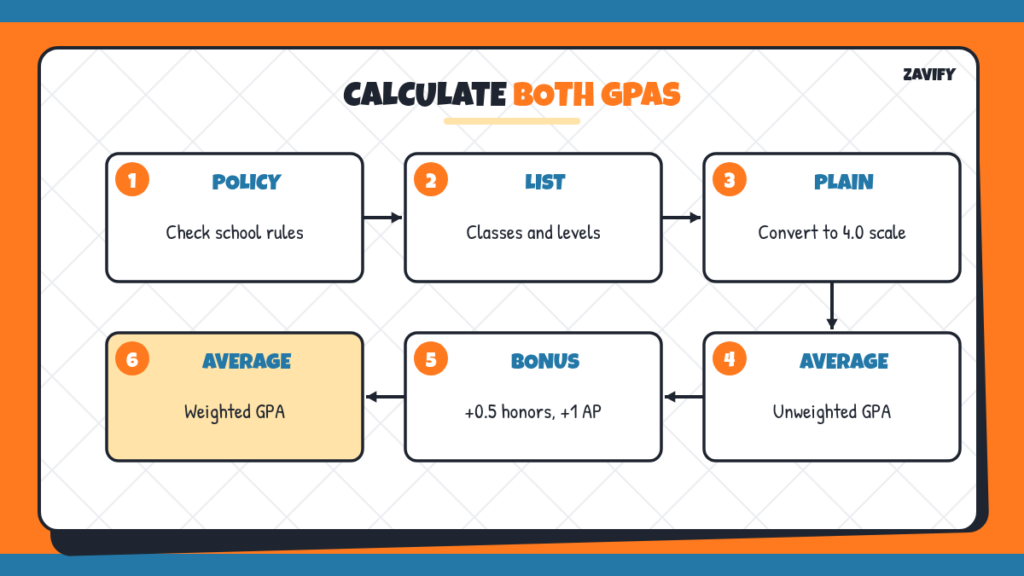
Before you compare weighted vs unweighted GPA numbers, look up how your school weights grades. The school profile, which counselors send to colleges, usually explains the scale and which courses earn extra points.
2. List Your Classes and Grades
Write down every class you have taken, the letter grade you earned and whether it was regular, honors or AP/IB. Include the credit value if your school uses credits.
3. Convert Each Grade to Unweighted Points
Use the plain scale for everything: A = 4.0, B = 3.0, C = 2.0, D = 1.0 and F = 0.0 (with plus and minus values if your school uses them).
4. Calculate Your Unweighted GPA
Add up all the unweighted points (multiplied by credits, if needed) and divide by the number of classes or total credits. This is your unweighted GPA.
5. Add the Weighting Bonus
Now go back to your list. Add the bonus to each honors or AP/IB grade, for example +0.5 or +1.0, using your school’s rules. Regular classes stay the same.
6. Calculate Your Weighted GPA
Add up the weighted points and divide by the same number of classes or credits. This gives you your weighted GPA.
7. Compare Both Numbers
When you put weighted vs unweighted GPA side by side, the gap between the two numbers shows how much your course rigor is lifting your GPA. A large gap means you have taken many advanced classes.
8. Check How Colleges Recalculate
Many colleges recalculate GPAs using their own rules. Some remove non-academic classes, some ignore ninth grade, and some cap the number of advanced courses that earn a bonus. Look at the admissions pages of the colleges on your list.
9. Use a Calculator to Double-Check
Enter your grades into our high school GPA calculator, which shows weighted and unweighted results side by side. It is a quick way to catch mistakes.
A Worked Example
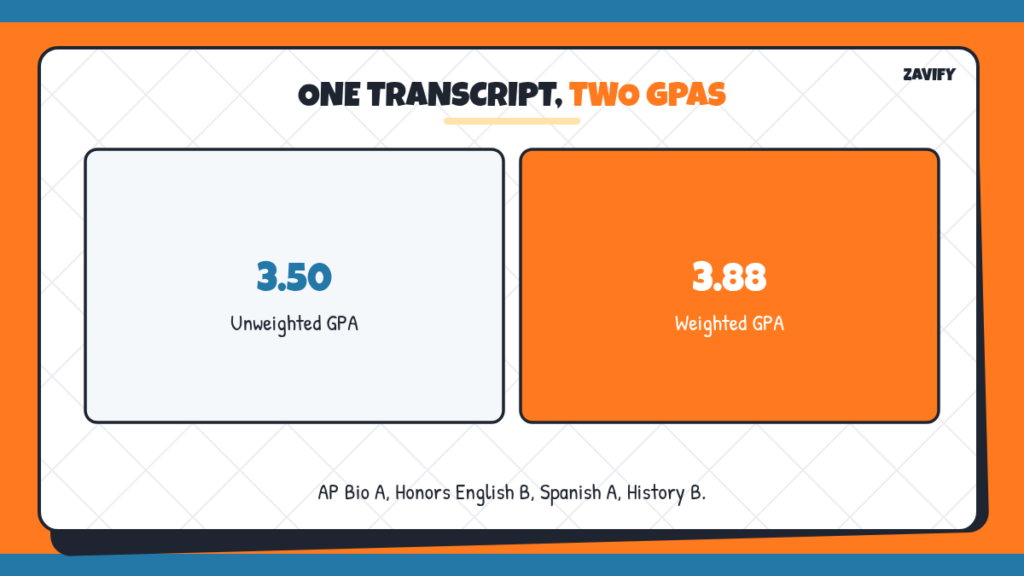
Imagine a student who took four classes this year: an A in AP Biology, a B in honors English, an A in regular Spanish and a B in regular History.
On the plain scale, the grades are 4.0, 3.0, 4.0 and 3.0, which average to 3.50. Weighted, AP Biology becomes 5.0 and honors English becomes 3.5, so the grades are 5.0, 3.5, 4.0 and 3.0. Those average to 3.88. Same transcript, two very different-looking numbers.
Which GPA Do Colleges Look At?
When it comes to weighted vs unweighted GPA, colleges look at both, but they rarely take either number at face value. Because every high school weights differently, many admissions offices recalculate an unweighted GPA from your core academic classes, then look separately at how challenging your courses were.
In practice, that means a strong unweighted GPA with a rigorous schedule is the best combination. A high weighted GPA earned mainly from easier classes will not impress as much as a slightly lower one earned in AP and honors courses.
Is a Weighted GPA Better Than an Unweighted GPA?
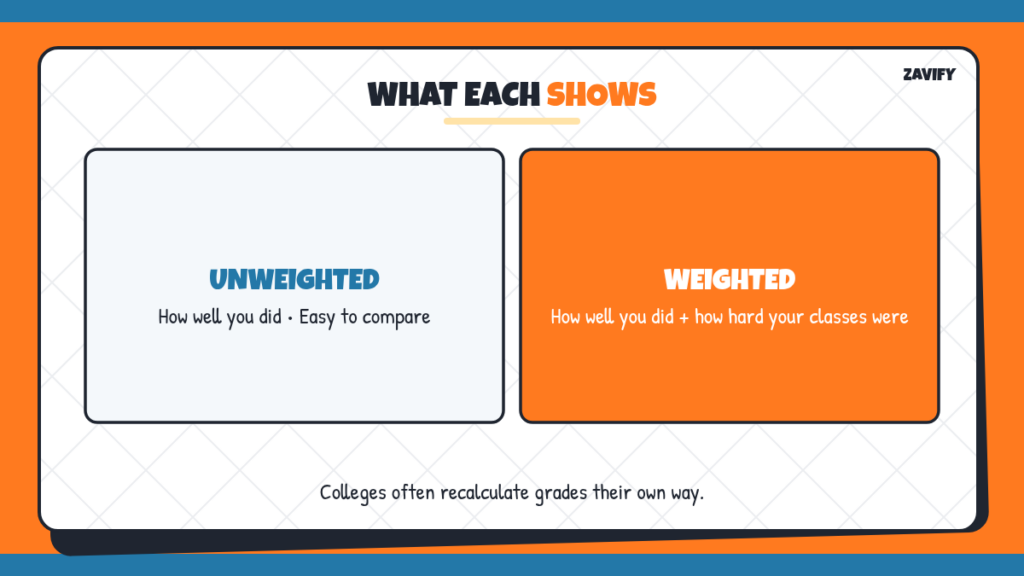
In the weighted vs unweighted GPA debate, neither is better; they show different things. For context, the NCES High School Transcript Study found that 2019 graduates averaged about a 3.11 GPA, a useful benchmark when you compare your numbers. An unweighted GPA is easier to compare between schools, because a 4.0 always means straight A’s. A weighted GPA rewards students who challenge themselves, which colleges value.
When you report your GPA on an application, give exactly what the form asks for. If it asks for an unweighted GPA, do not report your weighted one, and vice versa. Your counselor’s report will show the official numbers anyway.
Weighted vs Unweighted GPA in College
The weighted vs unweighted GPA question mostly ends after high school. Most colleges use only unweighted GPAs. Once you are in college, every class is graded on the same 4.0 scale, weighted only by credit hours, not difficulty. That means your college GPA is closer to your high school unweighted GPA in how it works. See our guide on cumulative GPA to learn how college averages are calculated.
How to Calculate Weighted GPA Quickly
If you only want a quick estimate of how to calculate weighted GPA, here is a shortcut. Work out your plain average first. Then count how many of your classes were honors and how many were AP or IB. Multiply the honors count by 0.5 and the AP/IB count by 1.0, add those together and divide by your total number of classes. Add the result to your plain average.
For the example above, that is (1 honors × 0.5 + 1 AP × 1.0) ÷ 4 classes = 0.375. Adding that to 3.50 gives 3.875, which rounds to the same 3.88. The shortcut works whenever all classes carry the same credit.
Why Schools Weight Grades at All
Weighting exists to encourage students to take harder classes without worrying that one B in AP Chemistry will hurt them compared with an A in an easier course. It also helps schools rank students fairly when calculating class rank or choosing valedictorians. The downside is that schools design their systems differently, which is exactly why comparing numbers across schools is so tricky.
Should You Take More AP Classes to Raise Your GPA?
Only if you can handle the workload. An AP class can lift your weighted average, but a C in that class is worth less than an A in a regular class on the plain scale, and colleges will see the C. Choose advanced courses in subjects you enjoy and are strong in, and balance them so your overall grades stay high. Course rigor helps most when your grades show you can keep up with it.
Common Mistakes With Weighted and Unweighted GPA
These mistakes lead to confusion and unfair comparisons:
- Comparing your weighted GPA with a college’s unweighted average.
- Assuming every school uses the same weighting system.
- Taking hard classes only for the bonus, then struggling with grades.
- Reporting the wrong GPA on applications.
- Forgetting that colleges often recalculate grades.
Compare Every GPA From 1.2 to 4.0
Use this quick chart to see how other GPAs compare on the standard unweighted 4.0 scale. Click any GPA to read its full guide, or work out your own number with our college GPA calculator.
| GPA | Letter Grade | Approx. Percentage |
|---|---|---|
| 1.2 GPA | D | ≈ 66% |
| 2.0 GPA | C | 73–76% |
| 2.5 GPA | C+ / B- | ≈ 79–80% |
| 2.8 GPA | B- | ≈ 81–82% |
| 3.0 GPA | B | 83–86% |
| 3.2 GPA | B / B+ | ≈ 86–87% |
| 3.3 GPA | B+ | 87–89% |
| 3.4 GPA | B+ | ≈ 88–89% |
| 3.5 GPA | B+ / A- | ≈ 89% |
| 3.6 GPA | A- / B+ | ≈ 89–90% |
| 3.7 GPA | A- | 90–92% |
| 3.8 GPA | A- | ≈ 91–92% |
| 3.9 GPA | A | ≈ 92–93% |
| 4.0 GPA | A | 93–100% |
Related guides: what is a good GPA, weighted vs unweighted GPA, dean’s list requirements and how to raise your GPA.
Frequently Asked Questions
What is weighted vs unweighted GPA?
Unweighted GPA uses a 0–4.0 scale for every class. Weighted GPA adds extra points for honors, AP or IB classes, so it can go above 4.0.
Is a 4.0 unweighted GPA good?
Yes. A 4.0 unweighted GPA means straight A’s, which is the highest possible on that scale.
What is a good weighted GPA?
It depends on your school’s scale, but anything above 4.0 usually means strong grades in advanced classes.
Do colleges prefer weighted or unweighted GPA?
Many colleges recalculate an unweighted GPA and look separately at course rigor. They value both strong grades and challenging classes.
How do I convert a weighted GPA to unweighted?
Remove the bonus points from each honors or AP grade, then recalculate the average on the plain 4.0 scale.
Does college use weighted GPA?
Generally no. College GPAs are unweighted and weighted only by credit hours.
Conclusion
The difference between weighted vs unweighted GPA comes down to one question: does the scale reward harder classes? Unweighted GPA uses a simple 4.0 scale. Weighted GPA adds bonus points for honors and AP courses.
Know both of your numbers, understand your school’s rules and remember that colleges look at your grades and your course choices together. For more help, read our guide to what counts as a good GPA.