Introduction
A 2.8 GPA is a B-minus average. It shows you are doing reasonable work in most classes, and it keeps you well clear of academic probation. What makes it frustrating is how close it is to 3.0, the number that appears on so many scholarship forms, job postings and graduate program pages.
If you have a 2.8 GPA, you are only 0.2 points from that line. This guide explains what your GPA means, how it is viewed, and nine steps that can realistically carry you over 3.0.
- Letter grade: B-minus.
- Percentage: roughly 81–82% on most US scales.
- Rating: slightly below average, and just under the common 3.0 cut-off.
Table of Contents
What Is a 2.8 GPA?
Your grade point average is the mean of the points you earn in each class, usually weighted by credit hours. On a 4.0 scale, a B is 3.0 and a B-minus is 2.7, so a 2.8 is a little above a B-minus average.
Most students with a 2.8 GPA have a transcript full of B’s with a few C’s mixed in. It is a solid foundation: the work is mostly good, and one or two weaker subjects are pulling the average down.
According to the NCES High School Transcript Study, 2019 high school graduates averaged about 3.11. A 2.8 sits a little below that typical student.
- Above 2.0 and 2.5: meets good standing and many program minimums.
- Below 3.0: just under the cut-off many employers and scholarships use.
- Trend: a rising 2.8 looks very different from a falling one.
How Does a 2.8 GPA Work?
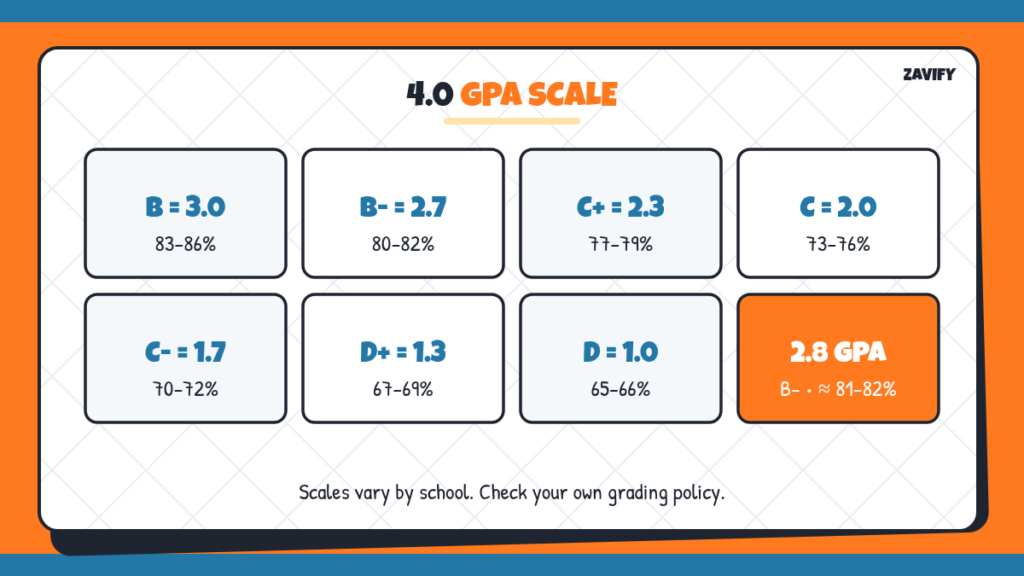
The 2.8 GPA letter grade sits just above the B-minus row of a standard conversion table:
| Letter Grade | Percentage | Grade Points |
|---|---|---|
| B+ | 87–89% | 3.3 |
| B | 83–86% | 3.0 |
| B- | 80–82% | 2.7 |
| C+ | 77–79% | 2.3 |
| C | 73–76% | 2.0 |
The key thing to notice is that every C on your transcript costs you a full point compared with a B. Turning just a couple of C’s into B’s is often enough to lift a 2.8 above 3.0.
Check your exact GPA with our cumulative GPA calculator.
1. Work Out the 3.0 Math
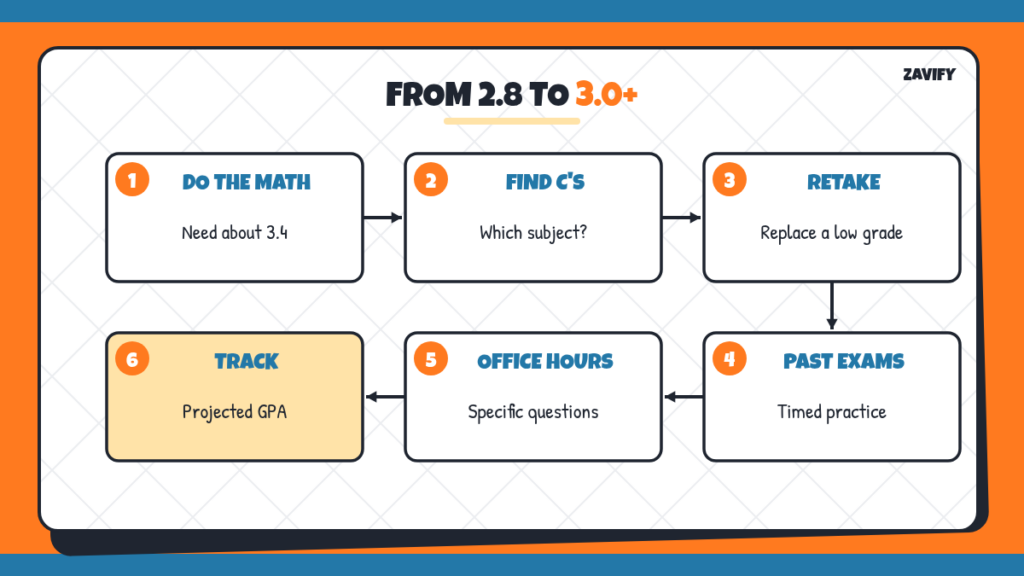
Start with the numbers. Imagine you have a 2.8 GPA and 60 credits. To reach 3.0 in one 15-credit term, you would need about a 3.8 that term. Spread over two terms (30 credits), you would need about a 3.4, which is a mix of B-pluses and A-minuses. Knowing that a 3.4 is enough turns an intimidating goal into a manageable one.
2. Find the Classes Holding You Back
Look through your transcript for the C’s. Are they concentrated in one subject area? If they are all in math or science, or all in classes with heavy writing, you know exactly where to get extra support.
3. Retake a Low Grade if Allowed
If your school offers grade replacement, retaking a class where you earned a C or lower can lift your GPA quickly. Check how many retakes are allowed and whether the new grade replaces or averages with the old one.
4. Prepare With Past Exams
Ask your teacher for sample or past exams, or use practice questions from your textbook. Doing them under timed conditions shows you what you still need to learn and builds confidence for the real test.
5. Use Office Hours Strategically
Bring a specific problem or a graded assignment and ask what would have earned more points. Teachers appreciate focused questions, and their answers show you exactly how they grade.
6. Plan Your Week in Advance
Every Sunday, look at the coming week’s deadlines and block out study time for each class. Planning ahead prevents the last-minute rush that often leads to rushed work and lower grades.
7. Get Feedback on Big Assignments
For essays and projects, use the writing center or ask a classmate to review your draft before you submit. One extra round of feedback can lift a B-minus paper to a B or B-plus.
8. Choose a Balanced Schedule
When you pick your classes, avoid taking all your hardest requirements in the same term. A balanced schedule makes it much easier to earn B’s and above in every class.
9. Keep a Running GPA Tracker
Update your grades every few weeks and calculate your projected GPA. Seeing yourself get closer to 3.0 is motivating, and it warns you early if one class needs more attention.
What Grades Make a 2.8 GPA?
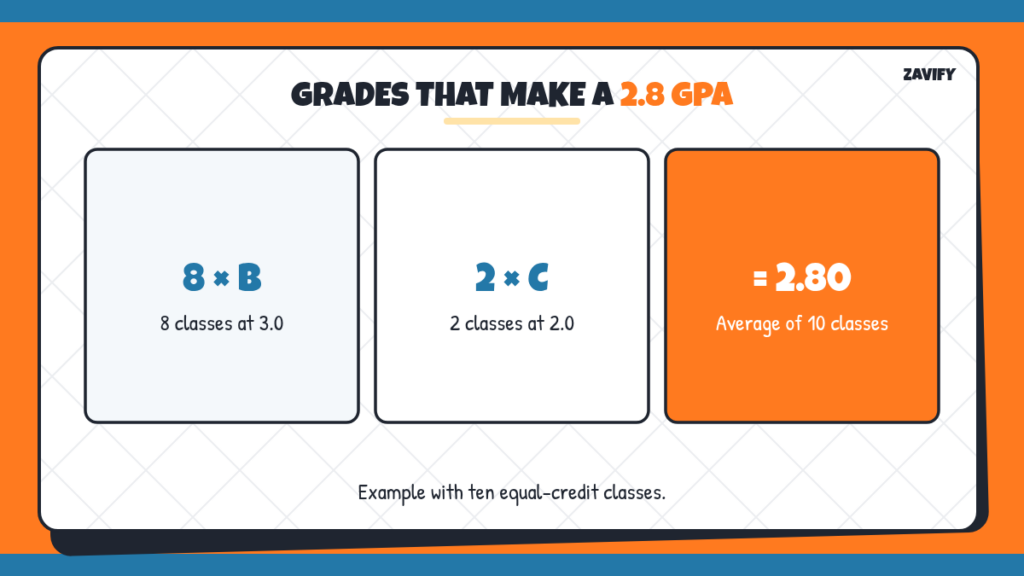
Here is an example. Across ten equal-credit classes, eight B’s (3.0) and two C’s (2.0) average to exactly 2.80. That shows how close you are: turn those two C’s into B’s and you are at 3.0.
Real transcripts use credit hours, so a C in a four-credit class hurts more than a C in a two-credit course. Look at your credits to see which grades are pulling hardest.
Is a 2.8 GPA Good?
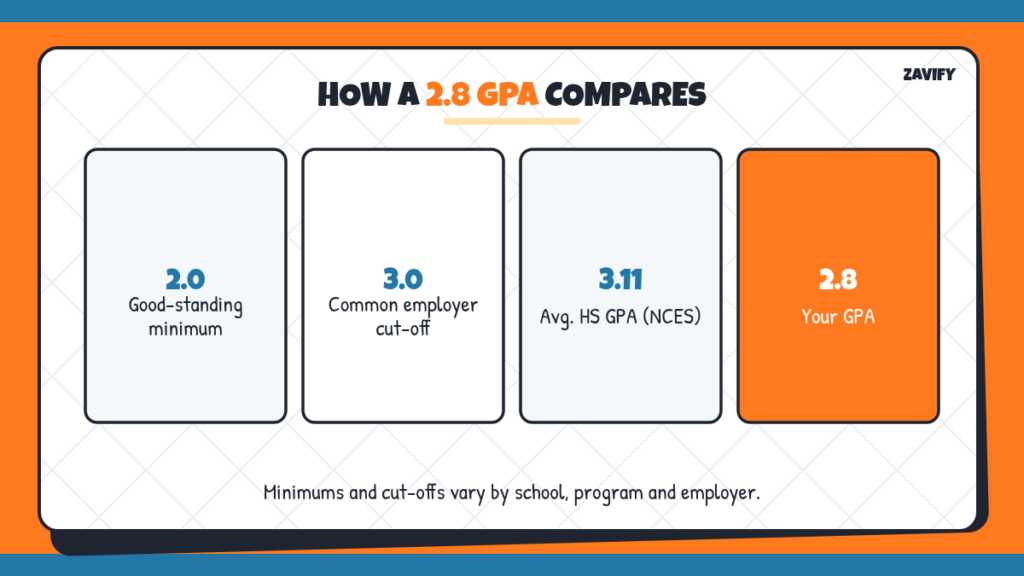
A 2.8 is slightly below average, so it is usually described as fair rather than good. It is still a solid, passing GPA that keeps you in good standing and above the 2.0 and 2.5 minimums used by many programs.
For college admissions, a 2.8 gives you options at many public universities and less selective private colleges, plus all community colleges. An upward trend, a challenging schedule and strong essays can make a real difference at schools where your GPA is near the middle of admitted students.
Is a 2.8 GPA Good for Jobs?
Many employers do not screen by GPA, especially for roles focused on skills. Those that do often use 3.0 as the cut-off, which is why getting over that line can help during recruiting season. Until then, focus your resume on internships, projects and skills. Our guides to jobs for people with a low GPA and whether to put your GPA on your resume can help.
Is a 2.8 GPA Good for Grad School?
Many master’s programs list 3.0 as their minimum, so a 2.8 may fall just short. Some programs look closely at your last 60 credits, and some offer conditional admission to applicants with strong experience or test scores. A strong final year can make a big difference to how your application is read.
How Fast Can a 2.8 GPA Rise?
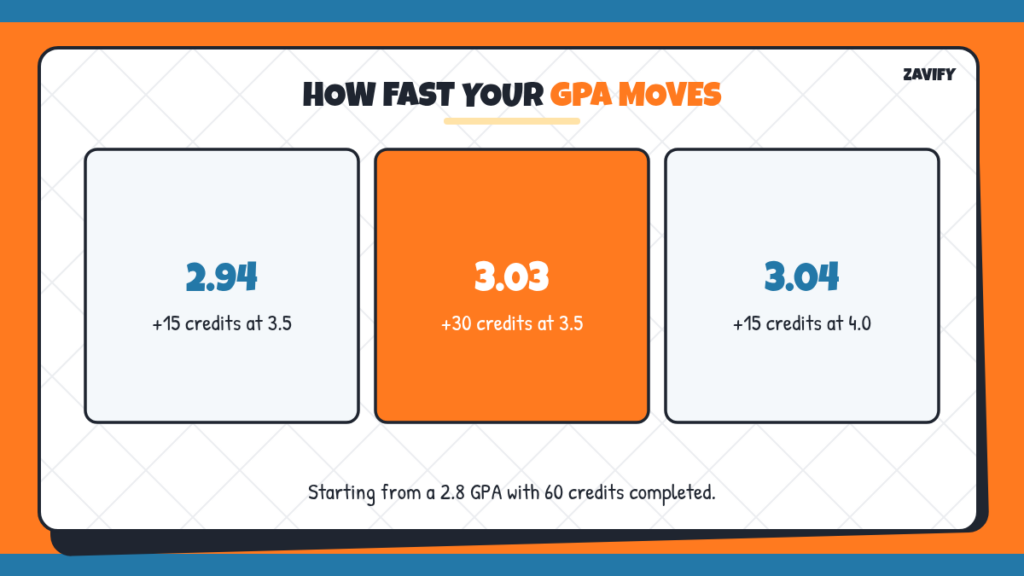
Here is an example for a college student with a 2.8 GPA and 60 credits:
| Next Credits | Average Grade | New GPA |
|---|---|---|
| 15 credits | 3.5 | 2.94 |
| 30 credits | 3.5 | 3.03 |
| 15 credits | 4.0 | 3.04 |
Two semesters at a B-plus or A-minus average are enough to cross 3.0. One outstanding term can do it too. For more strategies, see our guide on how to raise your GPA.
Why an Upward Trend Matters
Two students can both have a 2.8 and look very different. One started at 2.2 and has earned B-pluses for the last three terms. The other started at 3.3 and has been slipping. Admissions officers and employers notice that difference, and most of them value the first story more.
If your recent grades are stronger than your overall average, make that easy to see. Mention it in an application’s additional information section, or list your recent term GPA alongside your cumulative one when it helps.
Scholarships and a 2.8 GPA
Many scholarships and renewable awards require a 3.0, so a 2.8 may keep you just outside some of them. Others use 2.5 or look mainly at need, community service or a particular field of study. Read the requirements closely, and if an award you care about has a 3.0 minimum, check when it is measured. One strong term before the deadline could make you eligible.
Common Mistakes With a 2.8 GPA
These mistakes often keep students just under 3.0:
- Not doing the math to see how close 3.0 really is.
- Ignoring the subject where most C’s come from.
- Skipping office hours until grades are already low.
- Taking several hard classes in the same term.
- Missing retake and grade replacement options.
Frequently Asked Questions
Is a 2.8 GPA good?
It is slightly below average but solid. It keeps you in good standing and meets many program minimums, though some employers and grad schools look for 3.0.
What is a 2.8 GPA in letter grade?
It is a little above a B-minus on the standard 4.0 scale.
What percentage is a 2.8 GPA?
It is roughly 81–82% on most US grading scales.
Can I get into a good college with a 2.8 GPA?
Yes. Many public universities and private colleges admit students with a 2.8, especially with an upward trend and a strong application.
How long does it take to raise a 2.8 GPA to 3.0?
With 60 credits, about two terms averaging 3.4 or higher would do it. Earlier in your studies it can happen faster.
Should I put a 2.8 GPA on my resume?
Usually not, unless the employer asks. Lead with experience and skills, and add your GPA once it reaches 3.0 or higher.
Conclusion
A 2.8 GPA is a B-minus average, roughly 81–82%. It is a solid base that keeps you in good standing, and it is only a short distance from the 3.0 line.
Do the math, focus on the classes behind your C’s and use every tool your school offers. With two strong terms, crossing 3.0 is realistic. Read our 3.0 GPA guide and what counts as a good GPA to plan your next step.