Introduction
A 3.6 GPA is one of those numbers that sits in an interesting spot. It is clearly a strong result, well above what most students earn, yet it is just short of the 3.7 that many people picture when they think of an “A student.”
If you have a 3.6 GPA, you are probably wondering two things: is it good enough for the college, scholarship or job you want, and how hard would it be to move it up? This guide answers both questions in plain terms, with real numbers and nine steps you can start using this term.
- Letter grade: between A- and B+.
- Percentage: roughly 89–90% on most US scales.
- Rating: very good, well above the national average.
Table of Contents
What Is a 3.6 GPA?
Your GPA, or grade point average, is the average of the points you earn for each class. On the standard unweighted scale an A is worth 4.0, an A-minus 3.7, a B-plus 3.3 and a B 3.0. Classes with more credit hours count for more.
A 3.6 GPA means most of your grades are A’s and A-minus grades, with a few B’s or B-pluses mixed in. In other words, you are doing excellent work in most classes and good work in a couple.
To put it in perspective, the NCES High School Transcript Study reported that 2019 high school graduates averaged about 3.11. A 3.6 is comfortably ahead of that.
- Unweighted: the plain 4.0 scale, used by most colleges when they compare applicants.
- Weighted: includes extra points for honors, AP or IB classes.
- Major GPA: only the classes in your major, which some employers and graduate programs ask for separately.
How Does a 3.6 GPA Work?
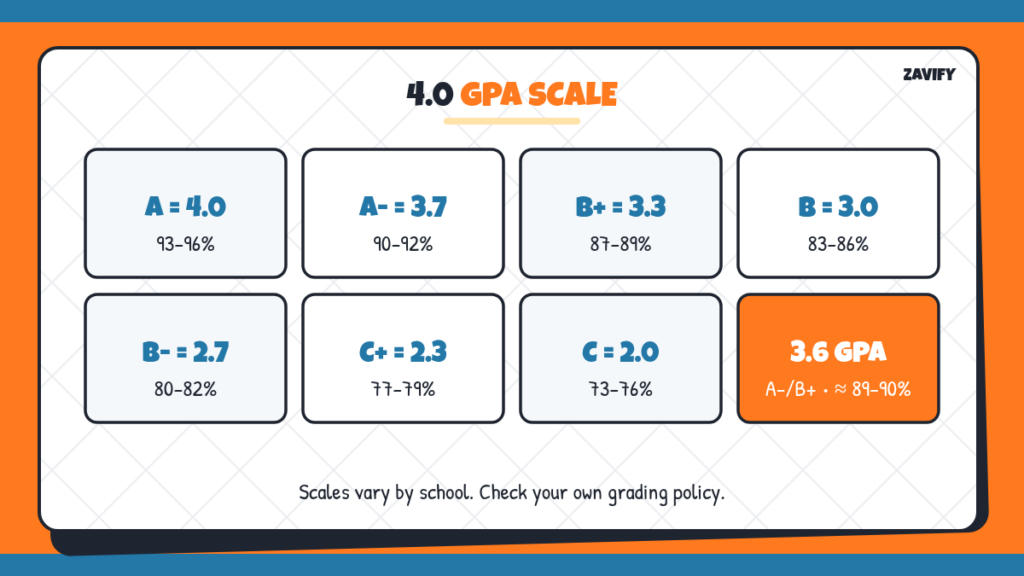
The 3.6 GPA letter grade falls between the A-minus row and the B-plus row on a typical conversion table:
| Letter Grade | Percentage | Grade Points |
|---|---|---|
| A | 93–96% | 4.0 |
| A- | 90–92% | 3.7 |
| B+ | 87–89% | 3.3 |
| B | 83–86% | 3.0 |
| B- | 80–82% | 2.7 |
Notice the gap between an A-minus (3.7) and a B-plus (3.3). It is 0.4 points, which is large. Turning just one or two B-plus grades into A-minus grades is often all it takes to lift a 3.6 into the high 3s.
You can test different grade combinations with our cumulative GPA calculator.
1. Find Your Weakest Category
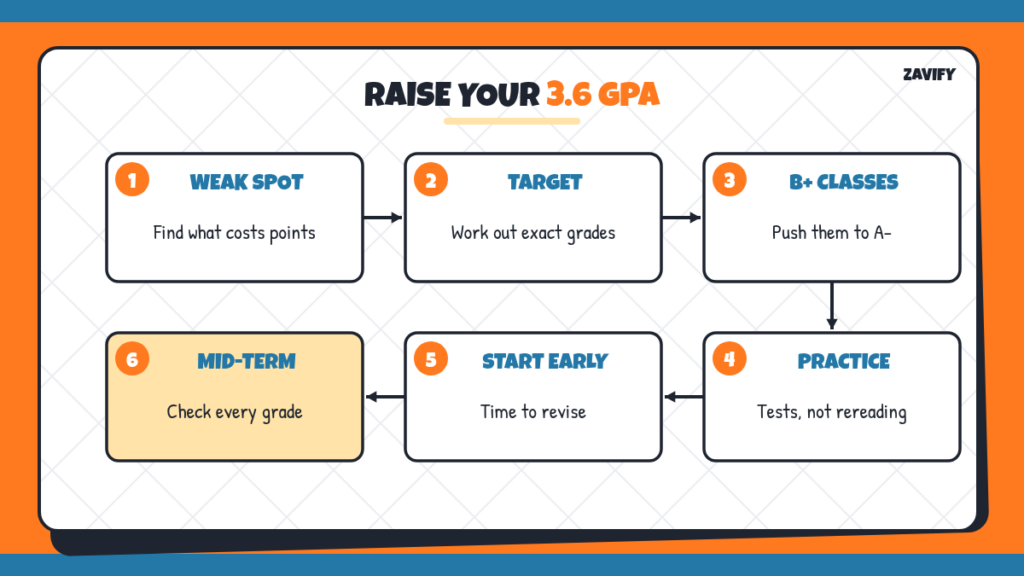
Open your grade portal and look at each class. Where are you losing points? For most students with a 3.6, the answer is one type of work: timed exams, long essays or lab reports. Once you know the pattern, you can fix it instead of trying to “study harder” at everything.
2. Work Out the Exact Grades You Need
Vague goals rarely work. Decide on a target, such as 3.7 by graduation, then calculate the grades you need to get there. You may find that one extra A next term is enough, which is far less scary than it sounds.
3. Go After Your B-Plus Classes First
The classes where you are sitting at a high B-plus are your best opportunity. Moving a B-plus to an A-minus is usually easier than turning a B-minus into an A, and it adds the same 0.4 points to that class. Put your extra effort where it is closest to paying off.
4. Change How You Study, Not Just How Long
Rereading notes feels productive but does little for exam scores. Practice tests, flashcards and explaining ideas out loud without looking at your notes all force your brain to recall information, which is what exams demand. Try swapping one hour of rereading for one hour of practice questions and see what happens.
5. Start Big Assignments Early
A-minus essays and A essays often differ by one round of revision. Starting a week earlier gives you time to write a draft, step away and fix it with fresh eyes. If your school has a writing center, book a session before the deadline, not the night before.
6. Visit Office Hours With a Specific Question
“Can you help me?” gets a general answer. “I lost points on question 4, and I want to understand why” gets a useful one. Teachers remember students who come prepared, and that sometimes helps when a grade sits right on the line.
7. Build a Small, Serious Study Group
Two or three focused classmates are better than a big group that turns into a social hour. Agree on a plan before each session, quiz each other and split the work of making practice problems.
8. Choose Electives That Fit Your Strengths
This is not about hunting for easy A’s. It is about balance. If your required classes this term are all heavy, pick an elective in a subject you enjoy and do well in. It keeps your workload manageable and gives your GPA a steady anchor.
9. Check Your Grades Mid-Term
Halfway through each term, calculate where you stand in every class. If one grade is slipping, you still have time to recover it. Waiting until finals week almost always costs you.
What Grades Make a 3.6 GPA?
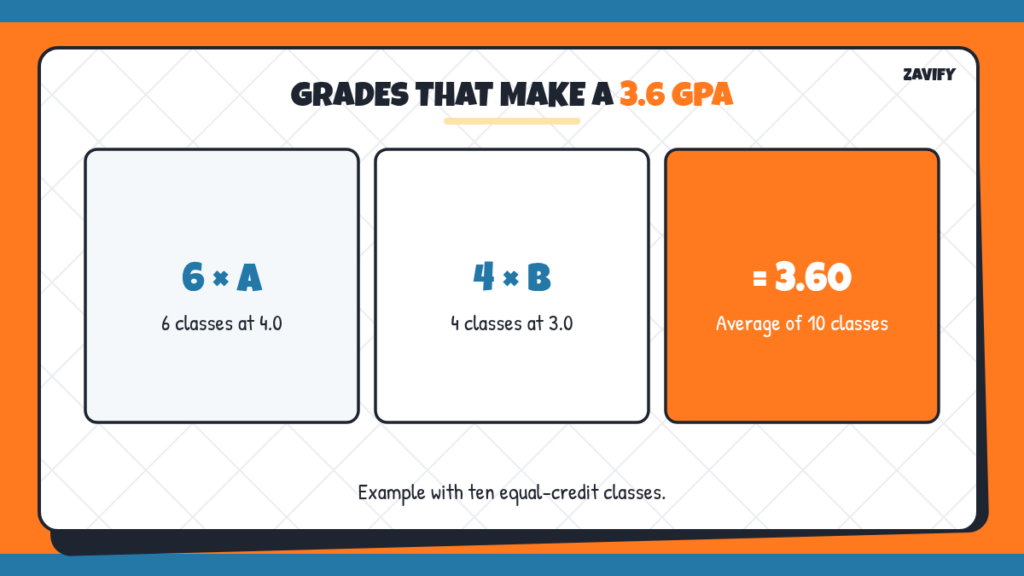
There are many paths to a 3.6. Say you take ten classes worth the same credits. Six A’s (4.0) and four B’s (3.0) average out to exactly 3.60. So do other mixes, such as a spread of A’s, A-minuses and B-pluses.
That is why two students with the same GPA can have very different transcripts. One may have steady A-minus grades everywhere, while another may have mostly A’s and a couple of tough classes.
Is a 3.6 GPA Good for College?
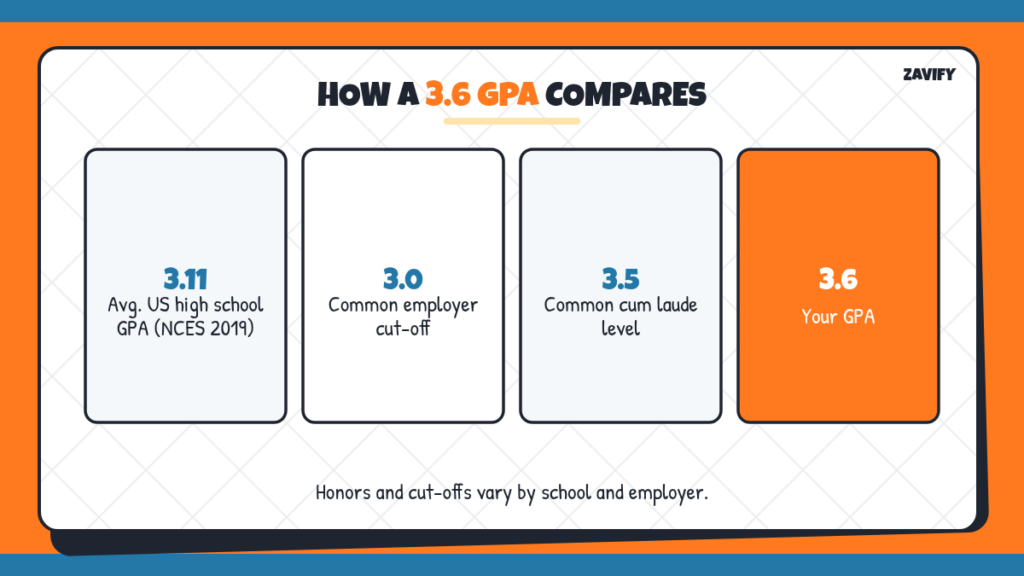
Yes. A 3.6 makes you a solid applicant at most public universities and a wide range of private colleges. Admissions officers will also look at how challenging your classes were, so a 3.6 earned in honors and AP courses carries more weight than the same number from a lighter schedule.
At the most selective colleges, many admitted students have GPAs of 3.8 or higher. You can still apply, but treat those schools as reaches and make sure the rest of your application, especially your essays and activities, is strong.
What a 3.6 GPA Means in College
Once you are in college, a 3.6 GPA opens plenty of doors. At many schools it meets the 3.5 level often used for the dean’s list and for cum laude honors at graduation. It also clears the 3.0 and 3.5 screening lines that many internship programs and employers use.
For graduate school, a 3.6 meets the minimum for nearly every master’s program. For medical school it is a little below the typical admitted student, which the AAMC reports at around 3.7 to 3.8, so a strong science GPA and test score would help. For jobs, see our advice on whether to put your GPA on your resume.
How Fast Can a 3.6 GPA Rise?
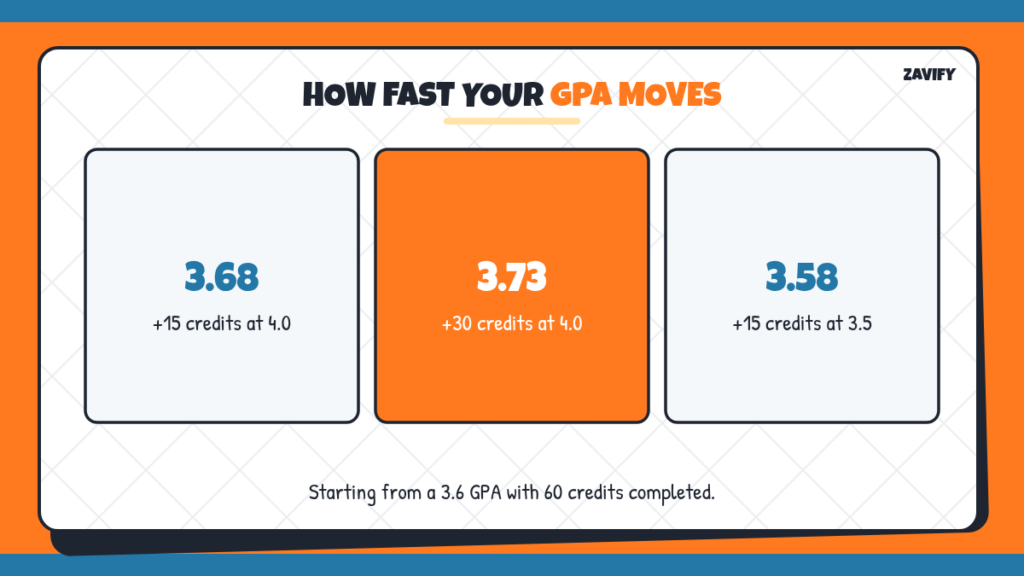
The further you are into your degree, the slower your GPA moves. Here is an example for a college student with 60 credits completed:
| Next Credits | Average Grade | New GPA |
|---|---|---|
| 15 credits | 4.0 | 3.68 |
| 30 credits | 4.0 | 3.73 |
| 15 credits | 3.5 | 3.58 |
One perfect semester lifts a 3.6 to about 3.68, and two get you past 3.7. That is realistic for a lot of students, especially if you use the steps above. For more ideas, read our guide on how to raise your GPA.
Weighted vs Unweighted: Which 3.6 Do You Have?
This question trips up a lot of high school students. If your school adds half a point for honors classes and a full point for AP classes, a weighted 3.6 could mean an unweighted average closer to 3.3. On the other hand, an unweighted 3.6 alongside a heavy AP schedule is a very strong combination.
Colleges know that every high school weights grades differently, so many of them recalculate your GPA using their own method. When you compare yourself with a college’s admission profile, try to compare unweighted with unweighted. Our high school GPA calculator shows both numbers side by side.
Common Mistakes With a 3.6 GPA
These habits often keep students stuck just below the high 3s:
- Studying longer instead of studying differently.
- Ignoring the classes sitting at a high B-plus.
- Starting essays and projects too late to revise.
- Treating weighted and unweighted GPAs as the same thing.
- Waiting until finals week to check grades.
Frequently Asked Questions
Is a 3.6 GPA good?
Yes. It is very good. It sits well above the national average and is competitive for most colleges, scholarships and jobs.
What is a 3.6 GPA in letter grade?
It falls between an A-minus and a B-plus on the standard unweighted 4.0 scale.
What percentage is a 3.6 GPA?
It is roughly 89–90% on most US grading scales, though your school’s scale may differ.
Is a 3.6 GPA good enough for cum laude?
At many colleges, cum laude starts around 3.5, so a 3.6 often qualifies. Check your school’s honors policy to be sure.
Can I raise a 3.6 GPA to a 3.8?
It depends on how many credits you have. Early in college it is realistic. With 60 or more credits, it would take several near-perfect semesters.
Is a 3.6 GPA good in high school?
Yes. It is well above the average high school GPA and keeps a wide range of colleges within reach.
Conclusion
A 3.6 GPA is a very good result. It sits between an A-minus and a B-plus, works out to roughly 89–90%, and places you well above the average student.
If you want more, focus on the classes where you are closest to the next grade, study with practice questions instead of rereading and check your progress mid-term. Compare your number with our guides to the 3.5 GPA and 3.7 GPA to see what the next step up looks like.