Introduction
A 3.9 GPA is the kind of number that makes parents grin and classmates wonder how you do it. It sits at 3.9, a tenth of a point shy of a perfect 4.0, meaning nearly every grade on your transcript is an A.
But a high number brings a new kind of stress. When you are already near the top, one rough class can pull you down, and it takes a long time to climb back. So this guide does two things. It explains what a 3.9 GPA actually means, and it gives you nine practical steps to keep it where it is.
- Letter grade: A (a solid A average).
- Percentage: roughly 92–93% on most US scales.
- Rating: excellent, far above the national average.
Table of Contents
What Is a 3.9 GPA?
GPA means grade point average. Your school turns every letter grade into points, usually 4.0 for an A, 3.7 for an A-minus, 3.3 for a B-plus and so on. It then averages those points, normally giving more weight to classes with more credit hours.
A 3.9 GPA tells anyone reading your transcript that you earned A’s in nearly every class, with maybe one or two A-minus grades mixed in. On the unweighted scale, that is about as close to perfect as most students get. In short, the 3.9 GPA letter grade is an A.
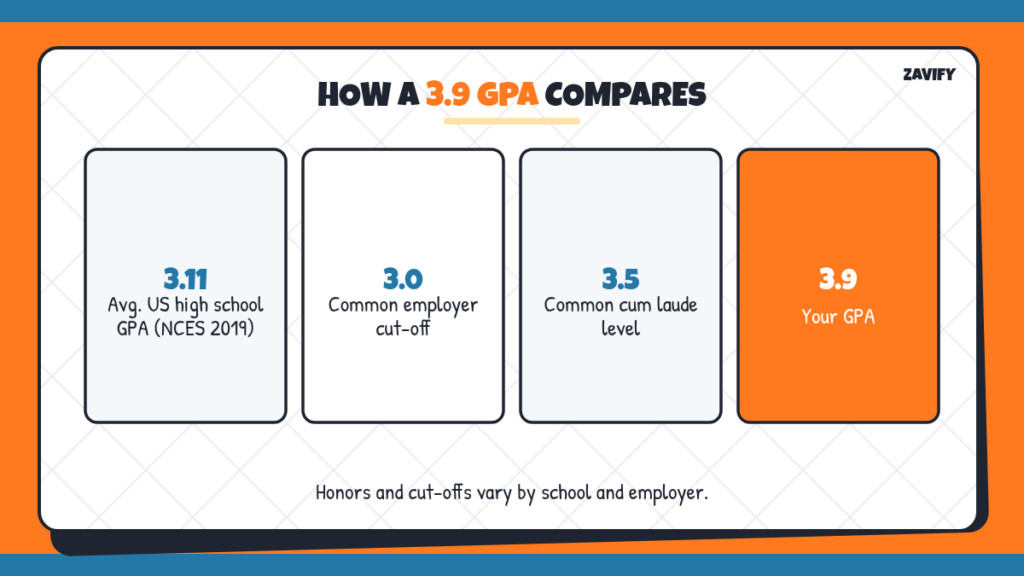
For context, the NCES High School Transcript Study found that US high school graduates in 2019 averaged a GPA of about 3.11. A 3.9 is a long way above that line.
- Unweighted: measured on the plain 4.0 scale, where 4.0 is the maximum.
- Weighted: honors, AP or IB classes can add extra points, so a weighted GPA may be higher than 4.0.
- Cumulative: the average of every semester so far, which is the number most colleges and employers care about.
How Does a 3.9 GPA Work?
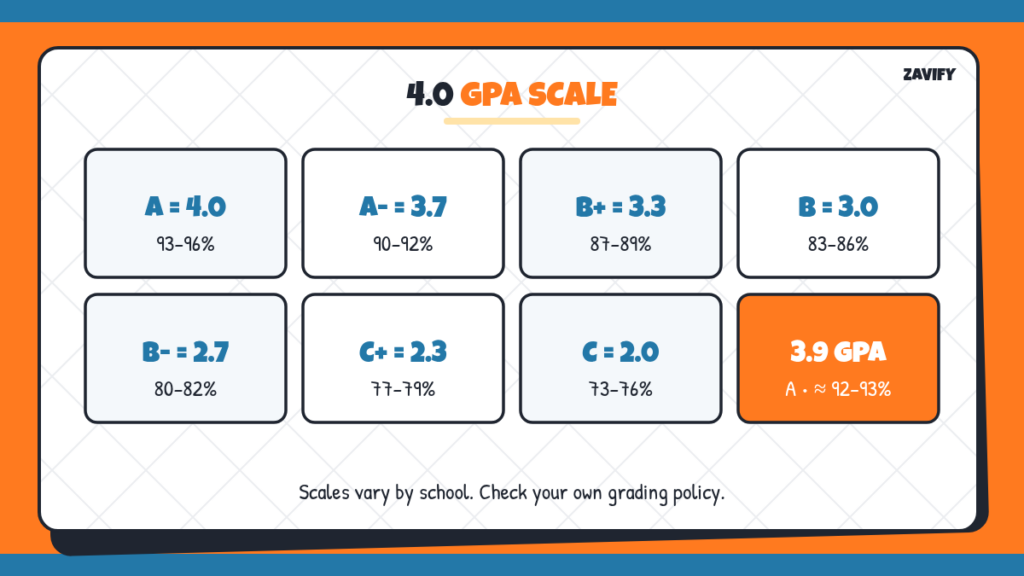
Most US schools use a conversion table like the one below. Your exact cut-offs may be a point or two different, so check your student handbook or course syllabus.
| Letter Grade | Percentage | Grade Points |
|---|---|---|
| A | 93–96% | 4.0 |
| A- | 90–92% | 3.7 |
| B+ | 87–89% | 3.3 |
| B | 83–86% | 3.0 |
| B- | 80–82% | 2.7 |
Here is the important detail. Because an A-minus is worth 3.7, even a handful of A-minus grades will pull a 4.0 down toward 3.9. That is why a 3.9 usually means “mostly A’s with a small number of A-minus grades” rather than “one bad class.”
If you want your exact number, plug your grades and credits into our college GPA calculator or the high school GPA calculator.
1. Know Which GPA Actually Counts
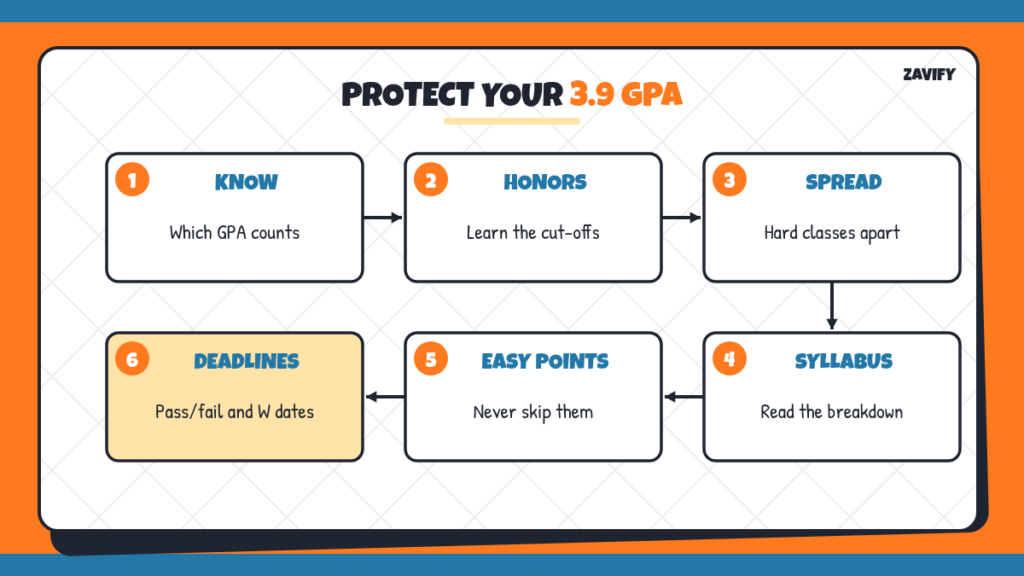
Students often carry around three different numbers without realizing it: a weighted GPA, an unweighted GPA and a major GPA. Colleges usually recalculate high school grades in their own way, while employers and graduate schools tend to look at your cumulative college GPA. Find out which number matters for your next goal, because that is the one you need to protect.
2. Learn the Honors Cut-Offs at Your School
At many colleges, summa cum laude starts somewhere around 3.9, magna cum laude around 3.7 and cum laude around 3.5. Some schools use percentages of the graduating class instead. Look up your school’s exact rule. If summa is set at 3.9 and you are sitting at 3.91, you know you have almost no room for error, and you can plan accordingly. Our summa cum laude GPA guide explains how these honors usually work.
3. Spread Your Hardest Classes Out
Stacking organic chemistry, a calculus sequence and a heavy writing seminar into the same term is the fastest way to lose an A. Where you have a choice, spread the toughest courses across different semesters and pair each one with classes you are confident in.
4. Read Every Syllabus Like a Contract
The syllabus tells you exactly how your grade is calculated. If the final exam is worth 40 percent, you now know where your real risk sits. If participation is worth 10 percent, you know that skipping class is not free. Write each class’s grade breakdown on one page so you can see where the points are.
5. Protect the Easy Points
Top students rarely lose A’s on the final exam. They lose them on a forgotten quiz, a late homework penalty or a missed lab report. Homework, attendance and small assignments are the easiest points in any class. Collect all of them and you give yourself a cushion for the harder tests.
6. Use Pass/Fail Carefully
Many colleges let you take a limited number of classes pass/fail, and those grades often do not count toward your GPA. Using this option for a class outside your major can protect a 3.9 GPA. Check the rules first, though: some programs, graduate schools and medical schools look closely at pass/fail choices in core subjects.
7. Know the Withdrawal Deadline
At most schools, withdrawing before a certain date leaves a “W” on your transcript, which usually does not change your GPA. A single W is rarely a problem. Write the deadline in your calendar for every term, so if a class is going badly you can make a calm decision instead of a panicked one.
8. Get Feedback Before Grades Are Final
Visit office hours before the big exam, not after it. Bring a practice problem you got wrong or a paragraph from your draft essay and ask, “What would make this an A?” Most teachers are happy to answer, and the advice is specific to the person grading you.
9. Look After Yourself
Keeping a near-perfect GPA for years can wear you down. Sleep, exercise and time with friends are not distractions from good grades. They are part of what keeps your memory and focus sharp. A student who burns out in junior year usually loses more points than one who takes a real weekend off.
What a 3.9 GPA Looks Like on a Transcript
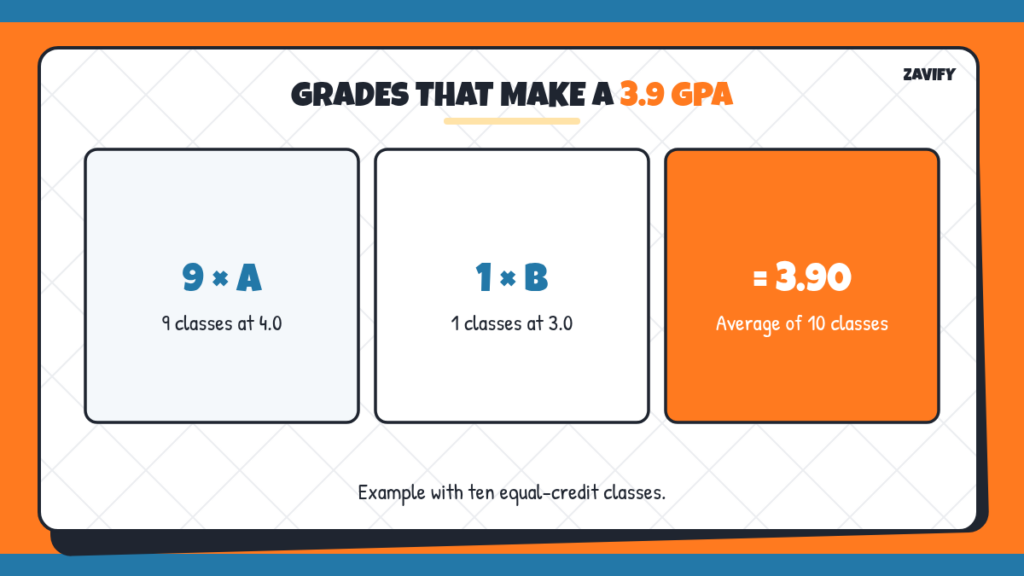
Imagine ten classes that each carry the same number of credits. If you earn nine A’s (4.0) and one B (3.0), your average is exactly 3.90. You could also get there with a few A-minus grades instead of one B. For example, seven A’s and three A-minus grades give an average of 3.91.
Credit hours change the picture. An A-minus in a four-credit science class moves your GPA more than the same grade in a one-credit seminar. That is why two students with the same letter grades can end up with slightly different GPAs.
Is a 3.9 GPA Good for College Admissions?
Yes, and by a wide margin. A 3.9 GPA puts you in a strong position at almost every college in the country. At most state universities, it is well above the typical admitted student.
At highly selective colleges, however, many applicants have similar grades. There, a 3.9 gets you through the first read, but it does not decide the result on its own. Admissions officers will look at how hard your classes were, what you did outside class, your essays and your recommendations. A 3.9 earned in AP and honors courses carries more weight than the same number from a lighter schedule.
Is a 3.9 GPA Good for Grad School and Jobs?
For graduate school, a 3.9 college GPA is excellent. It meets or beats the typical GPA of students admitted to medical school, which the AAMC reports at around 3.7 to 3.8, and it clears the minimum for nearly every master’s and PhD program. Your test scores, research and experience will still matter.
For jobs, a 3.9 clears every common screening line. Employers that filter by GPA often use 3.0 or 3.5 as a cut-off. List your GPA on your resume, and read our guide on whether to put your GPA on your resume for formatting tips.
How Much Can a 3.9 GPA Drop?
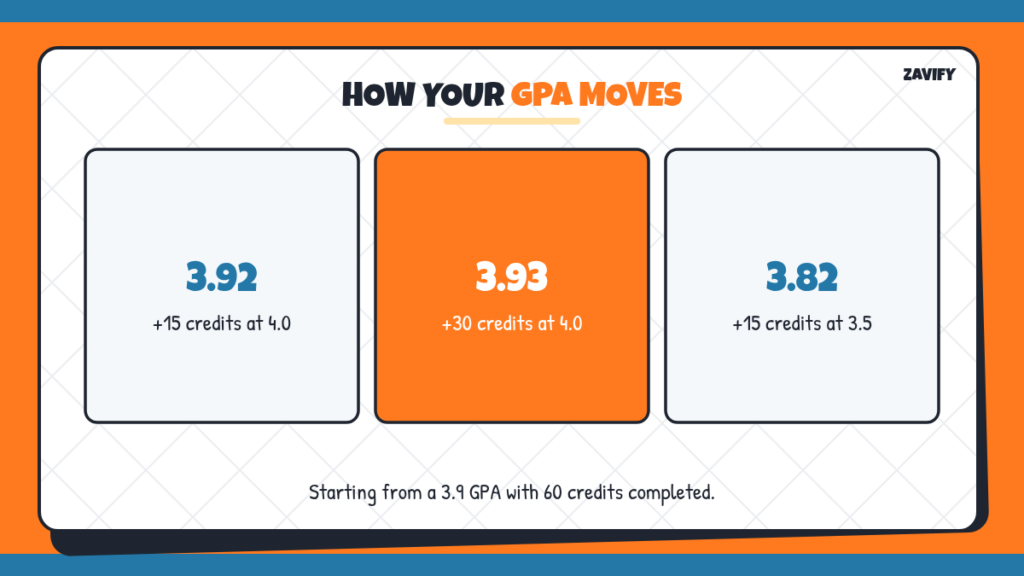
The good news is that once you have many credits, one weaker term does less damage. Here is an example for a college student with a 3.9 GPA and 60 credits completed:
| Next Credits | Average Grade | New GPA |
|---|---|---|
| 15 credits | 4.0 | 3.92 |
| 30 credits | 4.0 | 3.93 |
| 15 credits | 3.5 | 3.82 |
A semester averaging 3.5 would drop you to about 3.82, which is still excellent. But if your school sets summa cum laude at 3.9, that same semester could cost you the honor. This is why step 2 matters so much.
When a 3.9 GPA Is Not Enough on Its Own
It may sound strange, but a great GPA can hide weak spots. Some students protect their number by avoiding hard classes, and colleges notice when a transcript looks too safe. Others spend so much time on grades that they have little to write about in their essays. Aim for a strong GPA and a story: challenging courses, one or two activities you care about, and some real responsibility.
Common Mistakes With a 3.9 GPA
These are the mistakes that most often cost high-achieving students their A’s:
- Taking the hardest possible schedule in a single semester.
- Ignoring small assignments because “the exam matters more.”
- Missing pass/fail or withdrawal deadlines.
- Comparing weighted and unweighted numbers as if they were the same.
- Choosing easy classes only to protect the number.
Frequently Asked Questions
Is a 3.9 GPA good?
Yes. It is excellent. It sits well above the national average and is competitive for almost any college, scholarship or employer.
What is a 3.9 GPA in letter grade?
It is an A average on the standard unweighted 4.0 scale, usually made up of A’s with a few A-minus grades.
What percentage is a 3.9 GPA?
On most US scales it works out to roughly 92–93%. Your school’s exact scale may be slightly different.
Can I get into an Ivy League school with a 3.9 GPA?
It is a competitive GPA for any school, including the Ivy League. At that level, course rigor, essays, activities and recommendations usually decide the outcome.
Is a 3.9 GPA good enough for summa cum laude?
At many colleges, yes, but the cut-off varies. Check your school’s academic honors policy.
Is a 3.9 weighted GPA the same as a 3.9 unweighted GPA?
No. A weighted 3.9 includes bonus points for harder classes, so it may reflect a lower unweighted average.
Conclusion
A 3.9 GPA is an excellent result. It equals an A average, or roughly 92–93%, and it puts you ahead of the vast majority of students in the country.
The hard part now is keeping it. Know which number matters, spread out your toughest classes, grab every easy point and use pass/fail and withdrawal rules wisely. Compare your position with our 4.0 GPA guide and our page on the 3.8 GPA, and keep taking care of yourself along the way.