Introduction
A 2.0 GPA is a C average, and it is one of the most important numbers in American education. At most colleges it is the line between good academic standing and probation, and it is often the minimum you need to graduate.
That makes a 2.0 GPA a bit of a knife’s edge. You are passing, but there is very little room below you. This guide explains what the number means, how colleges, financial aid offices and employers view it, and nine steps to build a safer cushion above it.
- Letter grade: C.
- Percentage: roughly 73–76% on most US scales.
- Rating: below average, but at the minimum passing line for most colleges.
Table of Contents
What Is a 2.0 GPA?
GPA, or grade point average, turns your letter grades into numbers and averages them. On the standard 4.0 scale, an A is 4.0, a B is 3.0, a C is 2.0 and a D is 1.0. Most schools weight each class by its credit hours.
So what is a 2.0 GPA in practice? It means your average grade is a C. You might have straight C’s, or a mix such as some B’s balanced by some D’s. Either way, you are meeting the basic requirements but not much more.
According to the NCES High School Transcript Study, 2019 high school graduates averaged about 3.11. A 2.0 is roughly a full letter grade below that average.
- Good standing: most colleges require a cumulative 2.0 or higher.
- Graduation: many degrees require at least a 2.0 overall, and sometimes in your major too.
- Financial aid: satisfactory academic progress rules usually expect at least a C average.
How Does a 2.0 GPA Work?
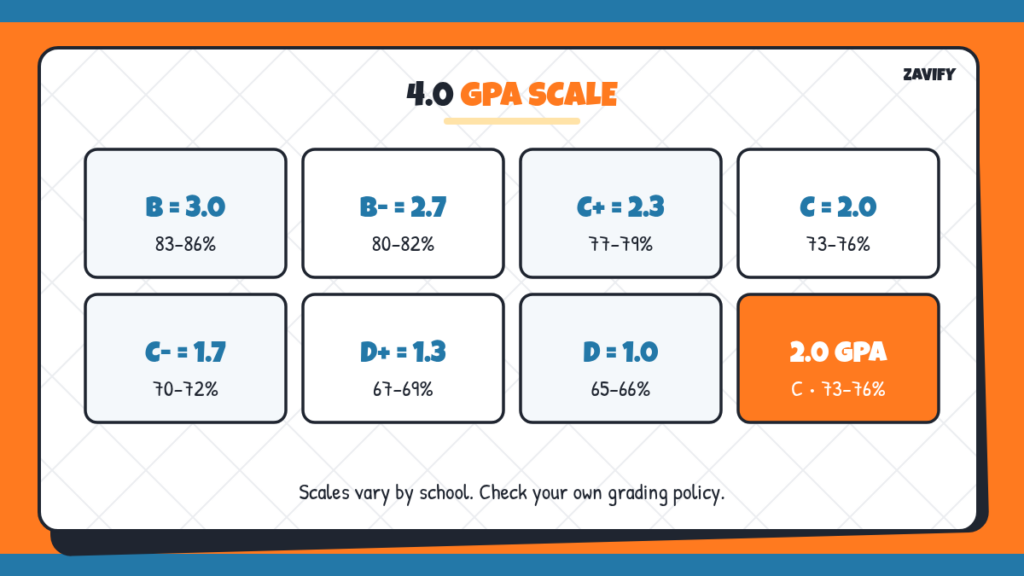
The 2.0 GPA letter grade is a plain C, which lines up with this row of a standard conversion table:
| Letter Grade | Percentage | Grade Points |
|---|---|---|
| B | 83–86% | 3.0 |
| B- | 80–82% | 2.7 |
| C+ | 77–79% | 2.3 |
| C | 73–76% | 2.0 |
| C- | 70–72% | 1.7 |
| D | 65–66% | 1.0 |
Here is why a 2.0 feels so fragile. Suppose you have a 2.0 after 60 credits and then have one rough term that drags you to 1.8. To get back to 2.0 in the next 15-credit semester, you would need about a 2.8 that term. Doable, but stressful. A cushion above 2.0 protects you from that situation.
Our cumulative GPA calculator lets you test these scenarios with your own numbers.
1. Check Your Exact Standing
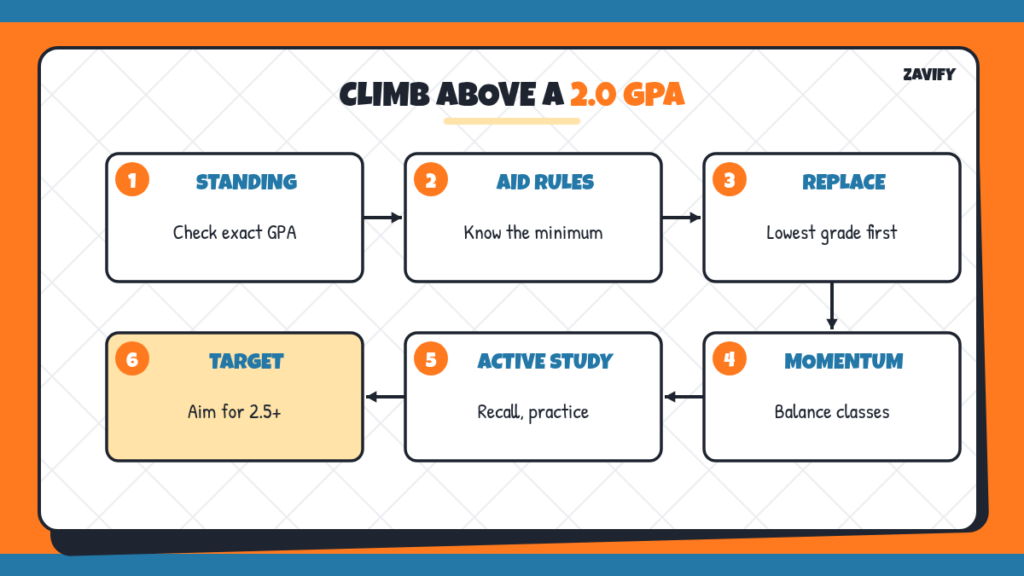
Log in to your student portal and confirm your cumulative GPA to two decimal places. A 2.04 and a 1.96 both round to “about 2.0,” but one keeps you in good standing and the other may trigger probation. Also check whether your major has its own GPA requirement.
2. Know Your Financial Aid Rules
Federal aid requires satisfactory academic progress, which usually includes a C average (2.0) by the end of your second year, plus completing enough of the credits you attempt. Scholarships may have stricter rules. Ask your financial aid office exactly what applies to you, so there are no surprises.
3. Replace Your Lowest Grade First
If you have any D’s or F’s, check whether your school allows grade replacement. Swapping a single F for a B in a three-credit class can move your GPA more than a whole term of small improvements.
4. Choose Classes That Build Momentum
Pair your hardest required course with classes in subjects you enjoy or understand well. A term with a couple of confident A’s or B’s creates a buffer and, just as important, reminds you that you can do well.
5. Learn How Each Class Is Graded
Every syllabus explains how your grade is calculated. Some classes give heavy weight to exams, others to homework or projects. Knowing this tells you where to put your effort. There is no point perfecting homework worth 5 percent if the midterm is worth 40.
6. Study Actively, Not Passively
Reading your notes over and over feels like studying, but it rarely sticks. Instead, cover the page and try to explain the idea from memory, work through practice problems or quiz a friend. This kind of active recall is what turns a C into a B.
7. Visit Office Hours Early in the Term
Go in during the first few weeks, before you are in trouble. Introduce yourself and ask one real question about the material. Teachers are far more willing to help students they know, and you will feel more comfortable returning when a harder topic comes up.
8. Limit Work Hours When Possible
Many students with a 2.0 GPA are also working long hours. If you can, reduce your hours during exam periods or in your toughest semesters. Even a small change can free up the time you need to move from C’s to B’s.
9. Set a Safer Target
Instead of aiming to “stay above 2.0,” aim for 2.5 by the end of the year. A higher target gives you breathing room and opens more doors, since many transfer programs, teacher preparation programs and internships use 2.5 as a minimum.
What Grades Make a 2.0 GPA?
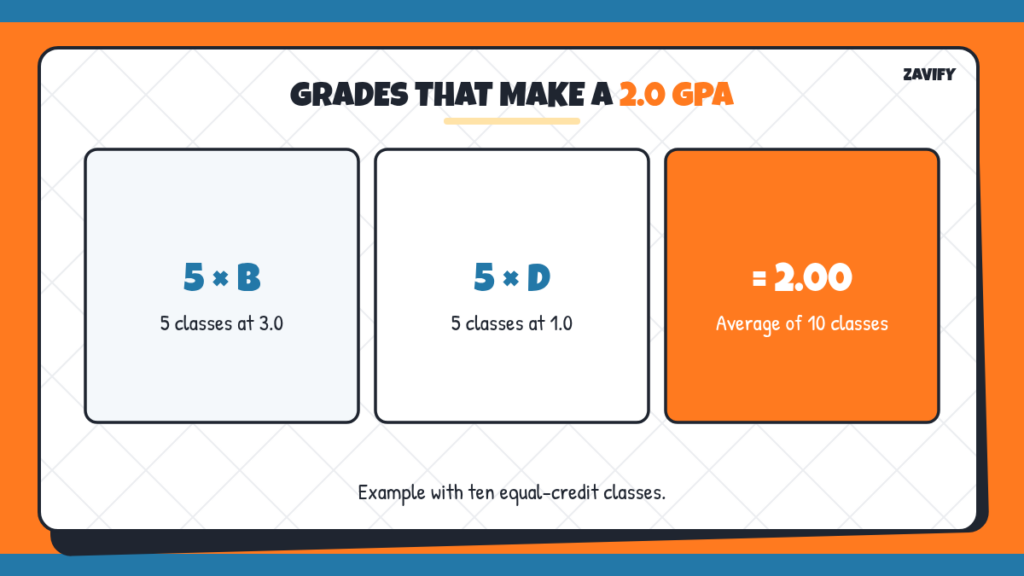
Here is one simple example. If you take ten classes of equal credit and earn five B’s (3.0) and five D’s (1.0), your average is exactly 2.00. Ten straight C’s give you the same number.
These two transcripts tell different stories. The first shows real strength in some subjects and serious trouble in others. The second shows steady but average work. Knowing which one describes you helps you decide where to focus.
Is a 2.0 GPA Good?
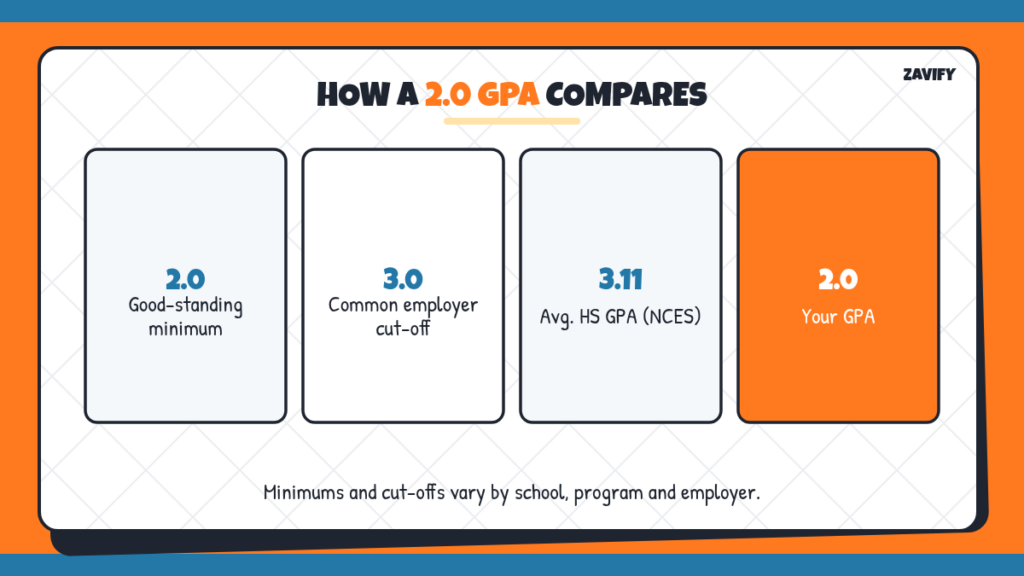
A 2.0 is below average, so it is not considered a good GPA. It is, however, the minimum passing average at most colleges. It keeps you in good standing and eligible to graduate, but it leaves no room for a bad term.
In high school, many districts use 2.0 as the minimum for sports and activities. For college admissions, a 2.0 limits your choices at four-year colleges, but community colleges usually have open admission, and a strong record there can lead to a transfer later.
Is a 2.0 GPA Good for Jobs and Grad School?
Many employers never ask for GPA, and experience quickly matters more once you have your first job. But employers that screen by GPA often use 3.0 as their cut-off, so with a 2.0 it is usually best to leave GPA off your resume and lead with skills, projects and experience. Our guide to jobs for people with a low GPA has practical ideas.
Most graduate programs ask for a 3.0, though some offer conditional admission for lower GPAs if you have strong experience or test scores. Raising your GPA in your final two years is the best way to keep that door open.
How Fast Can a 2.0 GPA Rise?
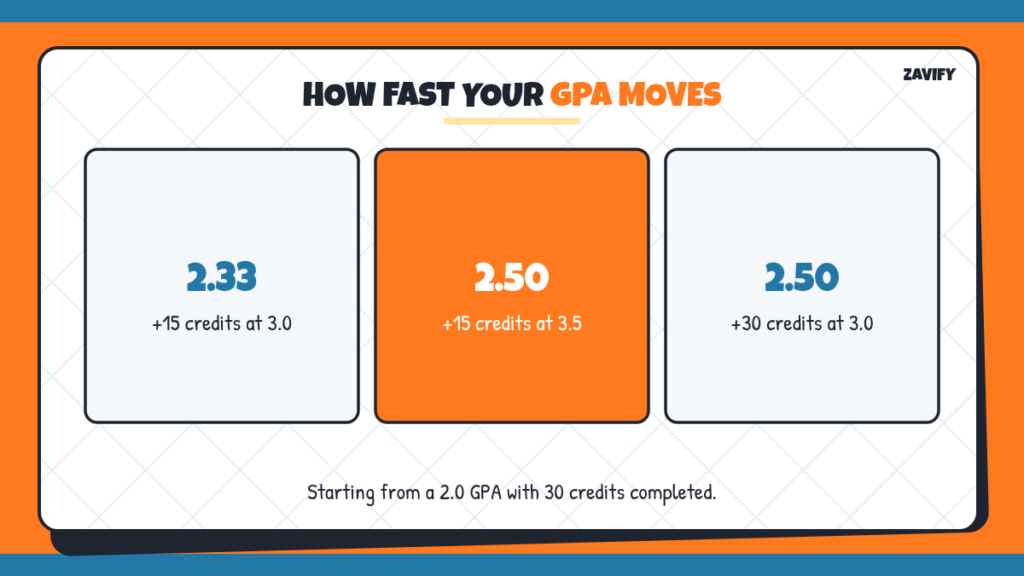
Early in your studies, your GPA can climb quickly. Here is an example for a student with a 2.0 GPA after 30 credits:
| Next Credits | Average Grade | New GPA |
|---|---|---|
| 15 credits | 3.0 | 2.33 |
| 15 credits | 3.5 | 2.50 |
| 30 credits | 3.0 | 2.50 |
One excellent term, or two solid B terms, can bring you to 2.5. That is a meaningful jump. For more ideas, see our guide on how to raise your GPA.
What Happens If You Drop Below 2.0?
At most colleges, falling below a cumulative 2.0 leads to academic probation. You usually stay enrolled but must meet certain conditions, such as earning a minimum term GPA or meeting with an advisor. If your GPA stays low for several terms, suspension is possible.
If this happens, act quickly. Read the probation letter carefully, meet your advisor and, if your financial aid is affected, ask about the appeal process and its deadline. Schools generally want you to succeed and will show you the path back.
Common Mistakes With a 2.0 GPA
These mistakes often keep students stuck at the minimum:
- Treating 2.0 as a safe target instead of a floor.
- Not checking financial aid and major GPA requirements.
- Ignoring grade replacement for D’s and F’s.
- Relying on rereading instead of active study.
- Waiting until they are failing to visit office hours.
Frequently Asked Questions
What is a 2.0 GPA?
It is a C average on the standard 4.0 scale, and the minimum GPA for good academic standing at most colleges.
Is a 2.0 GPA good?
It is below average, but it is passing. It keeps you in good standing at most schools, though with little room for error.
What percentage is a 2.0 GPA?
It is roughly 73–76% on most US grading scales.
Can you graduate college with a 2.0 GPA?
At most colleges, yes. A 2.0 cumulative GPA is a common graduation requirement, though some majors ask for more.
Can I get into college with a 2.0 GPA?
Community colleges usually accept all high school graduates. Some four-year colleges accept a 2.0, especially with strong test scores or an upward trend.
Does a 2.0 GPA affect financial aid?
It can. Federal aid usually requires a C average (2.0) by the end of your second year. Falling below it may pause your aid until you appeal or improve.
Conclusion
A 2.0 GPA is a C average, roughly 73–76%. It is the minimum passing line at most colleges: enough for good standing and graduation, but with almost no safety margin.
Treat it as a floor, not a goal. Replace your lowest grades, study actively and set a target of 2.5 or higher. Our guides to the 3.0 GPA and what counts as a good GPA show what the next steps can open up.