Introduction
If you are looking at a 1.2 GPA on your transcript, you are probably feeling worried, maybe even a little embarrassed. That is normal. But a low GPA is a snapshot of where things stand right now, not a final verdict on what you can do.
This guide gives you an honest answer to the question “is a 1.2 GPA good?” and then focuses on what matters more: what it means for your school standing, financial aid and future plans, and a realistic nine-step plan to bring it back up.
- Letter grade: a D average.
- Percentage: roughly 66% on most US scales.
- Rating: well below average, and below the 2.0 minimum most colleges require.
Table of Contents
What Is a 1.2 GPA?
GPA stands for grade point average. Schools convert each letter grade into points and then average them, usually weighting each class by credit hours. On the standard 4.0 scale, a C is 2.0, a D is 1.0 and an F is 0.0.
So a 1.2 GPA means your average grade is a low D. Usually that comes from a mix of C’s, D’s and at least one F. It often reflects a single very hard term rather than years of poor work, especially for first-year students who have only a few classes on their record.
For comparison, the NCES High School Transcript Study reported an average GPA of about 3.11 for 2019 high school graduates. A 1.2 sits far below that, which is exactly why it is worth acting on now.
- Semester GPA: your grades for one term.
- Cumulative GPA: your average across every term, which decides your academic standing.
- Academic standing: the status (good standing, probation or suspension) your school gives you based on that average.
How Does a 1.2 GPA Work?
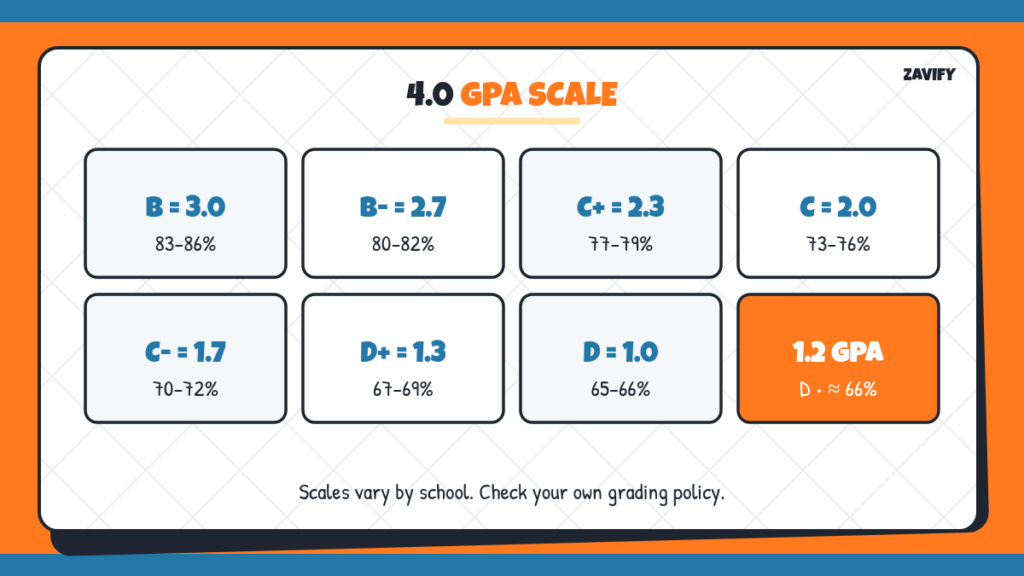
The 1.2 GPA letter grade falls between the D and D-plus rows of a typical conversion table:
| Letter Grade | Percentage | Grade Points |
|---|---|---|
| C | 73–76% | 2.0 |
| C- | 70–72% | 1.7 |
| D+ | 67–69% | 1.3 |
| D | 65–66% | 1.0 |
| F | Below 65% | 0.0 |
Pay attention to the F row. An F counts as zero points, so one failed class can pull your average down dramatically. The flip side is encouraging: replacing or balancing out that F is often the quickest way to recover.
You can model different outcomes in our cumulative GPA calculator.
1. Talk to Your Advisor This Week
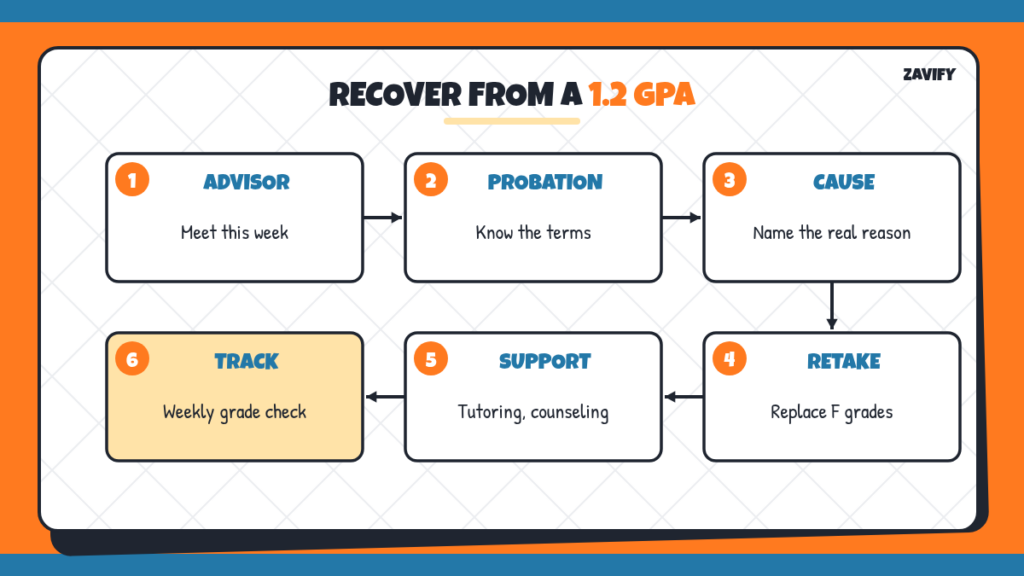
Do not wait for a letter from the registrar. Book a meeting with your academic advisor or school counselor now. They can tell you your exact standing, what the school requires you to do next and which options, such as retakes or reduced course loads, are open to you.
2. Understand Your Probation Terms
Most colleges place students below a 2.0 cumulative GPA on academic probation. Probation usually comes with conditions: a minimum GPA you must earn next term, limits on how many credits you can take, or required meetings. Read those conditions carefully and write them down. Meeting them is the first goal.
3. Be Honest About the Cause
A 1.2 almost always has a reason behind it. It might be a job with too many hours, a health issue, family stress, missed classes or simply not knowing how to study at college level. Name the cause as specifically as you can. The fix for “I worked 35 hours a week” is very different from the fix for “I never understood the math.”
4. Retake the Classes You Failed
Many schools let you retake a failed or D-grade class and replace the old grade in your GPA, or at least average the two. Because an F counts as zero, this can make a bigger difference than anything else on this list. Ask your advisor which classes qualify and how many retakes you are allowed.
5. Take a Lighter, Balanced Load
Trying to “catch up” with a huge schedule usually leads to more low grades. A smaller load, perhaps 12 credits in college, with a mix of retakes and classes you feel comfortable in, gives you the best chance of strong results.
6. Use Every Support Service
Tutoring centers, writing centers, math labs, disability services and counseling are usually free. Students on probation who use these services regularly tend to do much better than those who try to fix things alone. If your school offers a success coach or probation workshop, sign up.
7. Go to Every Class and Sit Near the Front
Attendance is one of the strongest predictors of grades. Being in the room means hearing what will be on the test, asking questions and getting participation credit. Sitting near the front also makes it easier to stay focused.
8. Track Your Grades Every Week
Keep a simple list of every class, its grading breakdown and your current scores. Update it every weekend. If a grade starts slipping, you will see it early enough to visit office hours or get tutoring before it becomes another D.
9. Think About Your Bigger Plan
Sometimes a low GPA is a sign that the major or the timing is not right. It may make sense to change your field of study, move to part-time study or spend a term at a community college. There is no shame in adjusting the plan. Many successful graduates took a detour after a rough start.
What Grades Make a 1.2 GPA?
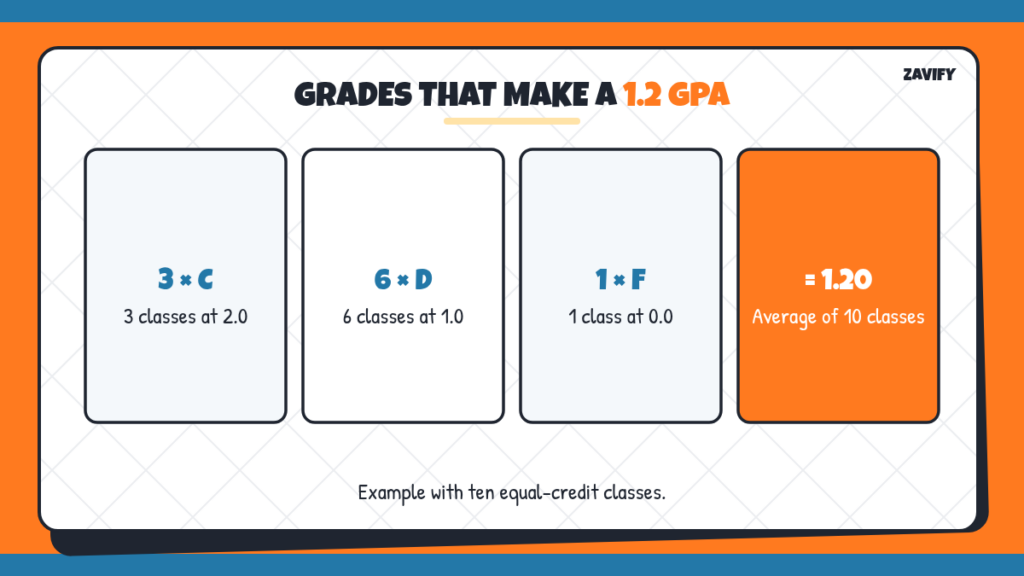
Here is one example. If you took ten classes with the same credits and earned three C’s (2.0), six D’s (1.0) and one F (0.0), your average would be exactly 1.20.
Now imagine that F is retaken and becomes a C. The average jumps to 1.40 without changing anything else. That shows how much a single retake can help.
Is a 1.2 GPA Good?
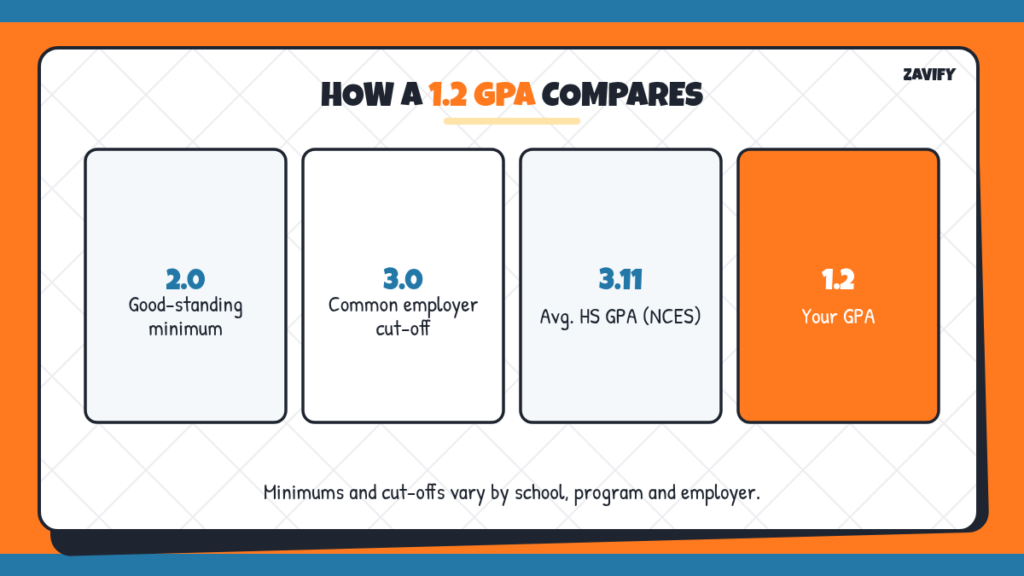
Honestly, no. A 1.2 is well below average and below the 2.0 that most colleges require for good academic standing and graduation. It can also affect federal financial aid, because students generally need to maintain satisfactory academic progress, which usually includes at least a C average (2.0) by the end of the second year.
In high school, many districts also require a minimum GPA, often 2.0, to play sports or take part in some activities. And most four-year colleges would find a 1.2 hard to accept without a strong upward trend.
But low is not the same as hopeless. A 1.2 early in your studies can move quickly, and schools pay attention to improvement.
How Fast Can a 1.2 GPA Rise?
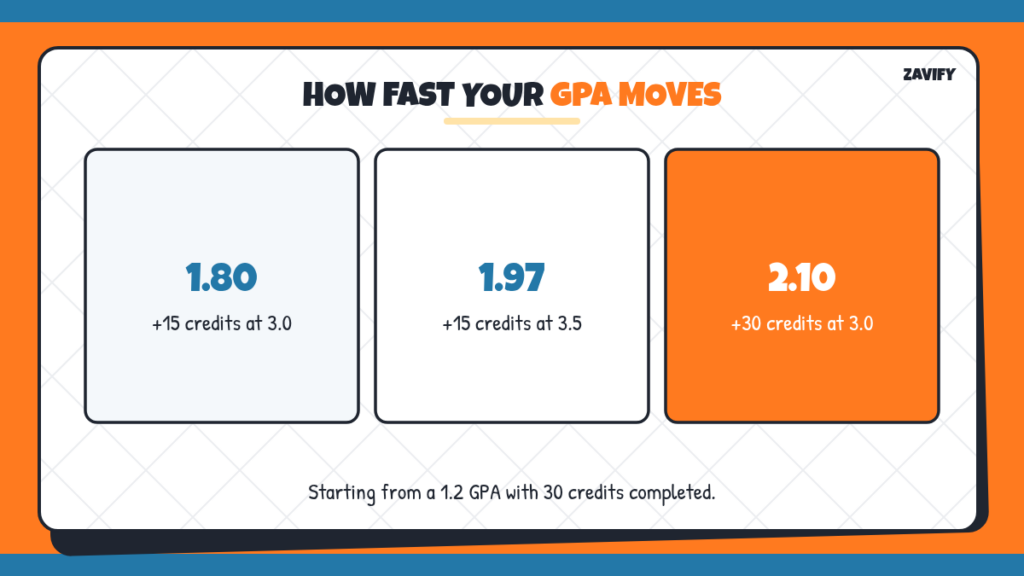
Early GPAs move fast because they are based on fewer credits. Here is an example for a college student with a 1.2 GPA after 30 credits:
| Next Credits | Average Grade | New GPA |
|---|---|---|
| 15 credits | 3.0 | 1.80 |
| 15 credits | 3.5 | 1.97 |
| 30 credits | 3.0 | 2.10 |
Two solid terms at a B average can take you past 2.0, back into good standing at most schools. Retaking failed classes can speed this up even more. See our guide on how to raise your GPA for more ideas.
What Are Your Options With a 1.2 GPA?
If you are a high school student, community colleges usually have open admission, which means you can enroll and build a strong college record before transferring to a four-year school. Many students do exactly this, and transfer admissions often focus more on your college grades than your high school ones.
If you are already in college, the main priority is getting back above 2.0. After that, your options widen quickly. For work, many employers never ask about GPA, especially after your first job. Our guide to jobs for people with a low GPA covers this in more detail.
Common Mistakes With a 1.2 GPA
These mistakes often make a low GPA harder to fix:
- Hiding from advisors instead of asking for help.
- Ignoring the conditions of academic probation.
- Taking an overloaded schedule to catch up.
- Not retaking failed classes when the school allows it.
- Missing the financial aid appeal deadline if aid is affected.
Frequently Asked Questions
Is a 1.2 GPA good?
No. It is well below average and below the 2.0 most colleges require for good standing. It can be raised, though, especially early in your studies.
What is a 1.2 GPA in letter grade?
It is roughly a D average on the standard 4.0 scale.
What percentage is a 1.2 GPA?
It is about 66% on most US grading scales, though exact cut-offs vary by school.
Will a 1.2 GPA put me on academic probation?
At most colleges, yes. Probation usually starts when your cumulative GPA drops below 2.0. Check your school’s academic standing policy.
Can I still get into college with a 1.2 GPA?
Community colleges usually accept all high school graduates. Four-year colleges will want to see strong improvement first, often through community college grades.
How long does it take to raise a 1.2 GPA to a 2.0?
With 30 credits completed, about two terms of B grades would do it. Retaking failed classes can make it faster.
Conclusion
A 1.2 GPA is low. It equals roughly a D average, or about 66%, and it sits below the level most colleges require for good standing.
The important part is what you do next. Talk to your advisor, understand your probation terms, retake failed classes and use every support service your school offers. With a lighter schedule and steady effort, getting back above 2.0 is realistic. For the next milestone, read our guide to the 3.0 GPA and what counts as a good GPA.