Introduction
A 3.3 GPA is a B-plus average. That is a good, dependable result, and it tells colleges and employers that you do solid work in almost every class. It is also the point where a lot of students feel stuck: the grades are good, but the A’s never quite arrive.
If that sounds familiar, you are in the right place. Below we explain what a 3.3 GPA really means, how it is viewed by colleges and employers, and nine steps for breaking through what many teachers call the “B-plus ceiling.”
- Letter grade: B-plus.
- Percentage: roughly 87–89% on most US scales.
- Rating: good, a little above the national average.
Table of Contents
What Is a 3.3 GPA?
Your GPA (grade point average) is the average of the points you earn in each class. On the standard unweighted 4.0 scale, an A is 4.0, a B-plus is 3.3 and a B is 3.0. Most schools also weight each class by its credit hours.
A 3.3 GPA can come from steady B-plus grades in every class, or from a mix of A’s and B’s that averages out the same way. Either way, it shows consistent effort and a good grasp of the material.
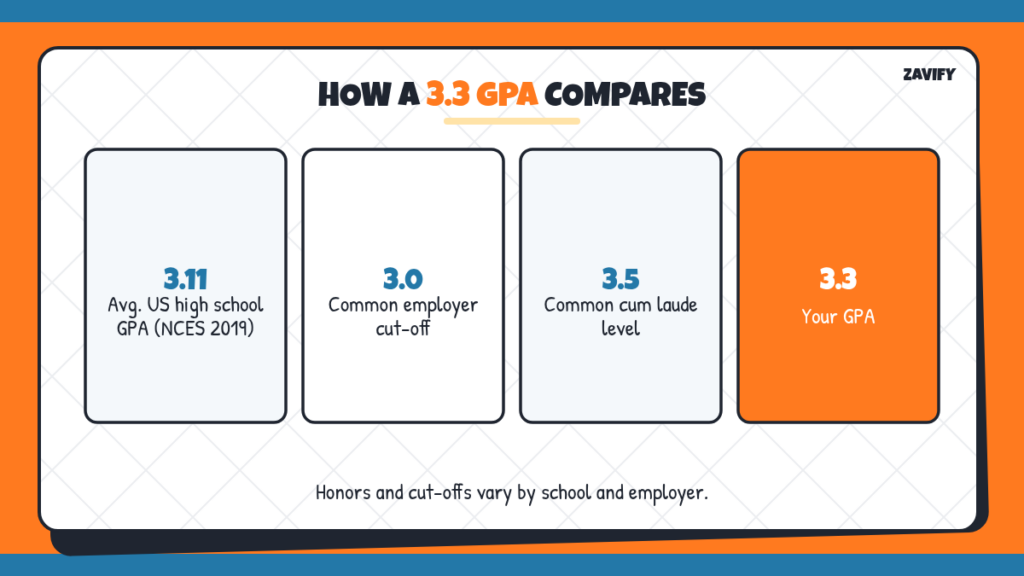
The NCES High School Transcript Study reported that US high school graduates in 2019 averaged about 3.11. A 3.3 is above that, though not by a huge margin, which is why the rest of your application matters.
- Unweighted: the plain 4.0 scale.
- Weighted: can be higher if you took honors or AP classes.
- Trend: whether your grades are rising or falling over time, which colleges notice.
How Does a 3.3 GPA Work?
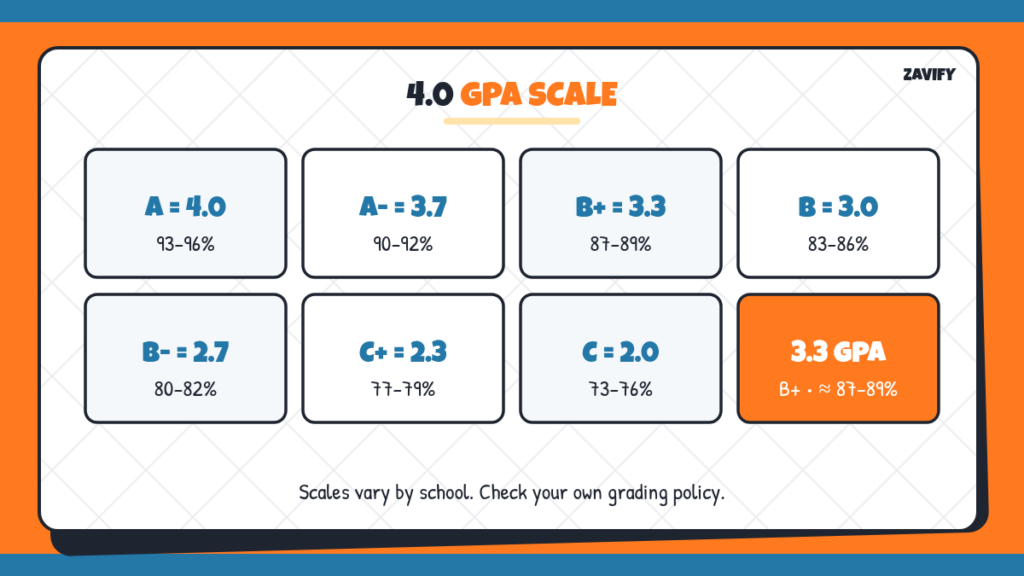
The 3.3 GPA letter grade is a B-plus, which lines up exactly with this row of a standard conversion table:
| Letter Grade | Percentage | Grade Points |
|---|---|---|
| A | 93–96% | 4.0 |
| A- | 90–92% | 3.7 |
| B+ | 87–89% | 3.3 |
| B | 83–86% | 3.0 |
| B- | 80–82% | 2.7 |
Your school might use slightly different cut-offs, and some schools do not use plus and minus grades at all. You can check your exact GPA with our cumulative GPA calculator.
1. Look at Your Grade Trend
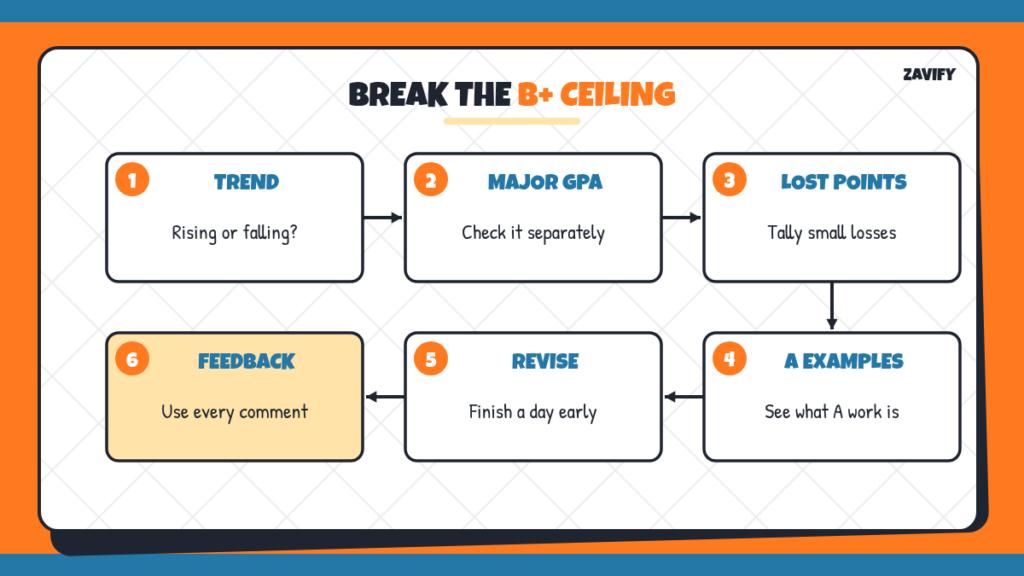
Pull up your grades by term. Is your GPA climbing, falling or flat? A 3.3 made up of a rough freshman year and strong recent terms tells a very different story from a 3.3 that is slowly slipping. Knowing your trend helps you decide what to fix and how to explain your record later.
2. Calculate Your Major GPA Separately
Some students have a much higher GPA in their major than overall. If yours is 3.6 in your major and 3.3 overall, that is worth knowing, because many employers and graduate programs pay close attention to the classes that relate to the job or field.
3. Find Where the Small Points Go
A B-plus is usually not one big failure. It is a lot of small losses: a point off here for formatting, two points there for a missed step, a late penalty on one assignment. Go through your graded work from last term and tally where the points went. The pattern is often surprising.
4. Ask to See What A Work Looks Like
Many teachers will share a rubric or an anonymous example of an A paper or project if you ask. Comparing your work with a real A answer shows you exactly what is missing, whether it is deeper analysis, clearer structure or more careful detail.
5. Revise Before You Submit
Students stuck at B-plus often hand in their first complete draft. Set a personal rule: finish every major assignment a day early, then reread it the next morning. You will catch errors and weak spots that would have cost you points.
6. Study a Little Every Day
Short, regular reviews spread across the week help you remember far more than one long session the night before a test. Even 20 minutes a day per class adds up, and it makes exam week much calmer.
7. Use the Feedback on Returned Work
When a graded paper or test comes back, most students look at the score and put it away. Instead, read every comment and write down one thing you will do differently next time. Teachers tend to grade the same way all term, so their comments are a map of what they want.
8. Balance Activities and Classes
Clubs, sports and jobs are valuable, and colleges like to see them. But if your schedule leaves no time for revision, your grades will stay at B-plus. Look for one commitment you could scale back during your heaviest academic terms.
9. Tell Your Story in Applications
A 3.3 GPA is not only a number; it has context. If your grades rose after a hard first year, or you worked long hours or dealt with a family situation, many applications give you space to explain it. Keep it short and factual, and focus on what you learned and how your results improved.
What Grades Make a 3.3 GPA?
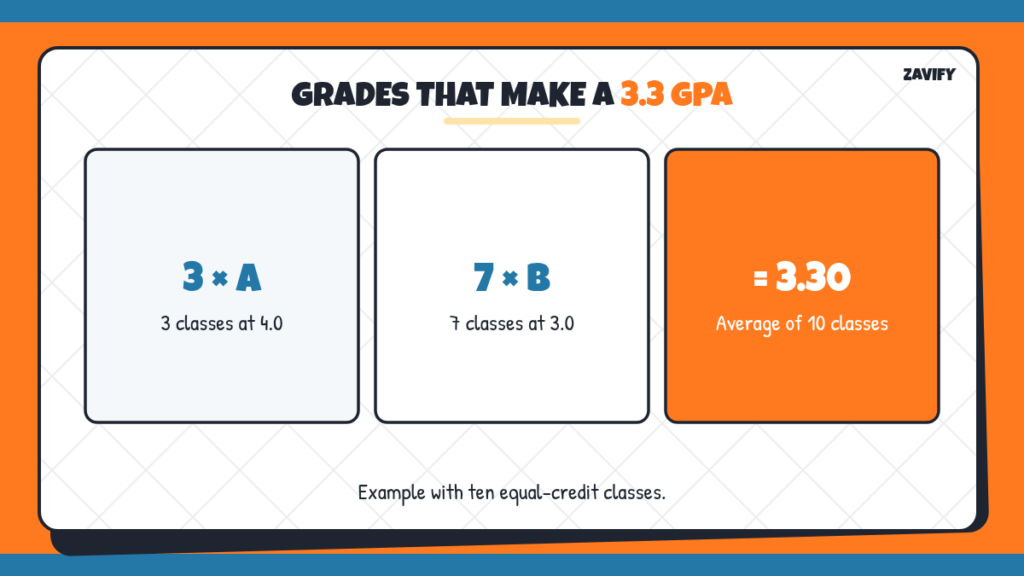
Here is one example. If you take ten classes of equal credit and earn three A’s (4.0) and seven B’s (3.0), your average is exactly 3.30. Ten B-plus grades would give you the same number.
Remember that credits change the math. A B in a four-credit lab class pulls your GPA down more than a B in a two-credit elective, so focus your effort on the courses that count the most.
Is a 3.3 GPA Good for College?
Yes. A 3.3 GPA gives you realistic options at many public universities, regional colleges and private schools. The strength of your courses, your essays and your activities will play a big part in where you are admitted.
The most selective colleges usually admit students with much higher GPAs, so treat those as reach schools. Build your list around schools where a 3.3 is close to or above the middle of their admitted students, and you will likely have several good choices.
Is a 3.3 GPA Good in College and for Jobs?
In college, a 3.3 keeps you in good academic standing and above the 3.0 minimum that many scholarships, internships and master’s programs require. It is below the 3.5 level often used for the dean’s list and cum laude honors.
For jobs, a 3.3 passes the 3.0 cut-off that many employers use. At companies that ask for 3.5 or higher, internships, projects and skills will carry more weight than your GPA. Our guide on whether to put your GPA on your resume explains how to present it.
How Much Can You Raise a 3.3 GPA?
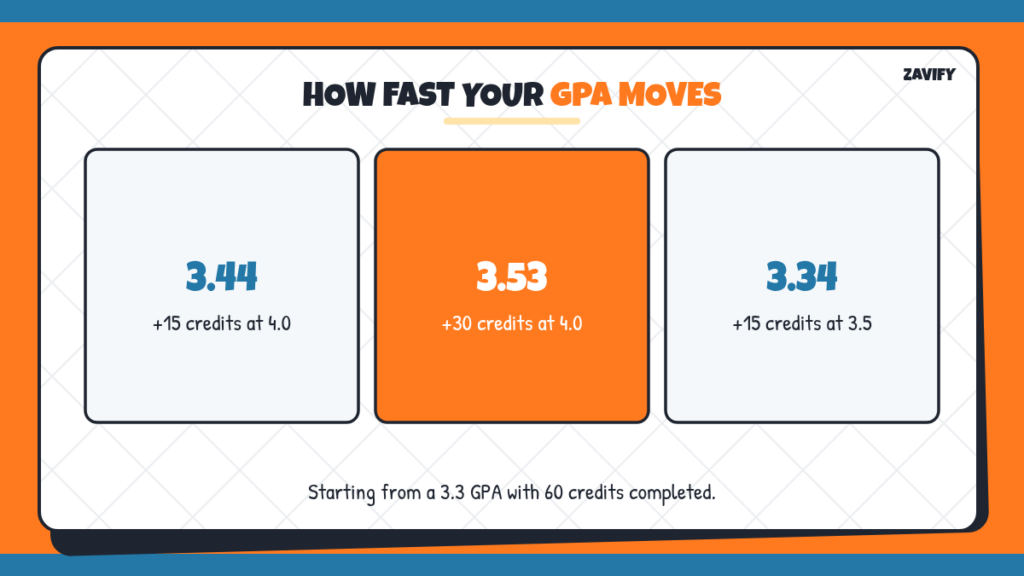
Here is what could happen for a college student with a 3.3 GPA and 60 credits:
| Next Credits | Average Grade | New GPA |
|---|---|---|
| 15 credits | 4.0 | 3.44 |
| 30 credits | 4.0 | 3.53 |
| 15 credits | 3.5 | 3.34 |
Two strong semesters could take you past 3.5, which opens up more scholarships and honors. Even steady 3.5 terms nudge your GPA upward over time. For more ideas, read our guide on how to raise your GPA.
How to Present a 3.3 GPA
You do not have to hide a 3.3. On a resume, list it if the employer asks for GPA or if it meets their stated minimum. If your major GPA is higher, you can list that alongside your overall number, as long as you label it clearly. In interviews, talk about your strongest classes and projects, and show what you can do rather than only what you scored.
Where a 3.3 Sits Between 3.0 and 3.5
Think of 3.0 and 3.5 as two common lines. The 3.0 line is the minimum for a lot of scholarships, internships and graduate programs. The 3.5 line is where many honors, merit awards and competitive employers start. A 3.3 sits comfortably above the first line and within reach of the second.
That middle position is useful. You are not in danger of losing opportunities that need a 3.0, so you can put your energy into climbing. A couple of strong terms can move you into the group that qualifies for more selective programs.
Common Mistakes With a 3.3 GPA
These habits often keep students at a B-plus average:
- Submitting first drafts without revision.
- Ignoring feedback on returned work.
- Cramming instead of reviewing a little each day.
- Not tracking where small points are lost.
- Overloading activities during heavy academic terms.
Frequently Asked Questions
Is a 3.3 GPA good?
Yes. It is a good, above-average GPA. It meets the minimum for most colleges and employers, though selective programs often look for 3.5 or higher.
What is a 3.3 GPA in letter grade?
It is a B-plus on the standard unweighted 4.0 scale.
What percentage is a 3.3 GPA?
It is roughly 87–89% on most US scales. Check your school’s grading policy for exact cut-offs.
Can I get into a good college with a 3.3 GPA?
Yes. Many good public and private colleges admit students with a 3.3, especially with challenging classes, strong essays and meaningful activities.
Is a 3.3 GPA good for grad school?
It meets the 3.0 minimum used by many master’s programs. Competitive programs may expect more, so strong test scores, experience or an upward trend can help.
How long does it take to raise a 3.3 GPA to a 3.5?
With about 60 credits completed, two semesters averaging close to 4.0 would do it. Earlier in your studies, it can happen faster.
Conclusion
A 3.3 GPA is a good, solid result. It equals a B-plus average, roughly 87–89%, and it keeps most doors open for college, scholarships and jobs.
To break through the B-plus ceiling, look for the small points you keep losing, revise before you submit and use every piece of feedback. Compare your position with our 3.0 GPA and 3.5 GPA guides, and check what counts as a good GPA for your goals.