Formula: Weighted GPA = Σ ((Grade Point + Weight Bonus) × Credits) / Σ Credits
📐 Formula
Weighted GPA = Σ ((Grade + Weight Bonus) × Credits) / Σ Credits- Enter your courses and letter grades on the 4.0 scale.
- Select each course’s type: Regular, Honors (+0.5), or AP/IB (+1.0).
- The calculator applies the rigor bonus and returns your weighted and unweighted GPA.
🎒 High School GPA Calculation Explained
Your high school GPA is one of the most critical numbers in the college admissions process — it summarizes four years of academic performance into a single figure that admissions officers compare across thousands of applicants. Keeping an accurate, up-to-date picture of where you stand helps you set realistic targets for the schools on your list.
This calculator tracks your performance across AP, Honors, and standard courses, and reports your GPA on both weighted and unweighted scales. Add each class with its grade and course type, and the tool handles the rigor bonuses and averaging automatically.
⚖️ Weighted vs. Unweighted GPA
An unweighted GPA uses the plain 4.0 scale regardless of course difficulty — an A is 4.0 and a B is 3.0 whether the class is a standard elective or the hardest AP on offer. It measures pure grade performance without accounting for rigor.
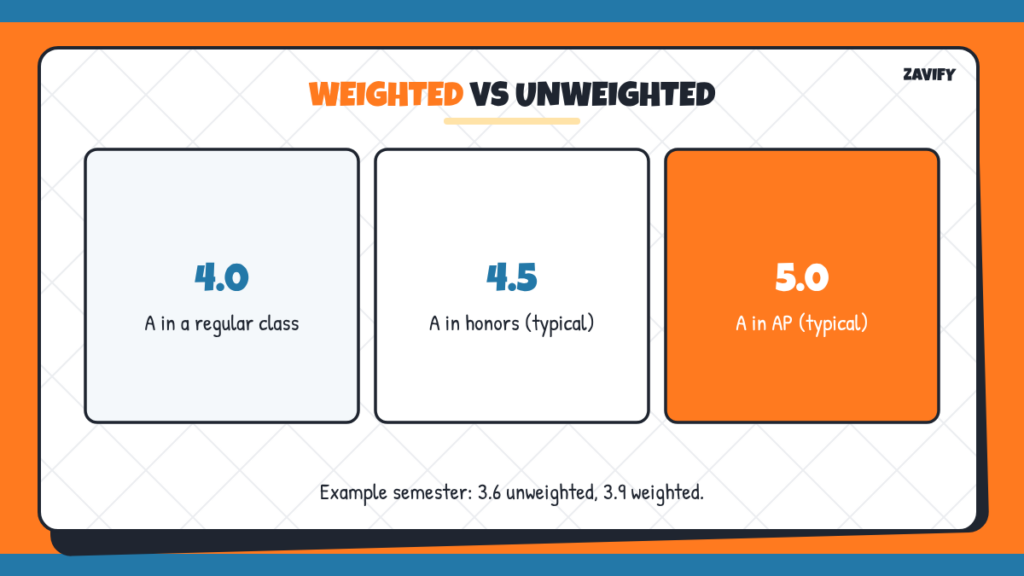
A weighted GPA grants bonus points for challenging coursework: AP/IB classes are effectively graded on a 5.0 scale (+1.0 bonus) and Honors classes on a 4.5 scale (+0.5 bonus). This is why competitive students taking rigorous schedules can report GPAs above 4.0, and why many colleges recalculate both versions when reviewing applications.
Weighted vs Unweighted: Worked Example
This high school GPA calculator can show both versions. Here is the same semester calculated each way, using a common weighting of +0.5 for honors and +1.0 for AP:
| Class | Level | Grade | Unweighted | Weighted |
|---|---|---|---|---|
| English 11 | Honors | A | 4.0 | 4.5 |
| AP U.S. History | AP | B | 3.0 | 4.0 |
| Algebra II | Regular | B | 3.0 | 3.0 |
| Chemistry | Regular | A | 4.0 | 4.0 |
| Spanish III | Regular | A | 4.0 | 4.0 |
| Average | 3.6 | 3.9 |
Weighting rules vary by school and district, so use the values on your transcript or school profile when you can.
Which GPA Do Colleges Use?
Colleges see the GPA your school reports, along with your transcript and your school’s profile. Many also recalculate a GPA using only core academic classes and their own weighting. That is why taking challenging classes matters as much as the number itself. When you apply, report your GPA exactly as your school does; our guide to GPA scale reporting explains how. The College Board’s GPA guide shows the standard 4.0 conversion.
How to Raise Your High School GPA
- Focus on classes where you are just below the next letter grade.
- Take honors or AP classes you can do well in; a B in AP often weighs the same as an A in a regular class.
- Use our final grade calculator to see what you need on finals.
- Remember that freshman grades count in most schools’ cumulative GPA, so start strong.
❓ Frequently Asked Questions
How do I calculate my high school GPA?
Sum your grade points and divide by the number of classes; for a weighted GPA, add 1.0 for AP/IB classes and 0.5 for Honors classes before averaging.
Is 3.8 a good high school GPA?
Yes — a 3.8 is top tier for most state and private universities.
Does Freshman year matter?
Yes, grades from 9–12 all count toward your cumulative GPA, though some colleges place more emphasis on later years.
What is a good high school GPA?
Around 3.0 unweighted is close to the US average; 3.5 and above is strong, and selective colleges often see 3.7 or higher.
Is a weighted GPA better than unweighted?
Neither is better. Colleges look at both your grades and how hard your classes were.
Can a high school GPA be above 4.0?
Yes, on a weighted scale. Honors and AP classes can push it toward 4.5 or 5.0.