Introduction
A 3.4 GPA lands in a spot that many students find frustrating. It is a good result, clearly above average, but it sits just below 3.5, the number that shows up again and again on scholarship forms, honors lists and internship applications.
The good news is that the gap is small. This guide explains what a 3.4 GPA means, how colleges and employers read it, and nine steps that can realistically carry you over the 3.5 line.
- Letter grade: B-plus, leaning toward A-minus.
- Percentage: roughly 88–89% on most US scales.
- Rating: good, above the national average.
Table of Contents
What Is a 3.4 GPA?
GPA stands for grade point average. Every grade you earn is converted into points (A = 4.0, A- = 3.7, B+ = 3.3, B = 3.0) and averaged, usually with bigger classes counting more.
A 3.4 GPA means your average grade is a little above a B-plus. Most students with this GPA have a mix of A’s and B’s, with slightly more B’s. It shows solid, reliable work with some standout classes.
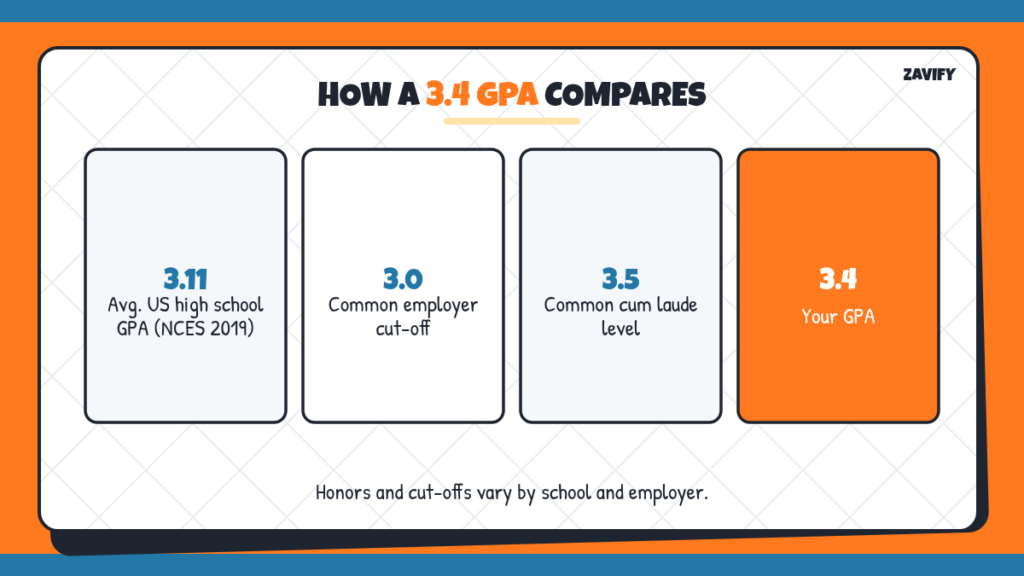
According to the NCES High School Transcript Study, 2019 high school graduates averaged a GPA of about 3.11. So a 3.4 puts you ahead of a typical student.
- Unweighted: the plain 4.0 scale most colleges use to compare students.
- Weighted: adds bonus points for honors or AP classes.
- Term vs cumulative: one semester can be higher or lower than your overall average.
How Does a 3.4 GPA Work?
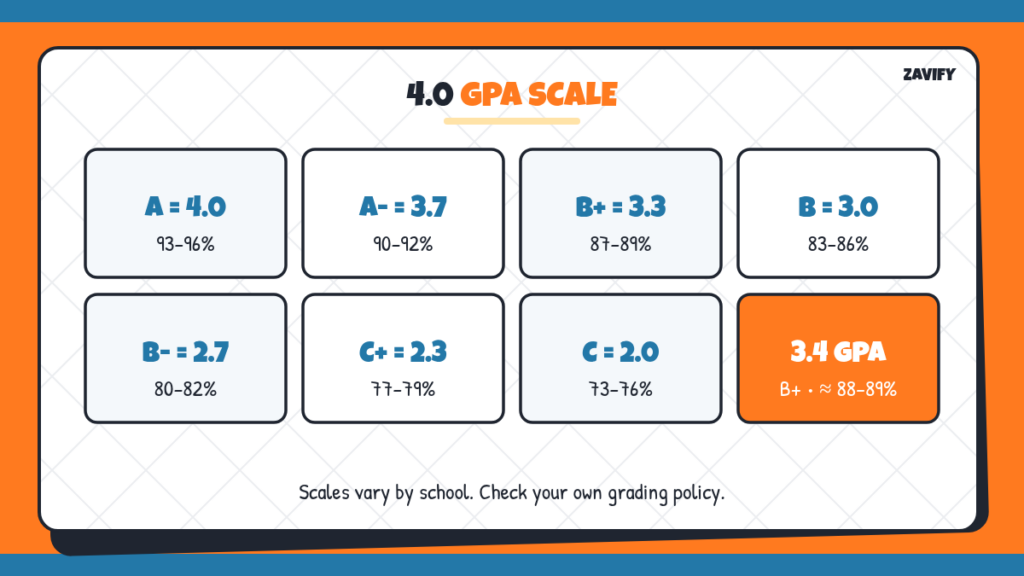
The 3.4 GPA letter grade sits just above the B-plus row of a standard conversion table:
| Letter Grade | Percentage | Grade Points |
|---|---|---|
| A | 93–96% | 4.0 |
| A- | 90–92% | 3.7 |
| B+ | 87–89% | 3.3 |
| B | 83–86% | 3.0 |
| B- | 80–82% | 2.7 |
Here is something worth noticing. A B-plus is often only one or two percentage points away from an A-minus. If several of your classes finish at 88 or 89 percent, you are much closer to a 3.5 than your GPA suggests.
Check your own numbers with our college GPA calculator.
1. Do the 3.5 Math First
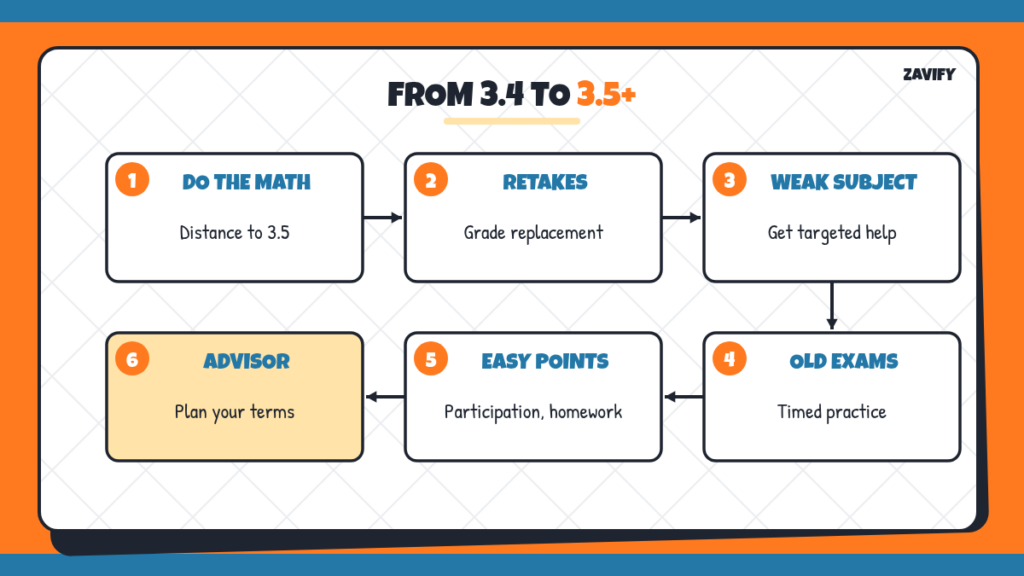
Before changing anything, find out exactly how far you are from 3.5. Take a college student with a 3.4 and 60 credits. To reach 3.5 in one 15-credit semester, they would need an average of about 3.9 that term. Spread over two semesters (30 credits), they would need about 3.7. That second target is very realistic, and knowing it removes a lot of guesswork.
2. Check for Grade Replacement
Many colleges let you retake a class and replace the old grade in your GPA, or at least average the two. If one C or low B is dragging you down, retaking that class could be the single fastest fix. Read your school’s policy carefully, as some only allow it for a limited number of courses.
3. Fix the Subject That Costs You Most
Look at your transcript and find the pattern. For many students with a 3.4, it is one subject area, often math, lab science or long writing assignments. Getting a tutor, joining a study session or using your school’s learning center for that one area can lift several grades at once.
4. Protect Your Sleep and Schedule
It is hard to earn an A-minus on four hours of sleep. Build a weekly schedule with fixed study blocks, and guard your sleep during exam weeks. A tired brain makes careless mistakes, and careless mistakes are exactly what separate an 88 from a 91.
5. Practice With Old Exams
Ask your teacher if past exams or sample questions are available. Working through them under timed conditions shows you the style of questions and the topics that come up most. It is one of the most reliable ways to add a few points to your test scores.
6. Use the Writing Center
If essays are part of your grade, a writing center or a trusted reader can catch unclear arguments and weak structure before your teacher does. Even one extra draft can turn a B-plus paper into an A-minus paper.
7. Collect Every Participation Point
Participation, attendance and small homework tasks often decide whether your final grade lands at 89 or 90. They require almost no extra skill, only consistency. Treat them as free points you cannot afford to leave behind.
8. Take a Balanced Load in Tough Terms
If you know next semester includes two very demanding classes, consider taking one fewer course or adding a class you are confident in. A slightly lighter term with higher grades usually does more for your GPA than a heavy term with more B’s.
9. Talk to Your Academic Advisor
Advisors know your school’s rules on retakes, pass/fail options, withdrawals and honors cut-offs. A 20-minute meeting can show you options you did not know existed, and it helps you plan the rest of your degree around your GPA goals.
What Grades Make a 3.4 GPA?
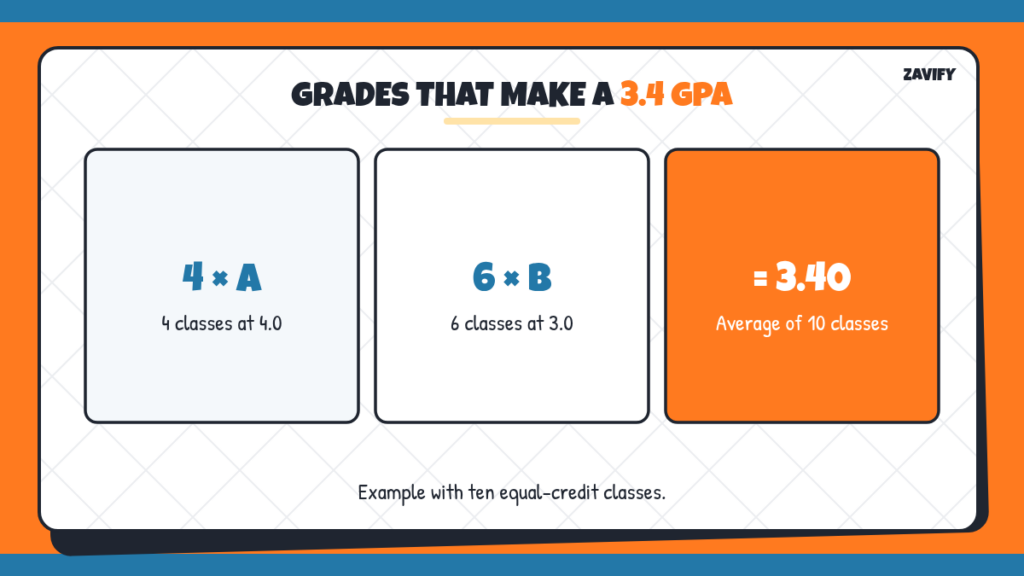
Here is a simple example. Across ten equal-credit classes, four A’s (4.0) and six B’s (3.0) average to 3.40. Another student might reach the same number with mostly B-plus grades and a few A-minus grades.
Credits matter too. A B in a four-credit course pulls your GPA down more than the same grade in a two-credit class, so weight your effort toward the biggest courses on your schedule.
Is a 3.4 GPA Good for College?
Yes. A 3.4 GPA gives you a good chance at many public universities and a wide range of private colleges. It shows you can handle college-level work, especially if your classes were challenging.
Highly selective colleges usually admit students with higher GPAs, so it makes sense to treat them as reach schools. Build a balanced list with match and safety options, and put real effort into your essays and activities, which can make a big difference when your GPA is close to a school’s average.
Scholarships and a 3.4 GPA
Scholarships are where the 3.5 line shows up most often. Many general and state awards ask for a 3.0, which you already meet. Some competitive merit scholarships, honors programs and departmental awards ask for 3.5 or higher. Before you give up on one, read the fine print: some use your weighted GPA, some use only your last two years, and some consider essays and financial need alongside grades.
If a scholarship you want has a 3.5 minimum and you are at 3.4, find out when the GPA is measured. Getting there by the deadline might be possible with one strong term.
Is a 3.4 GPA Good for Jobs and Grad School?
For most employers, yes. Companies that screen applicants by GPA often set the line at 3.0, which a 3.4 clears easily. A smaller group of competitive firms use 3.5, and that is where getting over the line can help. Internships, projects and skills matter a lot either way.
For graduate school, a 3.4 meets the minimum for most master’s programs. Some competitive programs look for 3.5 or higher, and a strong upward trend in your final semesters can make a real difference. Read our guide on whether to put your GPA on your resume as well.
How Much Can You Raise a 3.4 GPA?

Here is what happens to a 3.4 with 60 credits already completed:
| Next Credits | Average Grade | New GPA |
|---|---|---|
| 15 credits | 4.0 | 3.52 |
| 30 credits | 4.0 | 3.60 |
| 15 credits | 3.5 | 3.42 |
One excellent semester can push you past 3.5. Even a good 3.5 semester nudges your GPA upward. For more tips, see our guide on how to raise your GPA.
A Quick Word on Weighted Grades
If your high school uses weighted grades, check which version of your GPA is a 3.4. A weighted 3.4 might be an unweighted 3.1 or 3.2, while an unweighted 3.4 with several AP classes is quite strong. Colleges often recalculate grades their own way, so it helps to know both numbers. Our high school GPA calculator shows each one.
Common Mistakes With a 3.4 GPA
These mistakes keep many students stuck just below 3.5:
- Not calculating how close they actually are to 3.5.
- Ignoring grade replacement or retake policies.
- Losing easy participation and homework points.
- Taking on too many hard classes in one term.
- Comparing weighted and unweighted GPAs as if they match.
Frequently Asked Questions
Is a 3.4 GPA good?
Yes. It is a good, above-average GPA that meets the minimum for most colleges, scholarships and employers.
What is a 3.4 GPA in letter grade?
It is slightly above a B-plus on the standard unweighted 4.0 scale.
What percentage is a 3.4 GPA?
It works out to roughly 88–89% on most US scales. Your school may use slightly different cut-offs.
How can I raise a 3.4 GPA to a 3.5?
Aim for a few semesters around 3.7, use grade replacement if your school allows it and focus on classes sitting close to the next grade.
Is a 3.4 GPA good for scholarships?
It clears the 3.0 minimum used by many scholarships. Some merit awards ask for 3.5, so check each one’s rules.
Is a 3.4 GPA good in college?
Yes. The average college GPA is commonly reported at around 3.1 to 3.2, so a 3.4 is above average.
Conclusion
A 3.4 GPA is a good result. It equals a little more than a B-plus average, roughly 88–89%, and it places you above most students.
You are also closer to 3.5 than you might think. Run the numbers, fix the subject that costs you most and collect every easy point. Compare your position with our 3.0 GPA and 3.5 GPA guides, and read what counts as a good GPA to set your next goal.