Introduction
You have a GPA of 3.5 and an application, scholarship form or job portal asks for a percentage. Or you are an international student comparing grades with a US school. Either way, you need a clear, honest answer.
This guide explains what percentage a 3.5 GPA equals, the three common conversion methods and why they give slightly different results, plus a full chart and what a 3.5 means for admissions.
- A 3.5 GPA is roughly 87–90% on the standard US scale.
- It sits between a B+ (3.3) and an A- (3.7).
- Different conversion methods give slightly different numbers, so state which one you used.
Table of Contents
What Percentage Is a 3.5 GPA?
On the most widely used US grading chart, a B+ (3.3) covers 87–89% and an A- (3.7) covers 90–92%. A 3.5 sits halfway between them, so it corresponds to roughly 88–90%. That is the most accurate everyday answer.
You will also see 87.5%, which comes from a simple proportional formula. Both are approximations. A GPA is an average of letter grades, not a precise percentage, so no single conversion is official across all US schools.
- Letter grade: B+ to A-.
- Chart-based percentage: about 88–90%.
- Simple formula: 87.5%.
How Do You Convert a 3.5 GPA to Percentage?
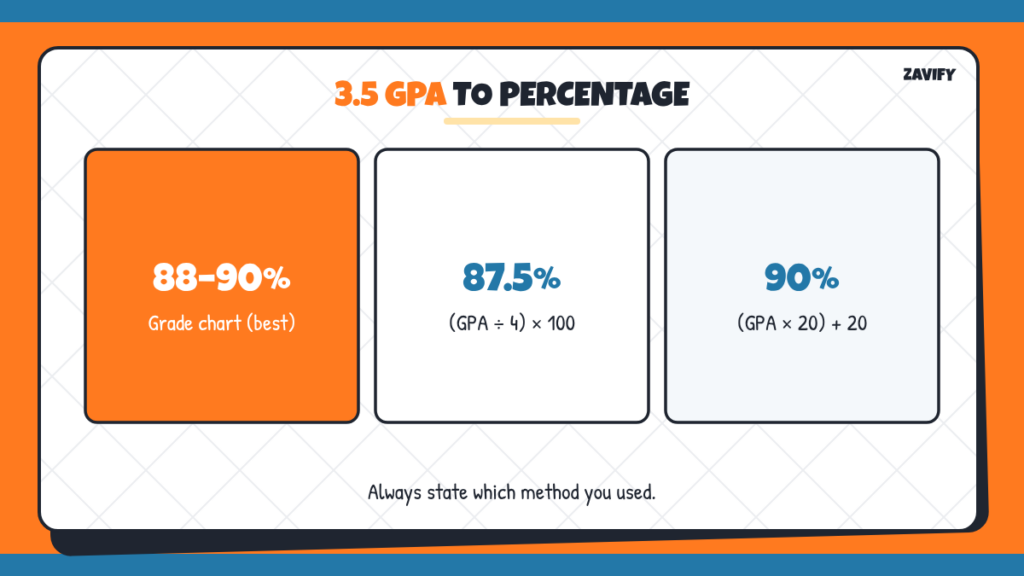
| Method | Formula | Result for 3.5 GPA |
|---|---|---|
| Grade chart (most common) | Match GPA to letter-grade ranges | About 88–90% |
| Simple proportion | (GPA ÷ 4) × 100 | 87.5% |
| Linear scale used by some converters | (GPA × 20) + 20 | 90% |
If a form asks for a percentage, check whether the institution gives its own formula. If not, the chart method is the most widely understood, and it is wise to add a note such as “3.5/4.0 GPA, approximately 88–90%.” Our study abroad GPA converter can help with estimates.
GPA to Percentage Chart
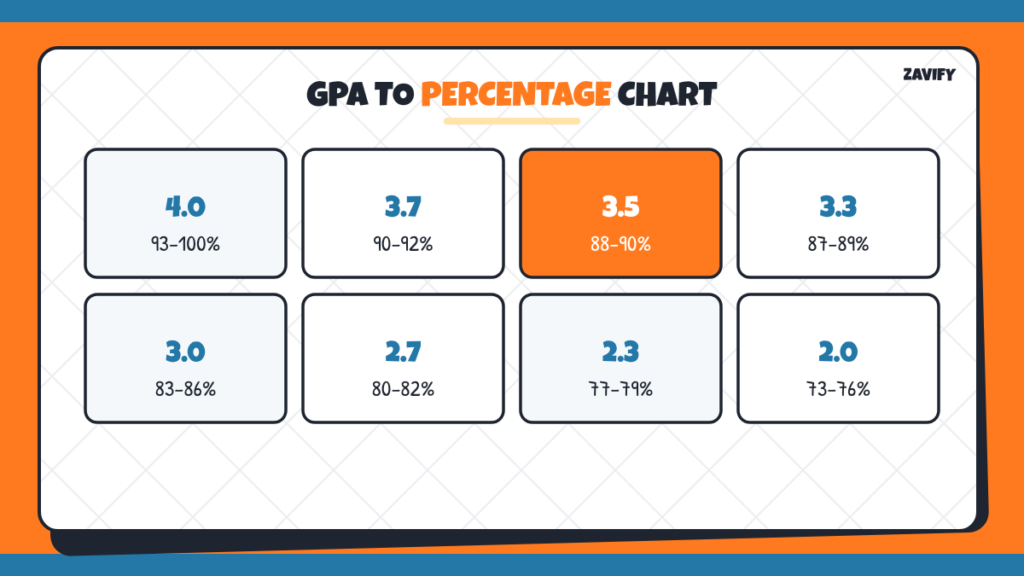
| GPA | Letter Grade | Approx. Percentage |
|---|---|---|
| 4.0 | A | 93–100% |
| 3.7 | A- | 90–92% |
| 3.5 | B+/A- | 88–90% |
| 3.3 | B+ | 87–89% |
| 3.0 | B | 83–86% |
| 2.7 | B- | 80–82% |
| 2.3 | C+ | 77–79% |
| 2.0 | C | 73–76% |
| 1.0 | D | 65–66% |
This chart follows the common US conversion scale; your school may use slightly different cutoffs. See our full letter grade scale for details.
Is a 3.5 GPA Good?
Yes. It is above the national average for US high school graduates (about 3.1) and is considered a strong GPA in college. It typically qualifies you for honors programs, many merit scholarships, competitive internships and most graduate programs.
At highly selective universities, admitted students often have higher unweighted GPAs, so it is competitive but not outstanding there. Strong essays, challenging courses and an upward trend make a big difference.
For International Students
If you studied in a system that uses percentages or a 10-point CGPA, US universities usually ask for your original grades and may require an evaluation from a credential service such as World Education Services (WES). Do not convert your grades yourself unless the application asks you to. For the reverse direction, our guides on CGPA to percentage and GPA to CGPA explain the common methods.
Example: Reporting Your GPA as a Percentage
Alex graduates from a US college with a GPA of 3.5 and applies for a job abroad that asks for a percentage. The employer gives no formula. Alex writes “3.5/4.0 GPA (approximately 88–90%, based on the standard US grade scale).” This is honest, clear and lets the employer check the method.
How to Raise Your GPA Above 3.5
- Focus on classes where you are closest to the next letter grade.
- Use our required GPA calculator to set a realistic target.
- Plan a balanced course load each semester.
- Use office hours and study groups regularly.
Why GPA Conversions Differ
A GPA is built from letter grades, and each letter covers a range of percentages. An A- might mean 90%, 91% or 92%. When you average several letters into a GPA, the exact percentages behind them are lost. That is why converting back from GPA to percentage can only ever be an estimate. Formulas like (GPA ÷ 4) × 100 are popular because they are simple, but they assume a straight line between 0 and 4, which is not how US letter grades work: an F covers everything from 0 to about 60–65%.
Chart-based conversions are closer to reality because they use the actual letter-grade ranges. They also match how most US teachers assign grades, which is why we recommend them for everyday use.
Scholarships and Honors
Many competitive scholarships, honors colleges and leadership programs set their minimum at 3.5. If you are just below it, a strong semester can make a difference, especially early in college. If you are above it, keep a buffer: one difficult term can push a 3.52 below the line. Our cumulative GPA calculator helps you plan.
What Grades Add Up to This GPA?
This GPA usually means a mix of As and Bs. For example, across ten equal-credit classes, five As and five Bs give (5 × 4 + 5 × 3) ÷ 10 = 3.5. Three A grades, four A- grades and three B grades give (12 + 14.8 + 9) ÷ 10 = 3.58. Small changes in a few classes move your GPA noticeably.
Reporting It on Applications
When an application asks for your GPA, enter the number on your transcript with its scale, such as 3.5 / 4.0. Only convert to a percentage if the form specifically asks, and if it gives a formula, use that formula even if it differs from the chart. Clear labeling prevents misunderstandings and shows attention to detail.
Common Mistakes
- Presenting 87.5% as an “official” conversion.
- Mixing weighted and unweighted GPAs.
- Converting without saying which method you used.
- Rounding a 3.45 up.
Frequently Asked Questions
What percentage is a 3.5 GPA?
About 88–90% on the standard US chart, or 87.5% using the simple formula.
What letter grade is a 3.5 GPA?
Between a B+ and an A-.
Is a 3.5 GPA good for college admissions?
Yes, it is above average and competitive at many colleges, though the most selective schools often expect higher.
Is it good in college?
Yes. It usually meets cutoffs for honors, scholarships, internships and graduate programs.
What is a 3.5 GPA on a 10-point scale?
Roughly 8.5–8.75 using a simple proportion, but universities often use their own conversion rules.
Is it the same as 87.5%?
Only under the simple proportional formula; most charts differ. Most US charts place it closer to 88–90%.
Conclusion
A 3.5 GPA is a strong result, roughly 88–90% on the common US scale. Because methods differ, always state how you converted it.
For more conversions, see 3.8 GPA to percentage and our guide to a 3.0 GPA.