Introduction
Cybersecurity is one of the most hands-on fields in computer science. Employers want to see that you can configure, monitor and defend real systems, not just pass exams. A strong project is the fastest way to prove that.
This guide lists 15 cybersecurity project ideas for students, grouped from beginner to final year. Each one includes what it does, the skills you learn, the tools you need and how long it takes. Every project is defensive or runs in a lab you control, because that is the only safe and legal way to practise.
- Beginner projects teach the basics: passwords, encryption and networks.
- Intermediate projects add monitoring, web security and automation.
- Final-year projects build a complete defensive system with testing and a report.
Table of Contents
What Makes Good Cybersecurity Project Ideas?
The best cybersecurity project ideas solve a defensive problem that organisations really face, use a lab you own, and end with clear evidence: logs, alerts, charts or a written report. Graders and hiring managers look for three things: that you understood the threat, that your solution works, and that you can explain its limits.
- A real threat: weak passwords, phishing, misconfigured servers, vulnerable web apps.
- Your own lab: virtual machines or containers on your computer or a free cloud tier.
- Measurable results: what was detected, blocked or fixed.
- Clear documentation: setup steps, results and lessons learned.
Safety and Legal Rules First
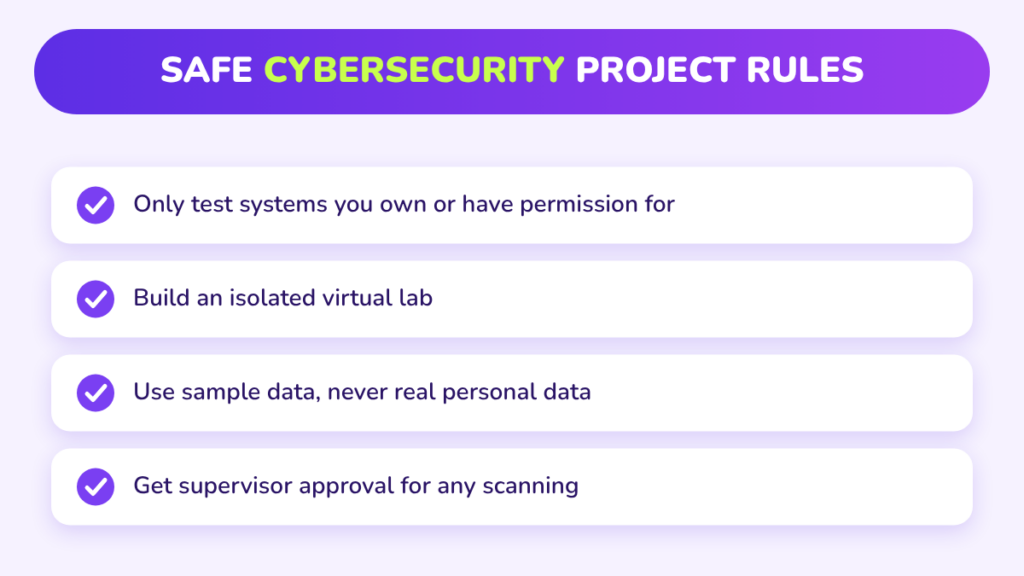
Before choosing between cybersecurity project ideas, learn the rules. Testing systems you do not own or have written permission to test can be illegal, even if you mean no harm. In the US, unauthorised access is covered by federal law, and colleges have their own acceptable-use policies.
- Only test systems you own or have written permission to test.
- Build your lab with virtual machines and intentionally vulnerable practice apps.
- Never use real people’s data; create sample data instead.
- Keep the lab isolated from your college or home network.
- Get your supervisor’s approval for anything involving scanning or attack simulation.
How to Choose Between Cybersecurity Project Ideas
| Level | Who it suits | Typical time | What you build |
|---|---|---|---|
| Beginner | First and second year, basic programming | 1–3 weeks | A small tool or a configured lab |
| Intermediate | Students who know networking and Linux | 4–8 weeks | A monitoring, scanning or hardening project with results |
| Final year | Capstone or thesis students, often in teams | 3–6 months | A complete defensive system with testing, evaluation and a report |
When you compare cybersecurity project ideas, match the project to your deadline and your strongest skill: programming, networking or systems administration. If the project carries many credits, our guide to how projects affect your GPA shows how much it can move your final grade.
Beginner Cybersecurity Project Ideas
1. Password strength checker. Rate passwords by length, character variety and common patterns, and explain why each one is weak or strong. Skills: password policy, basic string handling. Tools: Python. Time: 1 week.
2. File encryption tool. Encrypt and decrypt files with a password using a modern library rather than writing your own cipher. Skills: symmetric encryption, key handling. Tools: Python with a standard cryptography library. Time: 1–2 weeks.
3. Home lab network map. Set up two or three virtual machines and document every device, port and service in your lab. Skills: networking basics, ports and services. Tools: VirtualBox or similar, Nmap used only inside your lab. Time: 2 weeks.
4. Phishing awareness quiz. A web quiz that shows sample emails and teaches users how to spot warning signs. Skills: social engineering awareness, simple web development. Tools: HTML, JavaScript, made-up sample emails. Time: 1–2 weeks.
5. Log file analyzer. Read a web server or login log and flag repeated failed logins and unusual times. Skills: log analysis, pattern matching. Tools: Python, sample logs from your own lab. Time: 2 weeks.
Intermediate Cybersecurity Project Ideas
6. Intrusion detection in a home lab. Install an open-source intrusion detection system, generate test traffic in your lab and tune the rules to reduce false alarms. Skills: network monitoring, rule tuning. Tools: Suricata or Snort, virtual machines. Time: 4–6 weeks.
7. Secure a vulnerable web app. Use an intentionally vulnerable practice application, find its weaknesses with guided exercises, then fix them in the code. Skills: web security basics such as injection and broken access control. Tools: OWASP Juice Shop or DVWA in your own lab. Time: 5–6 weeks.
8. Server hardening checklist and script. Harden a fresh Linux server against a public benchmark and write a script that checks each setting. Skills: Linux administration, configuration management. Tools: Ubuntu or Debian virtual machine, Bash or Python. Time: 4 weeks.
9. Email security checker. Check whether a domain you control has SPF, DKIM and DMARC records set correctly and explain what each one does. Skills: DNS, email authentication. Tools: Python, DNS lookup libraries, your own test domain. Time: 3–4 weeks.
10. Two-factor authentication demo app. Add time-based one-time passwords to a small login system. Skills: authentication design, secure sessions. Tools: Python or Node.js web framework, an authenticator app. Time: 4–5 weeks.
Final-Year Cybersecurity Project Ideas
11. Security monitoring dashboard (mini SIEM). Collect logs from several lab machines, detect suspicious patterns and show alerts on a dashboard. Skills: log pipelines, detection rules, visualization. Tools: Elastic Stack or Wazuh, virtual machines. Time: 3–4 months.
12. Phishing email classifier. Train a machine learning model on public phishing datasets and evaluate how well it separates phishing from normal mail. Skills: machine learning, feature engineering, evaluation. Tools: Python, scikit-learn, public phishing datasets. Time: 3–5 months.
13. Secure file-sharing system. Build a small app where files are encrypted before upload and only authorised users can decrypt them. Skills: encryption, key management, access control. Tools: A web framework, a cryptography library, cloud storage free tier. Time: 4–6 months.
14. Vulnerability management workflow. Scan your own lab on a schedule, rank findings by risk and track each fix until it is closed. Skills: vulnerability scanning, risk scoring, reporting. Tools: OpenVAS, a database, a simple web interface. Time: 3–5 months.
15. Security awareness training platform. Short lessons, quizzes and simulated phishing exercises for volunteers who have agreed to take part, with progress tracking. Skills: security awareness, learning design, ethics. Tools: A web framework, a database, consent forms. Time: 4–6 months.
Tools You Need for These Cybersecurity Project Ideas
| Need | Common free options |
|---|---|
| Virtual lab | VirtualBox, VMware Workstation Player, Docker |
| Operating systems | Ubuntu, Debian, Kali Linux for lab testing |
| Network monitoring | Wireshark, Suricata, Zeek |
| Practice targets | OWASP Juice Shop, DVWA |
| Logging and alerts | Wazuh, Elastic Stack |
| Programming | Python, Bash |
Most cybersecurity project ideas on this list can be built on a laptop with 8 to 16 GB of memory. The OWASP Foundation keeps a list of common web risks in its OWASP Top 10, which is a good reference for web projects.
How to Plan Cybersecurity Projects for Students
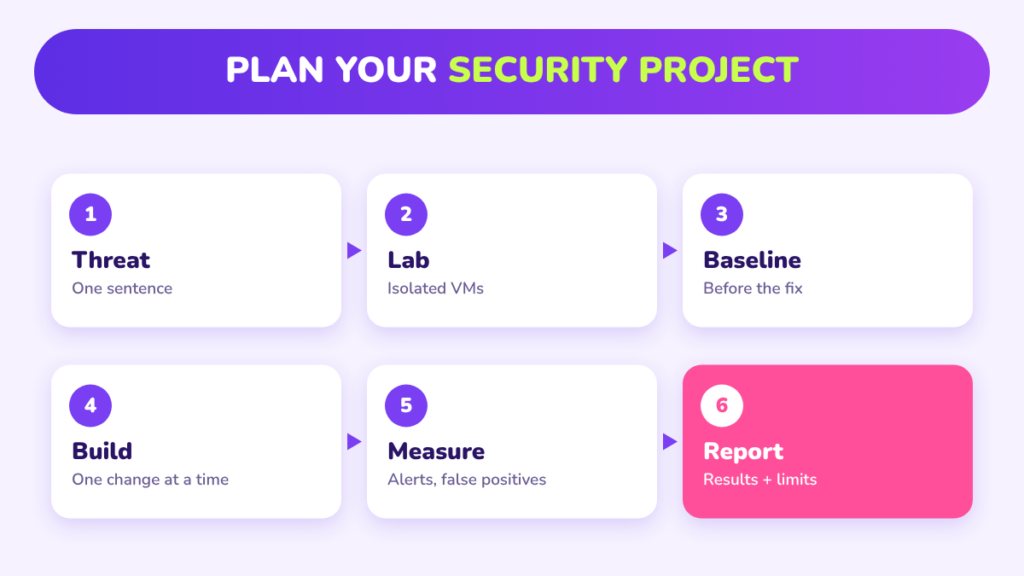
- 1. State the threat in one sentence.
- 2. Build and isolate the lab before writing any code.
- 3. Create a baseline: what happens before your fix or tool.
- 4. Implement and test one change at a time.
- 5. Measure results: alerts, blocked attempts, false positives.
- 6. Write up setup, results, limits and next steps.
For cybersecurity final year projects, framing your work around the NIST Cybersecurity Framework (identify, protect, detect, respond, recover) shows examiners you understand how organisations manage security.
Example: Cybersecurity Final Year Projects in 6 Weeks
Cybersecurity final year projects work best with a weekly plan. Aisha, a third-year student, chooses the intrusion detection project. Week 1: set up three virtual machines on an isolated network. Week 2: install the intrusion detection system with default rules. Week 3: generate normal and test traffic inside the lab and record the alerts. Week 4: tune the rules to cut false alarms. Week 5: compare detection results before and after tuning. Week 6: write the report and record a short demo. Simple, finished and well documented beats ambitious and half-built.
How Projects Help Your Grades and Career
Good cybersecurity projects for students pay off twice. Security employers often ask candidates to walk through a lab project in interviews. A well-documented project on GitHub, with a clear README, can matter as much as a certificate for an entry-level role. Projects also carry real weight in your GPA; check the impact with our college GPA calculator. For more ideas, see our AI project ideas and final-year project ideas.
Common Mistakes
- Testing websites or networks you do not own, which turns cybersecurity project ideas into a legal problem.
- Skipping documentation until the last week.
- Copying a tutorial without extending it.
- Reporting what worked but not what failed.
- Using real personal data instead of sample data.
Frequently Asked Questions
What are good cybersecurity project ideas for beginners?
A password strength checker, a file encryption tool or a log analyzer. Each takes one or two weeks and needs only basic Python.
Which cybersecurity final year projects are best?
Complete defensive systems such as a mini SIEM, a phishing classifier or a secure file-sharing app, with testing and a written evaluation.
Is it legal to practise hacking for a project?
Only on systems you own or have written permission to test, such as your own virtual lab or intentionally vulnerable practice apps.
Do I need a powerful computer?
Not usually. 8 to 16 GB of memory runs a small virtual lab.
Which programming language is best for security projects?
Python is the most common choice, with Bash for scripting on Linux.
Should I get a certification as well?
It can help, but a strong project you can explain often matters just as much for entry-level roles.
Conclusion
The best cybersecurity project ideas defend a real system, run in a lab you control and end with clear evidence of what worked. Start at your level, follow the safety rules and document everything.
Pick one project from this list and plan it week by week. For related guides, read AI project ideas for students and mini project ideas.