Introduction
Knowing how to calculate percentage of marks is one of the most useful skills for any student in India. Board results, college admission forms, scholarship portals, and job applications all ask for your score as a percentage, even when your marksheet only shows raw marks.
The good news is that once you know the formula calculating percentage of marks is easy. In this guide you will learn exactly how to do this, see worked examples for different situations and avoid the mistakes that lead to wrong results on important forms.
- Percentage shows your score out of 100.
- It makes results from different exams easy to compare.
- Most admission and job forms ask for it in a fixed format.
Table of Contents
What Is Percentage of Marks?
The percentage of marks is your total marks obtained, expressed as a share of 100. The word “percent” literally means “per hundred”. So if you score 82 per cent, it means you earned 82 marks for every 100 marks available.
Because every exam can have a different maximum, such as 500, 600, or 1100, raw marks alone are hard to compare. Converting them into a percentage puts every result on the same scale.
- Marks obtained: the total you actually scored.
- Maximum marks: the total marks the exam was out of.
- Percentage: marks obtained divided by maximum marks, multiplied by 100.
How to Calculate Percentage of Marks: The Formula
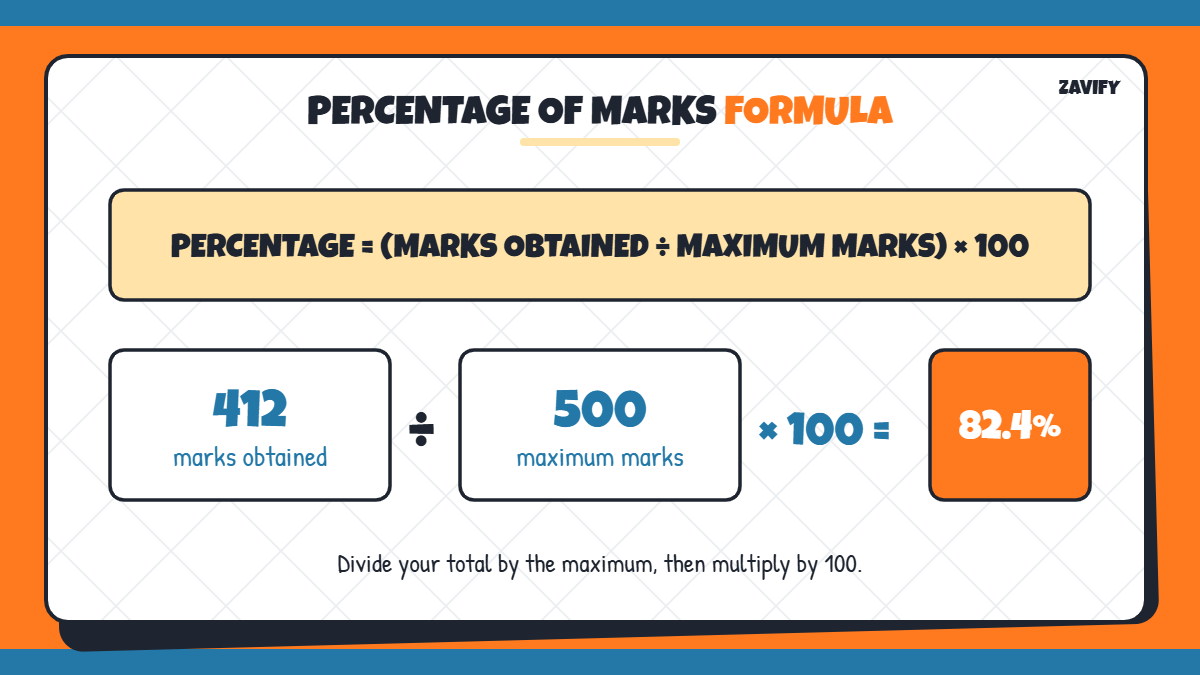
Whether you use a marks percentage calculator or work it out by hand, here is how to calculate percentage of marks with one basic formula:
Percentage = (Marks Obtained ÷ Maximum Marks) × 100
Here is how the formula works for a few common exam totals:
| Marks Obtained | Maximum Marks | Calculation | Percentage |
|---|---|---|---|
| 412 | 500 | (412 ÷ 500) × 100 | 82.4% |
| 398 | 500 | (398 ÷ 500) × 100 | 79.6% |
| 450 | 600 | (450 ÷ 600) × 100 | 75% |
| 205 | 230 | (205 ÷ 230) × 100 | 89.13% |
Now let us walk through how to calculate percentage of marks step by step so you get the right answer every time.
1. Collect Your Marksheet
The first step in how to calculate percentage of marks is to collect your official marksheet or result printout. Do not rely on memory or screenshots of partial results, because a single wrong digit changes the final percentage.
- Use the latest official marksheet.
- Check the subject list is complete.
- Note any grace marks or revised marks.
2. Note the Marks Obtained in Each Subject
Write down the marks you scored in every subject, including theory and practical marks if they are shown separately. For example, a student might have scored 78, 85, 69, 92, and 74 in five subjects.
- Add theory and practical marks for each subject.
- Include internal assessment marks if they count toward the total.
3. Find the Maximum Marks for Each Subject
Next, check how many marks each subject was out of. Many boards use 100 marks per subject, but some papers are out of 50, 80, or 150. This step matters because the percentage depends on the total maximum, not on the number of subjects.
4. Add Up Your Total Marks Obtained
Add the marks from every subject to get your grand total. Using the example above: 78 + 85 + 69 + 92 + 74 = 398.
5. Add Up the Total Maximum Marks
Now add the maximum marks for all the subjects. Five subjects of 100 marks each give a total maximum of 500. Many students skip this part when learning how to calculate percentage of marks, but it decides the final answer.
6. Divide Marks Obtained by Maximum Marks
Divide your total by the maximum: 398 ÷ 500 = 0.796. This decimal is your score as a fraction of the full marks.
7. Multiply the Result by 100
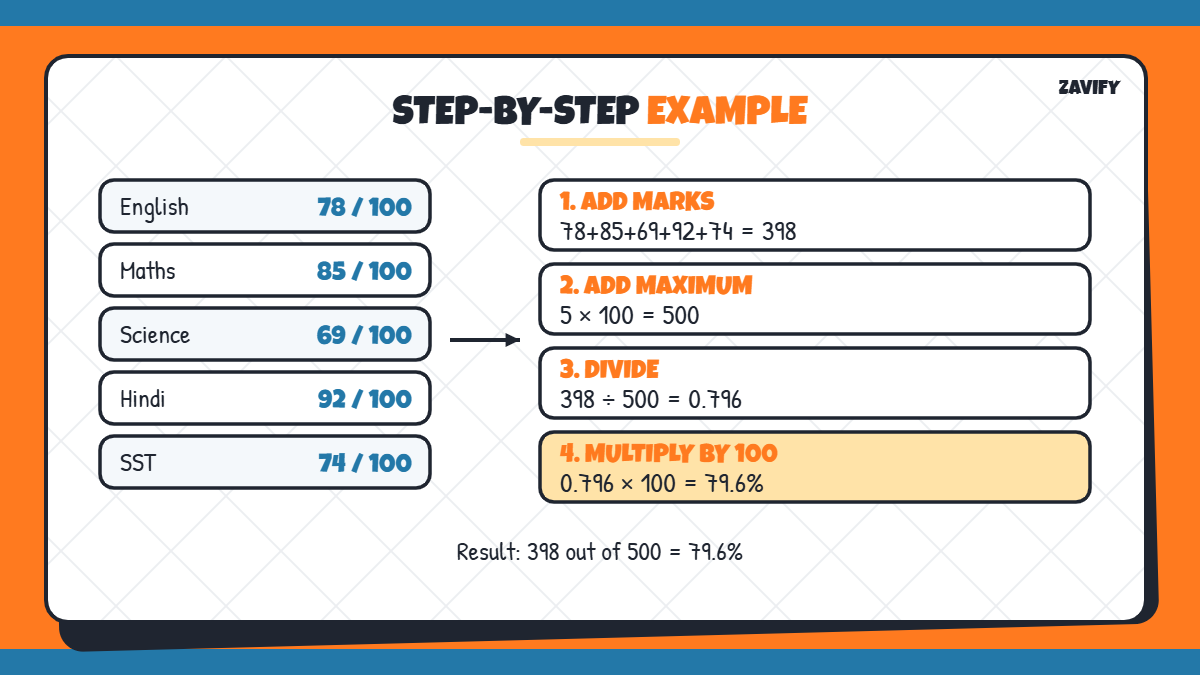
Multiply the decimal by 100 to turn it into a percentage: 0.796 × 100 = 79.6%. That is your overall percentage of marks.
- Quick method: divide by the maximum, then move the decimal point two places to the right.
- On a phone calculator, type 398 ÷ 500 and press the % key if available.
8. Handle Subjects With Different Maximum Marks
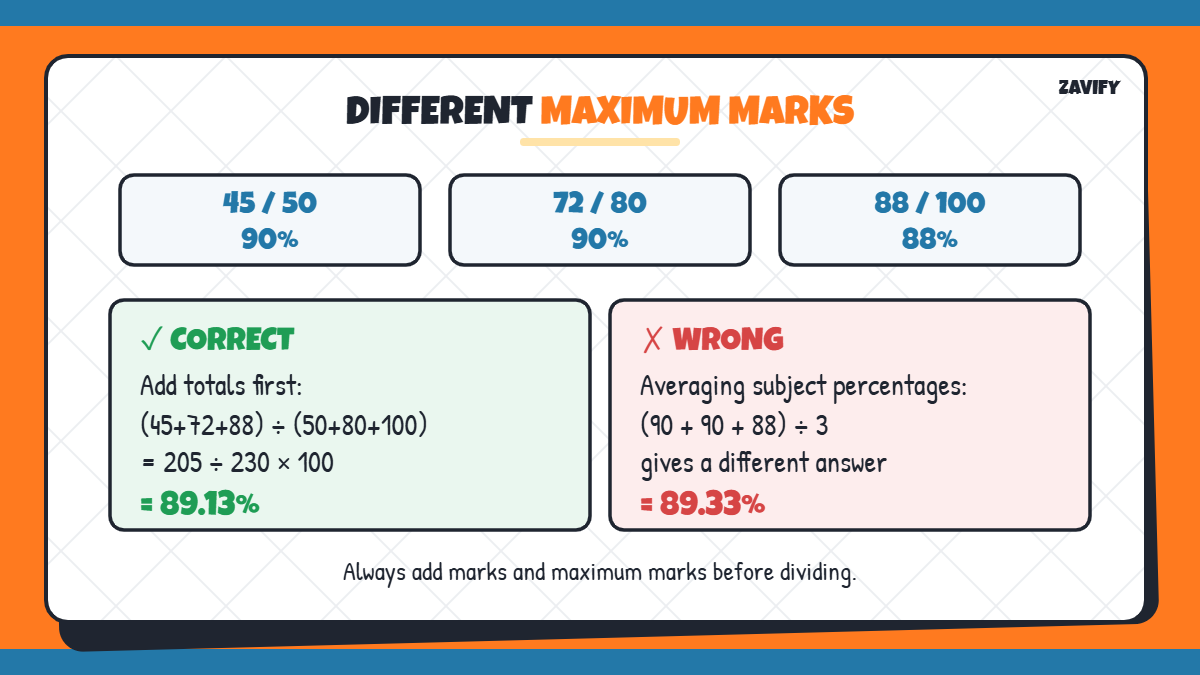
When subjects have different maximum marks, the rule for how to calculate percentage of marks stays the same: add the totals first and then divide. Do not average the individual subject percentages, because that gives a different answer.
Example: a student scores 45 out of 50, 72 out of 80, and 88 out of 100. The correct method is (45 + 72 + 88) ÷ (50 + 80 + 100) × 100 = 205 ÷ 230 × 100 = 89.13%. Averaging the three subject percentages (90%, 90%, and 88%) would give 89.33%, which is wrong for most official forms.
9. Round and Record Your Percentage Correctly
Finally, round the result the way the form asks. Most forms accept two decimal places, so 82.456% becomes 82.46%. If a form asks for a whole number, follow its instruction instead of rounding up on your own.
- Keep two decimal places unless told otherwise.
- Never round up to cross an eligibility cut-off.
- Write the same figure on every form you submit.
How to Find Percentage of Marks for a Target Score
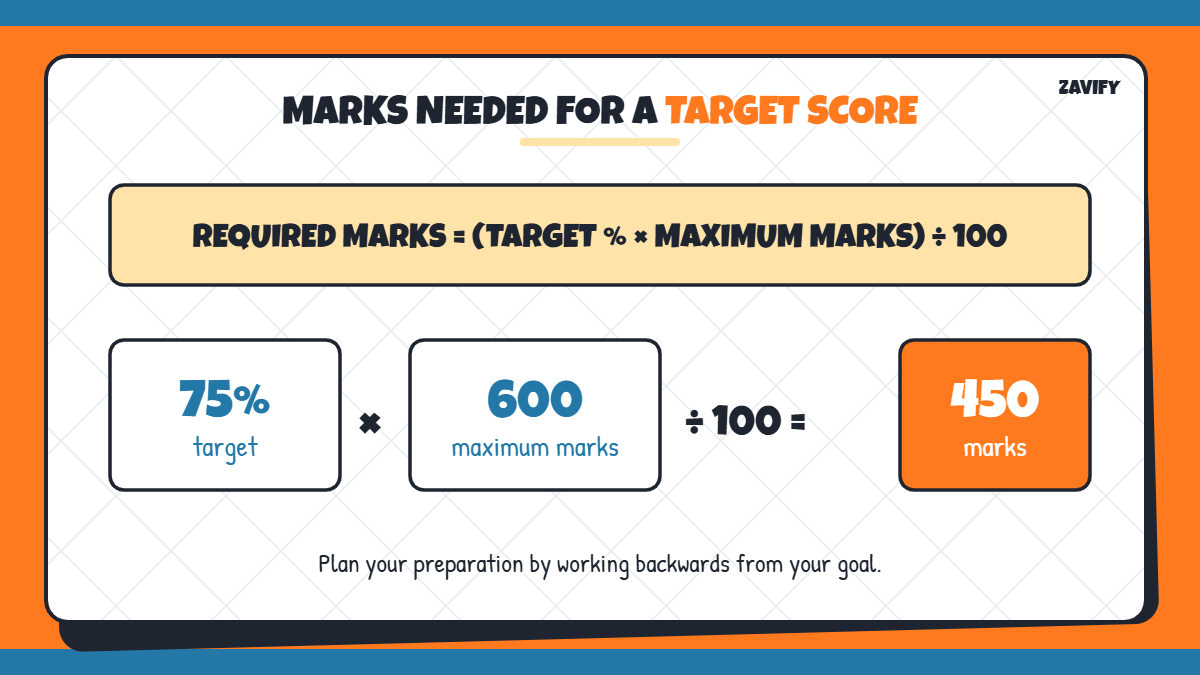
Once you know how to calculate percentage of marks, you can also run the formula in reverse to find how many marks you need. The formula is: Required Marks = (Target Percentage × Maximum Marks) ÷ 100.
For example, if you want 75% in an exam out of 600, you need (75 × 600) ÷ 100 = 450 marks. This is useful for planning your preparation before board exams or entrance tests.
Percentage of Marks vs CGPA
Many universities now report results as CGPA or SGPA instead of marks. In that case, you cannot use the marks formula directly. You need the conversion rule set by your board or university.
- If your result is in CGPA, use our CGPA to percentage converter.
- If you need to go the other way, try the percentage to CGPA calculator.
- For semester results, see SGPA to percentage.
Common Mistakes When Calculating Percentage of Marks
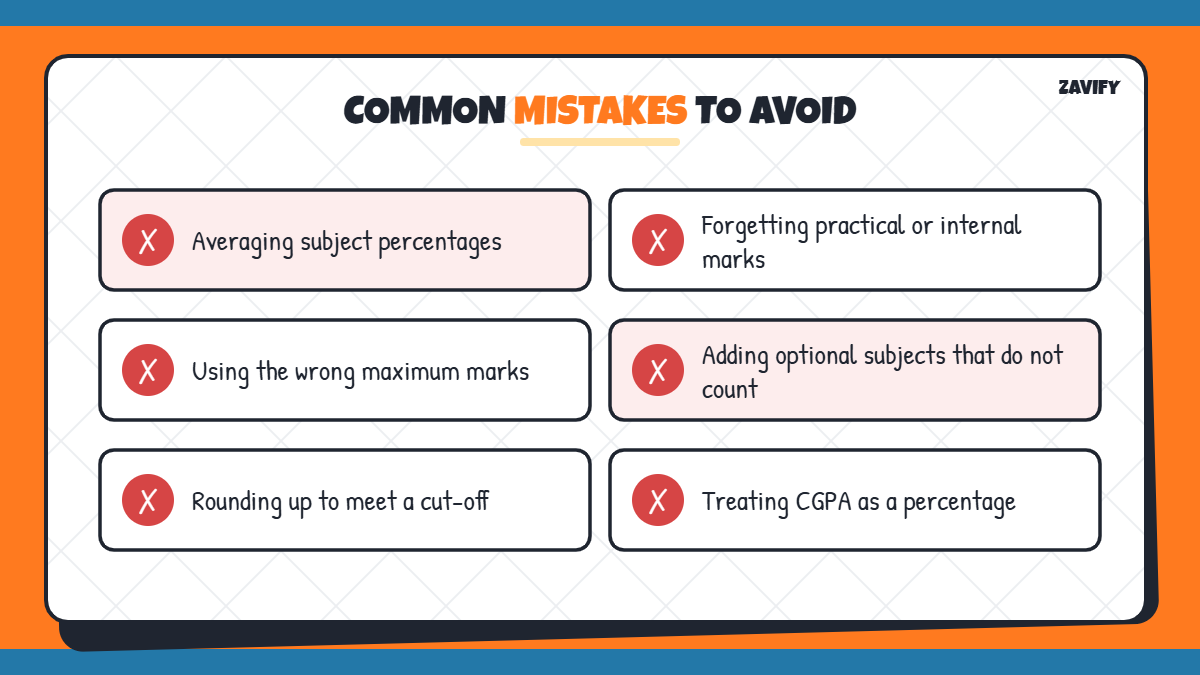
Even when you know how to calculate percentage of marks, small errors can change your final result. Watch out for these common mistakes:
- Averaging subject percentages when maximum marks differ.
- Forgetting practical or internal marks in the total.
- Using the wrong maximum marks, such as 500 instead of 600.
- Including additional or optional subjects that do not count.
- Rounding up to meet an eligibility requirement.
- Treating CGPA as if it were a percentage.
Frequently Asked Questions
What is the formula to calculate percentage of marks?
The simplest answer to how to calculate percentage of marks is this formula: (Marks Obtained ÷ Maximum Marks) × 100. For example, 412 marks out of 500 equals 82.4%.
How to calculate percentage of marks for 6 subjects?
Add the marks of all six subjects, add their maximum marks (usually 600), divide the first total by the second, and multiply by 100.
Should I include additional subjects in my percentage?
Only if your board or the form asks for it. Some admissions use the best five subjects, so always read the eligibility instructions carefully.
Is a marks percentage calculator accurate?
Yes, as long as you enter the correct total marks and maximum marks. The calculator only applies the same formula, so accuracy depends on your inputs.
Can I convert CGPA to percentage using this formula?
No. CGPA uses a grade point scale, so you need your university’s official conversion formula instead of the marks formula.
Conclusion
Learning how to calculate percentage of marks takes only a few minutes, but it saves you from costly errors on admission forms, scholarship applications, and job portals. Add your marks, add the maximum marks, divide, and multiply by 100.
Remember to handle different maximum marks correctly, round only as instructed, and use the official conversion rule if your result is in CGPA or SGPA. With these steps, you can find your percentage confidently every time.