Introduction
If you have ever received a salary slip, fixed deposit statement or a freelance payment in India, you must have come across the word TDS. TDS stands for Tax Deducted at Source. It is a way of collecting income tax at the time income is paid rather than at the end of the year.
Understanding TDS helps you read your salary slip, avoid penalties if you make payments, and claim refunds when too much tax is cut. This guide explains the TDS full form, how it works, and what changed from 1 April 2026.
- TDS stands for Tax Deducted at Source.
- The payer deducts tax before paying you.
- The deducted amount is credited against your final tax.
Table of Contents
What Is the TDS Full Form?
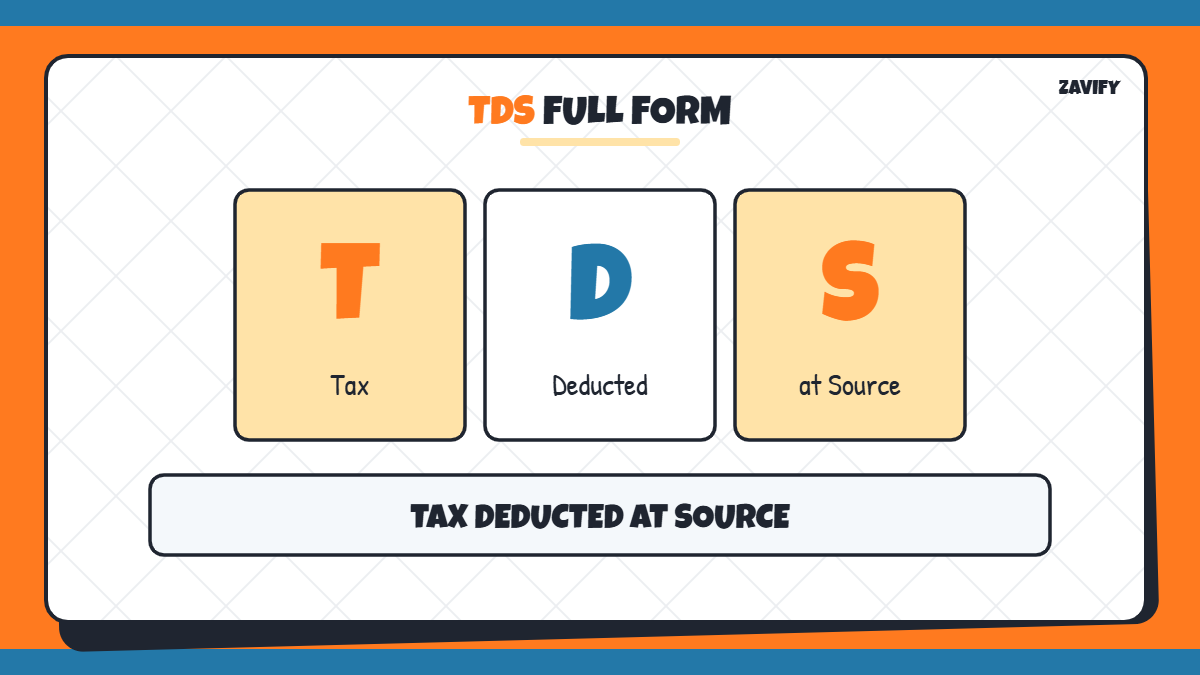
The TDS full form is Tax Deducted at Source. “Source” refers to the point where income is generated, such as your employer or bank. Instead of you paying all your tax later, the payer deducts a part at the source and deposits it with the government in your name.
When people search for the TDS full form in income tax, they mean this same system under Indian income tax law. It is different from GST, which is a tax on goods and services.
- T – Tax
- D – Deducted
- S – Source
How Does TDS Work?
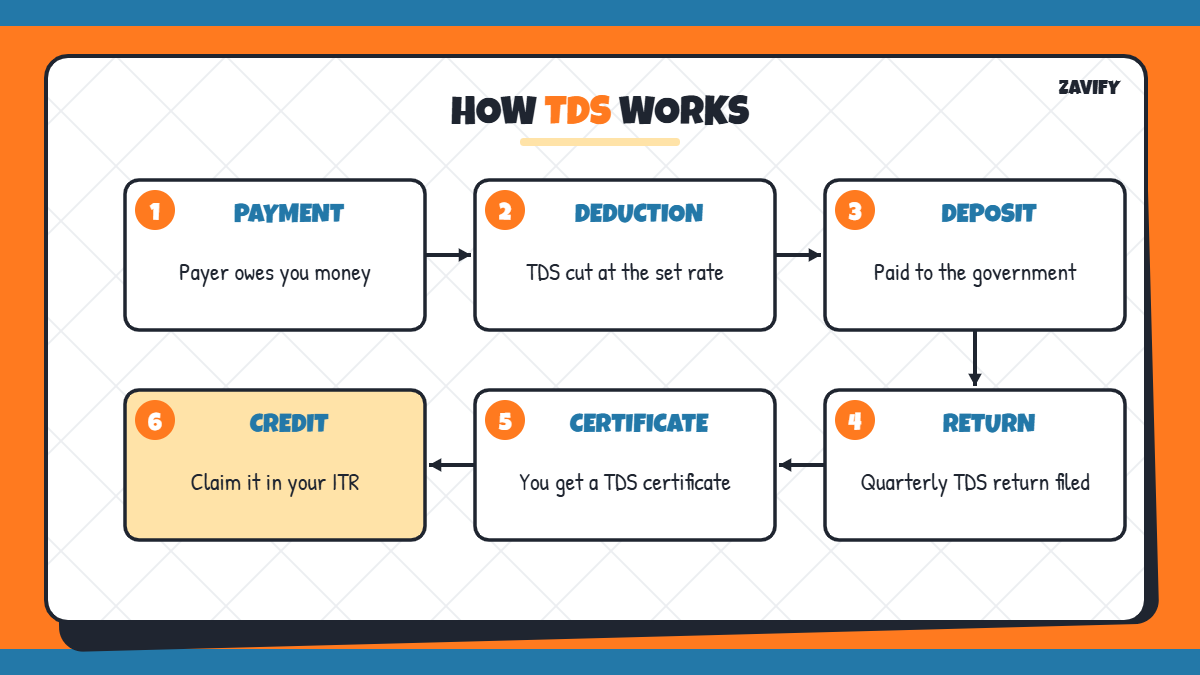
Now that you know the TDS full form, here is the basic flow of how TDS works in practice:
| Stage | What Happens |
|---|---|
| Payment due | A payer (employer, bank, company) owes you money |
| Deduction | The payer cuts TDS at the prescribed rate |
| Deposit | The payer deposits the TDS with the government |
| Return | The payer files a quarterly TDS return |
| Certificate | You receive a TDS certificate showing the amount |
| Credit | You claim the TDS while filing your income tax return |
Let us now go through the ten points that make TDS easy to understand.
1. TDS Full Form and Its Purpose
The TDS full form, Tax Deducted at Source, shows its main goal: collect tax early and regularly. This gives the government a steady flow of revenue and makes tax evasion harder, because income is recorded as soon as it is paid.
2. Who Deducts TDS?
The person or organisation making the payment is called the deductor. The person receiving the payment is the deductee. Employers, banks, companies, and many businesses act as deductors. Every deductor must have a TAN (Tax Deduction and Collection Account Number).
3. The New Law From 1 April 2026
From 1 April 2026, the Income-tax Act, 1961 was replaced by the Income-tax Act, 2025. The TDS full form and concept remain the same, but the section numbers changed. Salary TDS now falls under section 392, and most other TDS payments are grouped under section 393.
- Old sections such as 194C, 194J and 194I are now part of section 393.
- The term “tax year” replaces “previous year” and “assessment year”.
- Most TDS rates stayed broadly similar.
4. Common Types of Payments Covered
Anyone learning the TDS full form should also know which payments usually attract TDS:
- Salary paid by an employer
- Interest on bank fixed deposits
- Rent above the prescribed limit
- Professional and technical fees
- Payments to contractors
- Commission and brokerage
- Purchase of property above ₹50 lakh
- Dividends from companies
5. Common TDS Rates
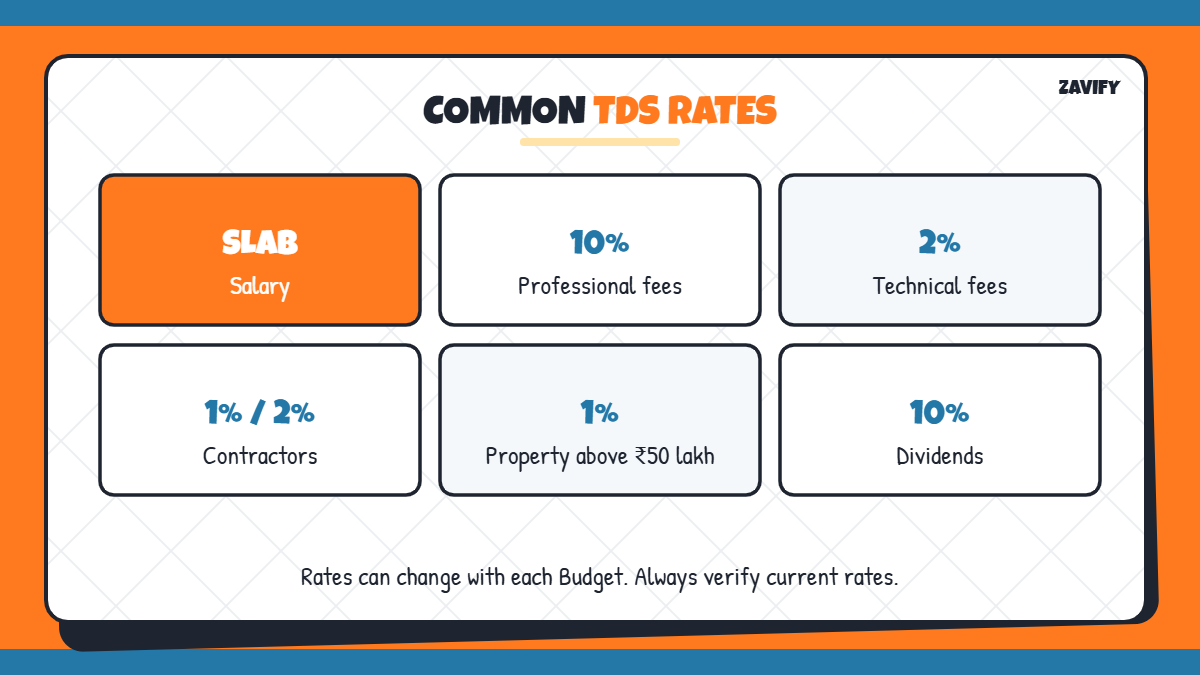
Rates depend on the type of payment. Here are some commonly reported rates for residents from April 2026:
- Salary: as per your income tax slab
- Professional fees: 10%
- Technical fees: 2%
- Contractor payments: 1% (individual/HUF) or 2% (others)
- Property purchase above ₹50 lakh: 1%
- Dividends: 10%
Thresholds and rates can change with each Budget, so always verify current rates on the Income Tax Department website.
6. Higher TDS Without PAN
If the deductee does not provide a valid PAN, TDS is generally deducted at a higher rate, often 20%. Sharing your PAN with your employer and bank keeps the deduction at the normal rate.
7. TDS Deposit Due Dates
Deductors must deposit TDS with the government by the 7th of the following month. For deductions made in March, the deadline is usually 30 April. Late deposit attracts interest and penalties.
8. TDS Returns and Certificates
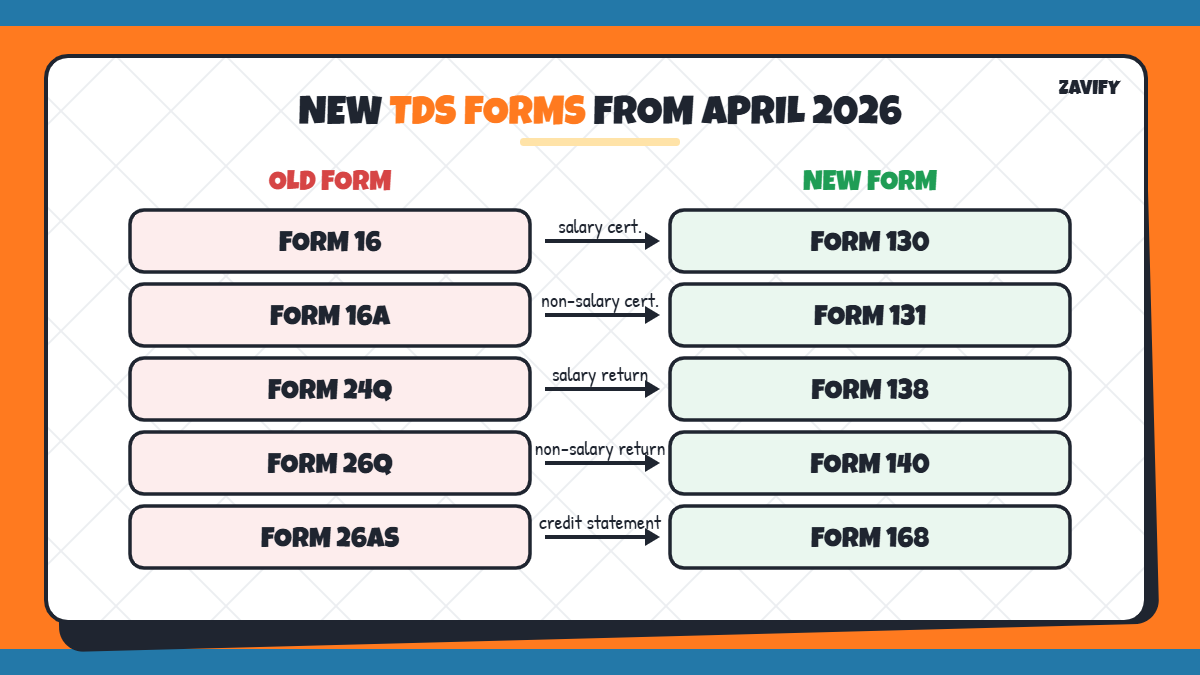
Deductors file quarterly TDS returns and issue certificates to deductees. Under the new rules, the familiar forms were renumbered:
- Form 16 (salary certificate) is now Form 130.
- Form 16A (non-salary certificate) is now Form 131.
- Form 24Q (salary TDS return) is now Form 138.
- Form 26Q (non-salary TDS return) is now Form 140.
- Form 26AS (tax credit statement) is now Form 168.
9. How to Check Your TDS
Once you understand the TDS full form, you should check your TDS credits every year. Log in to the Income Tax e-filing portal and view your tax credit statement and Annual Information Statement (AIS). Make sure every deduction shown on your certificates appears there.
10. How to Claim a TDS Refund
If the TDS cut from your income is more than your actual tax, you can claim the extra amount back. File your income tax return on time, report all income, and claim the TDS credit. The excess is refunded to your bank account after processing.
TDS vs TCS
TDS is tax deducted by the payer when making a payment. TCS, or Tax Collected at Source, is tax collected by the seller when receiving payment for certain goods, such as some high-value purchases. Both share a similar idea, but the TDS full form points to deduction while TCS points to collection.
Common Mistakes Related to TDS
Even after learning the TDS full form, many people make errors that cost them money:
- Not sharing PAN, leading to higher deduction.
- Ignoring TDS shown in the tax credit statement.
- Missing deposit or return deadlines as a deductor.
- Forgetting to claim TDS while filing the return.
- Not submitting a nil TDS declaration when eligible.
Frequently Asked Questions
What is the TDS full form?
The TDS full form is Tax Deducted at Source. It means tax is deducted by the payer at the time of making a payment.
What is the TDS full form in income tax?
In income tax, TDS stands for Tax Deducted at Source, a system under which part of your income tax is deducted when you earn income.
Is TDS the final tax?
No. TDS is an advance collection. Your final tax is calculated when you file your income tax return, and TDS is adjusted against it.
Can I get TDS back?
Yes. If your total TDS is more than your tax liability, you can claim a refund by filing your income tax return.
Which section covers TDS from April 2026?
Under the Income-tax Act, 2025, salary TDS is covered by section 392 and most other TDS payments by section 393.
Conclusion
The TDS full form is Tax Deducted at Source, a system that collects tax at the time income is paid. It applies to salary, interest, rent, fees and many other payments, and it is credited against your final tax.
Now that you know the TDS full form, how it works, and the new forms from April 2026, check your tax credit statement regularly and claim every rupee of TDS when you file your return. For more money basics, read our guide on building an emergency fund.