Introduction
If you want to become a doctor in India, the first exam you will hear about is NEET. The NEET full form is National Eligibility cum Entrance Test. It is the single national entrance exam for MBBS, BDS, AYUSH and several other medical courses across India.
Every year, more than 20 lakh students register for NEET UG, which makes it one of the largest entrance exams in the world. In this guide, you will learn the NEET full form, what the exam involves, who can apply, and how to prepare with a clear plan.
- NEET stands for National Eligibility cum Entrance Test.
- It is conducted by the National Testing Agency (NTA).
- A NEET score is required for admission to MBBS and BDS in India.
What Is the NEET Full Form?
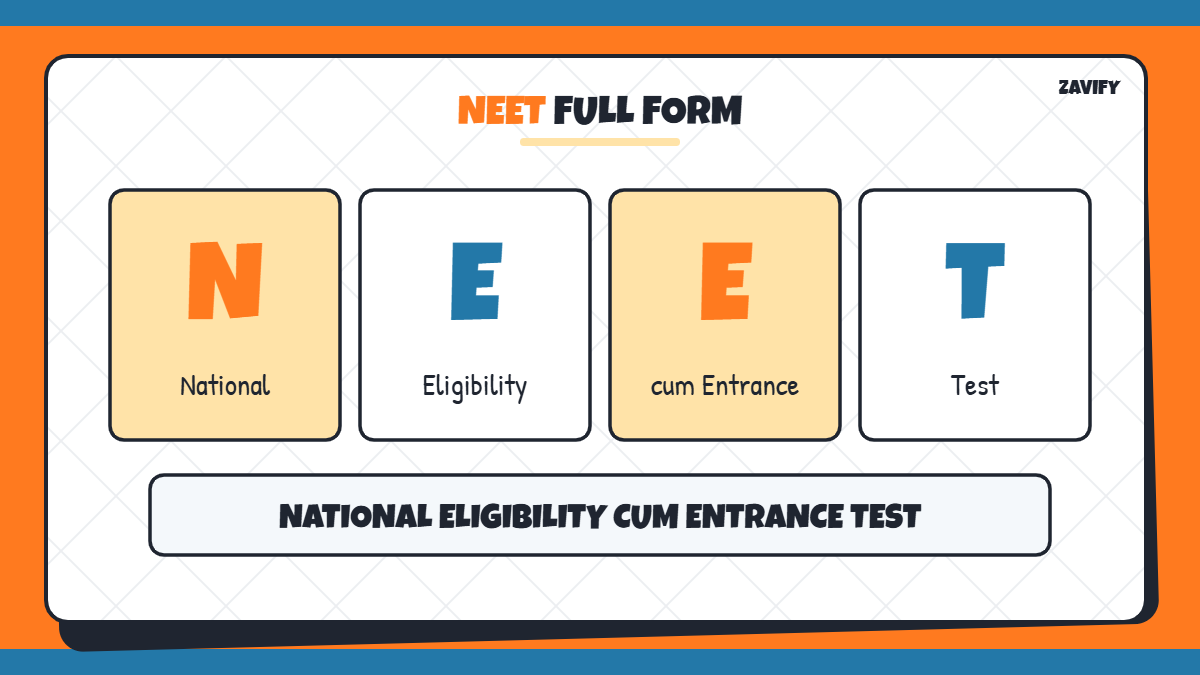
The NEET full form is National Eligibility cum Entrance Test. Each word explains part of its purpose. “National” means it is held across India, “Eligibility” means it checks whether you qualify for medical admission, and “Entrance Test” means your score decides the college you can join.
When people search for the NEET full form in medical, they usually mean NEET UG, the undergraduate exam taken after Class 12. There is also NEET PG for MBBS graduates, which is covered later in this article.
- N – National
- E – Eligibility
- E – cum Entrance
- T – Test
How Does NEET Work? A Quick Overview
Now that you know the NEET full form, here is a quick summary of how the NEET UG 2026 exam was structured, based on the official NTA information bulletin:
| Feature | NEET UG Details |
|---|---|
| Full form | National Eligibility cum Entrance Test |
| Conducted by | National Testing Agency (NTA) |
| Mode | Pen and paper (offline) |
| Duration | 3 hours |
| Questions | 180 compulsory MCQs |
| Total marks | 720 |
| Languages | 13 languages |
Let us now look at the ten most important facts every aspirant should know.
1. NEET Full Form and Its Purpose
The NEET full form, National Eligibility cum Entrance Test, reflects its main job: one common test for medical admissions. Before NEET, students had to write many separate state and college exams. NEET replaced most of them with a single merit list.
- One exam for government and private medical colleges.
- Same syllabus and pattern for all students.
- Fair comparison of students from every state.
2. Who Conducts NEET?
NEET UG is conducted by the National Testing Agency (NTA), an autonomous body under the Ministry of Education. Registration, admit cards, answer keys and results are all released on the official NTA NEET website.
3. NEET Eligibility Criteria
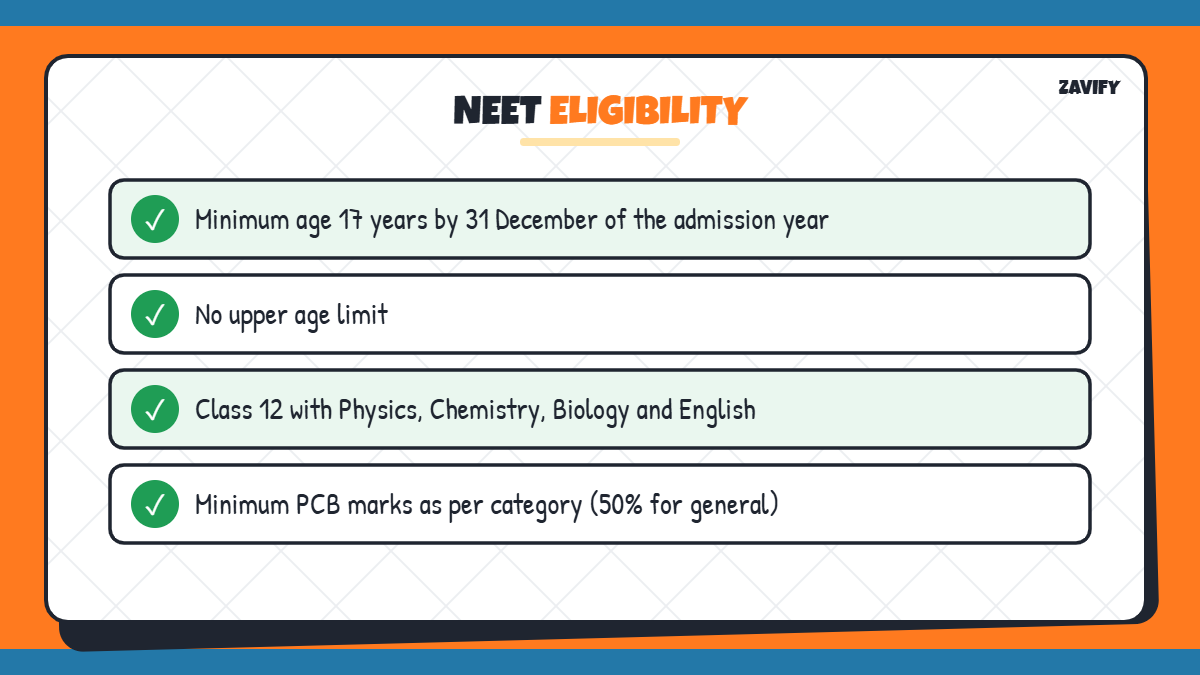
Knowing the NEET full form is easy, but checking eligibility carefully is what really matters. According to the NEET UG 2026 bulletin, the main conditions are:
- You must be at least 17 years old on or before 31 December of the admission year.
- There is no upper age limit.
- You must have passed or be appearing in Class 12 with Physics, Chemistry, Biology/Biotechnology and English.
- Minimum Class 12 marks in PCB apply, usually 50% for general category and lower for reserved categories.
Always confirm the exact rules in the latest official information bulletin before you apply.
4. NEET Exam Pattern and Marking Scheme
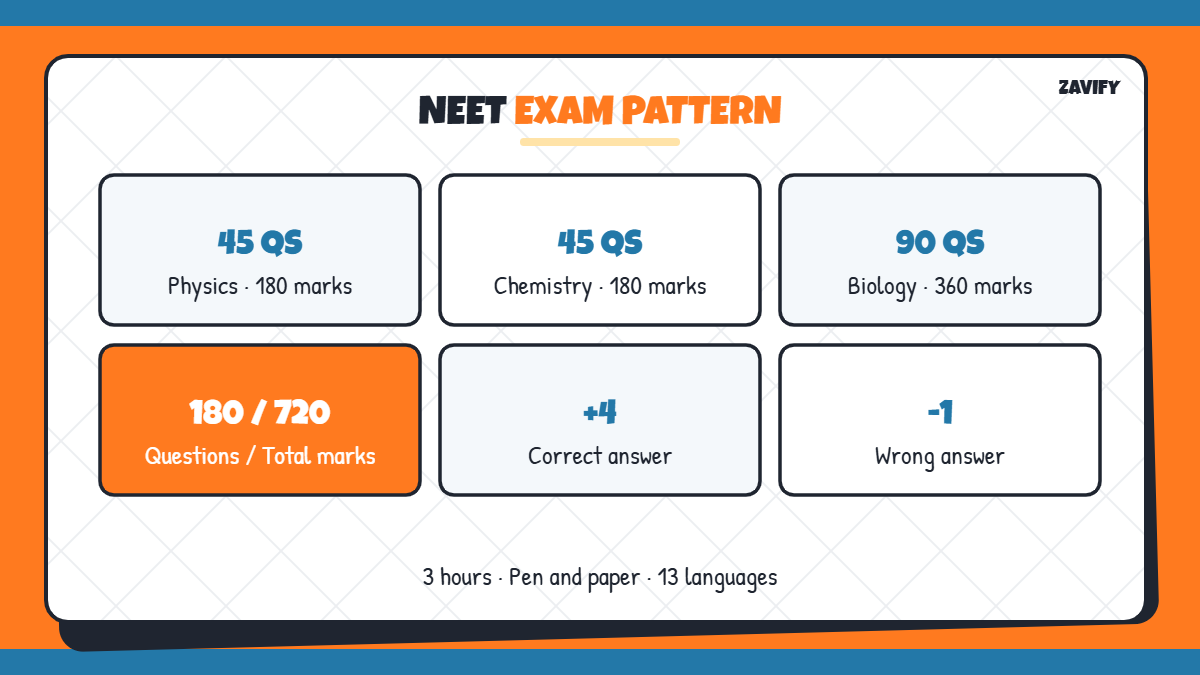
NEET UG 2026 had 180 compulsory multiple-choice questions to be answered in 3 hours. The subject-wise split is shown below.
- Physics: 45 questions (180 marks)
- Chemistry: 45 questions (180 marks)
- Biology (Botany and Zoology): 90 questions (360 marks)
Each correct answer earns +4 marks, each wrong answer loses 1 mark, and unanswered questions get zero. This negative marking means guessing blindly can reduce your score.
5. NEET Syllabus
The NEET syllabus is based on NCERT Class 11 and Class 12 Physics, Chemistry and Biology. Biology carries half the total marks, so most toppers spend extra time on NCERT Biology line by line.
6. Languages Available
NEET is offered in 13 languages: English, Hindi, Assamese, Bengali, Gujarati, Kannada, Malayalam, Marathi, Odia, Punjabi, Tamil, Telugu and Urdu. You choose your medium while filling the application form.
7. Courses You Can Join Through NEET
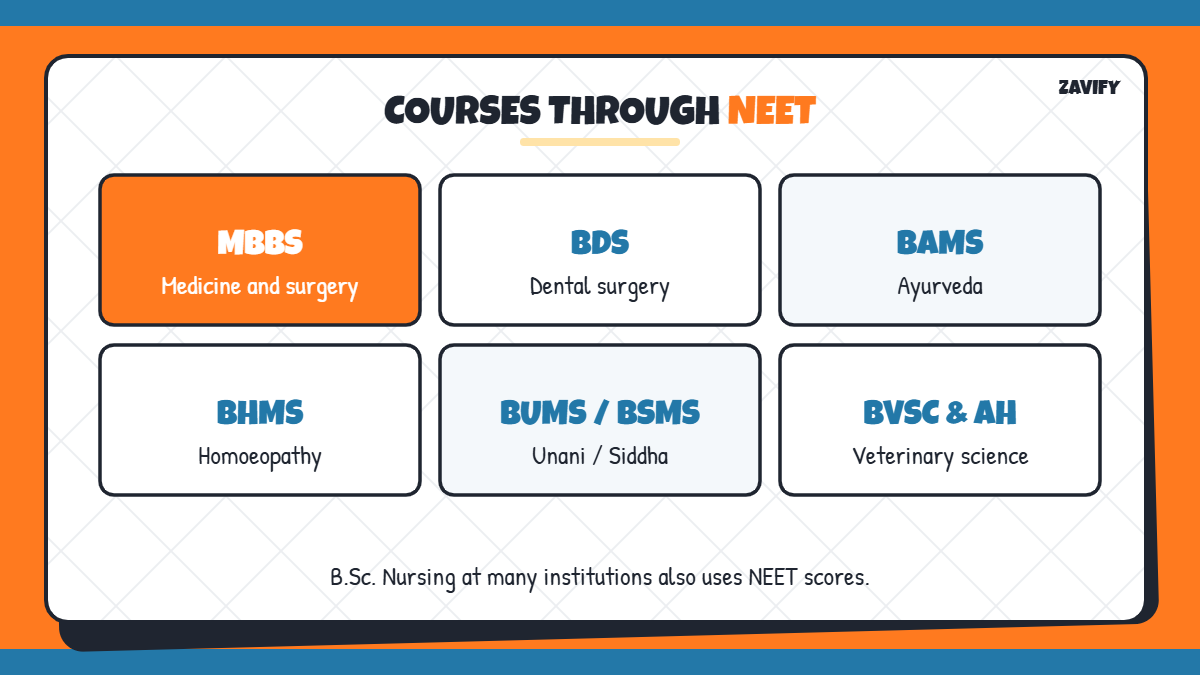
The NEET full form tells you it is an eligibility test, and the list of courses shows how wide that eligibility is. A valid NEET score is used for admission to:
- MBBS (see our guide to the MBBS full form)
- BDS (dental surgery)
- BAMS, BUMS, BSMS and BHMS (AYUSH courses)
- BVSc & AH (veterinary science)
- B.Sc. Nursing at many institutions
8. How to Apply for NEET
The application is filled online on the NTA NEET website, usually between February and March. You register, fill in personal and academic details, upload a photo and signature, and pay the fee. Keep your Class 10 and 12 documents ready before you start.
9. Result, Cut-off and Counselling
NTA publishes the result with your score and All India Rank. To qualify, general category students need the 50th percentile, while SC, ST and OBC students need the 40th percentile. Counselling for the 15% All India Quota and central institutions is run by the Medical Counselling Committee (MCC), and state quota seats are filled by state counselling authorities.
10. How to Prepare for NEET
Understanding the NEET full form and pattern is only the start. A steady plan works better than last-minute cramming.
- Finish NCERT textbooks for all three subjects first.
- Solve previous year papers under timed conditions.
- Revise weak chapters every week.
- Take full-length mock tests in the last three months.
- Read our exam strategy guide for scoring tips.
NEET UG vs NEET PG
NEET UG is for students entering MBBS, BDS and similar courses after Class 12. NEET PG is a separate exam for MBBS graduates who want admission to MD, MS and PG diploma courses. Both share the same NEET full form, but they differ in eligibility, syllabus and conducting body.
Common Mistakes Students Make About NEET
Even after learning the NEET full form and rules, many students lose marks or opportunities because of simple mistakes:
- Ignoring NCERT and relying only on reference books.
- Guessing too many answers despite negative marking.
- Missing the application or correction window deadlines.
- Uploading the wrong photo size or signature format.
- Not checking category-wise eligibility and cut-offs.
Frequently Asked Questions
What is the NEET full form?
The NEET full form is National Eligibility cum Entrance Test. It is the national entrance exam for medical courses in India.
What is the NEET full form in medical?
In the medical field, NEET means National Eligibility cum Entrance Test, the exam used for admission to MBBS, BDS, AYUSH and other UG medical courses.
Is there an age limit for NEET?
You must be at least 17 years old by 31 December of the admission year. There is currently no upper age limit.
How many marks is NEET out of?
NEET UG is out of 720 marks, with 180 questions carrying 4 marks each.
Can I get MBBS without NEET?
No. Admission to MBBS in Indian medical colleges requires a qualifying NEET score.
Conclusion
The NEET full form is National Eligibility cum Entrance Test, and it is the gateway to MBBS, BDS and many other medical courses in India. Conducted by NTA, it tests Physics, Chemistry and Biology through 180 questions for 720 marks.
Now that you know the NEET full form, eligibility and exam pattern, focus on NCERT, practise previous papers, and follow official NTA updates. With a steady plan, you can give yourself the best chance of reaching a good medical college.