Introduction
A Systematic Withdrawal Plan (SWP) lets you take out a fixed amount from your mutual fund every month while the rest of your money stays invested. It is popular with retirees, parents paying fees, and anyone who wants a regular income from savings. An SWP calculator shows how long your money will last and how much will be left after a chosen period.
In this guide, you will learn what an SWP calculator does, the formula it uses, how to read the results, and how tax and inflation affect your plan.
- SWP means Systematic Withdrawal Plan.
- You withdraw a fixed amount at regular intervals.
- The remaining balance keeps earning returns.
Table of Contents
What Is an SWP Calculator?
An SWP calculator is a free online tool that estimates the value of your investment after regular withdrawals. You enter your investment amount, monthly withdrawal, expected return and time period. The tool then shows the total amount withdrawn and the final balance.
It does not predict actual market returns. It simply applies an assumed return rate so you can compare different plans before you invest.
- Total investment: the lump sum you start with.
- Monthly withdrawal: the fixed amount you take out.
- Expected return: the yearly return you assume.
- Time period: how many years you plan to withdraw.
How Does an SWP Calculator Work?
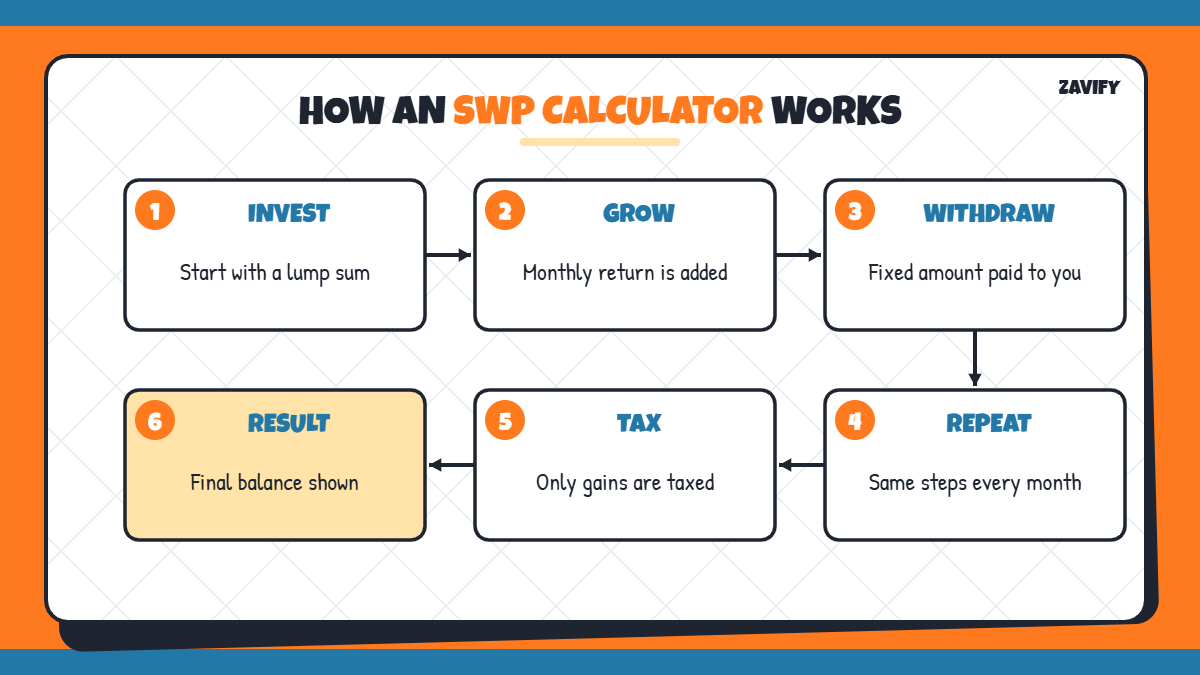
Every such tool uses the same basic logic. Each month, your balance grows by the monthly return, and then your withdrawal is subtracted. The shortcut formula is:
Final Balance = P × (1 + r)n − W × [((1 + r)n − 1) ÷ r]
Here, P is your investment, W is the monthly withdrawal, r is the monthly return (annual return ÷ 12), and n is the number of months.
| Investment | Monthly Withdrawal | Return | Period | Final Balance |
|---|---|---|---|---|
| ₹10,00,000 | ₹8,000 | 10% a year | 5 years | ₹10,25,812 |
| ₹10,00,000 | ₹8,000 | 10% a year | 10 years | ₹10,68,282 |
| ₹10,00,000 | ₹8,000 | 10% a year | 20 years | ₹12,53,123 |
Now let us walk through how to use an SWP calculator step by step.
1. Decide Your Investment Amount
Start with the lump sum you plan to invest, such as retirement savings, a bonus, or maturity money from an FD. Keep an emergency fund separate so you never need to break your SWP early. Our guide on building an emergency fund explains how much to keep aside.
2. Choose Your Monthly Withdrawal
Decide how much you need each month. In the calculation, a smaller withdrawal lets your balance grow, while a larger one reduces it faster.
- Cover fixed expenses first.
- Keep the yearly withdrawal below your expected return if you want the corpus to last.
3. Enter a Realistic Expected Return
Use a conservative return, not the best past year. Equity funds are volatile, while debt and hybrid funds are steadier. Many planners test 8%, 10% and 12% to see a range of outcomes.
4. Set the Time Period
Enter how many years you want the withdrawals to run. Retirees often test 20 to 25 years, while a parent funding college fees may need only 4 or 5 years.
5. Read the Total Withdrawn
The tool shows how much you receive in total. In our example, ₹8,000 a month for 10 years adds up to ₹9,60,000.
6. Check the Final Balance
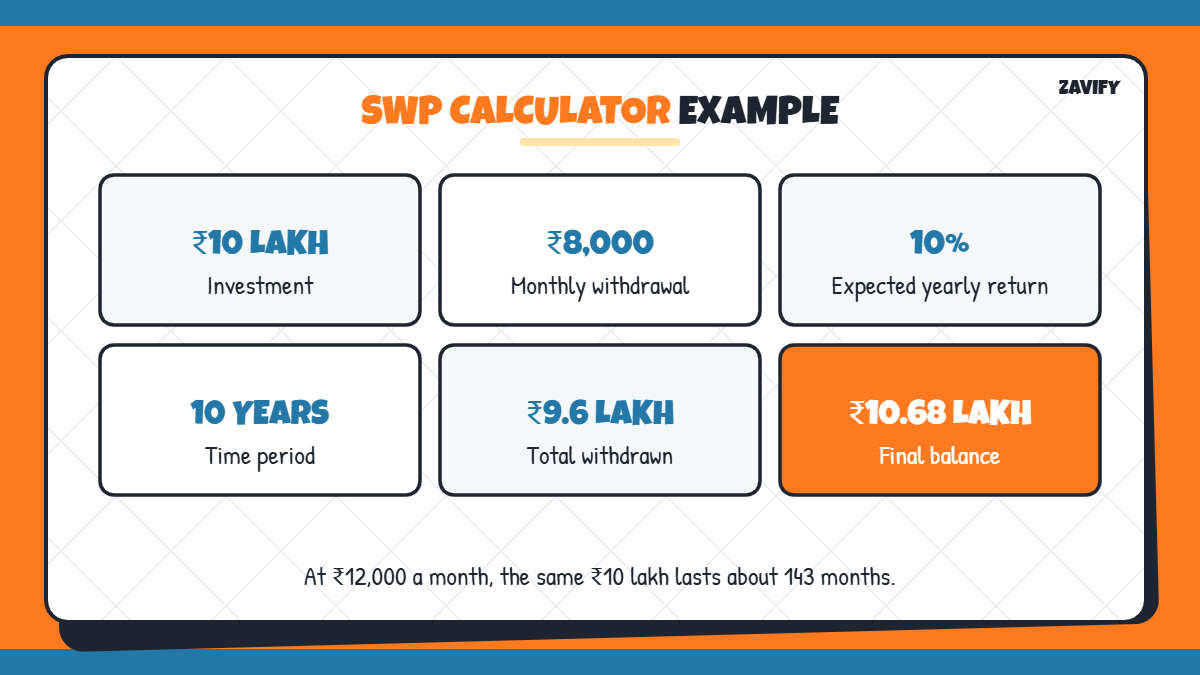
This is the most important number. In the same example, your balance after 10 years is about ₹10,68,282, which is more than you started with, because the 10% return is higher than your 9.6% yearly withdrawal rate.
7. Test a Higher Withdrawal
Now increase the withdrawal to ₹12,000 a month. The result shows that the ₹10 lakh runs out in about 143 months, or just under 12 years. This test shows why the withdrawal rate matters so much.
8. Use an SWP Calculator With Inflation
Prices rise every year, so a fixed ₹8,000 will buy less in the future. An SWP calculator with inflation lets you raise the withdrawal each year, for example by 5% or 6%. Your money then runs out sooner, but your income keeps its buying power. To see how growth compounds over time, read our guide on compound interest.
9. Understand How SWP Is Taxed
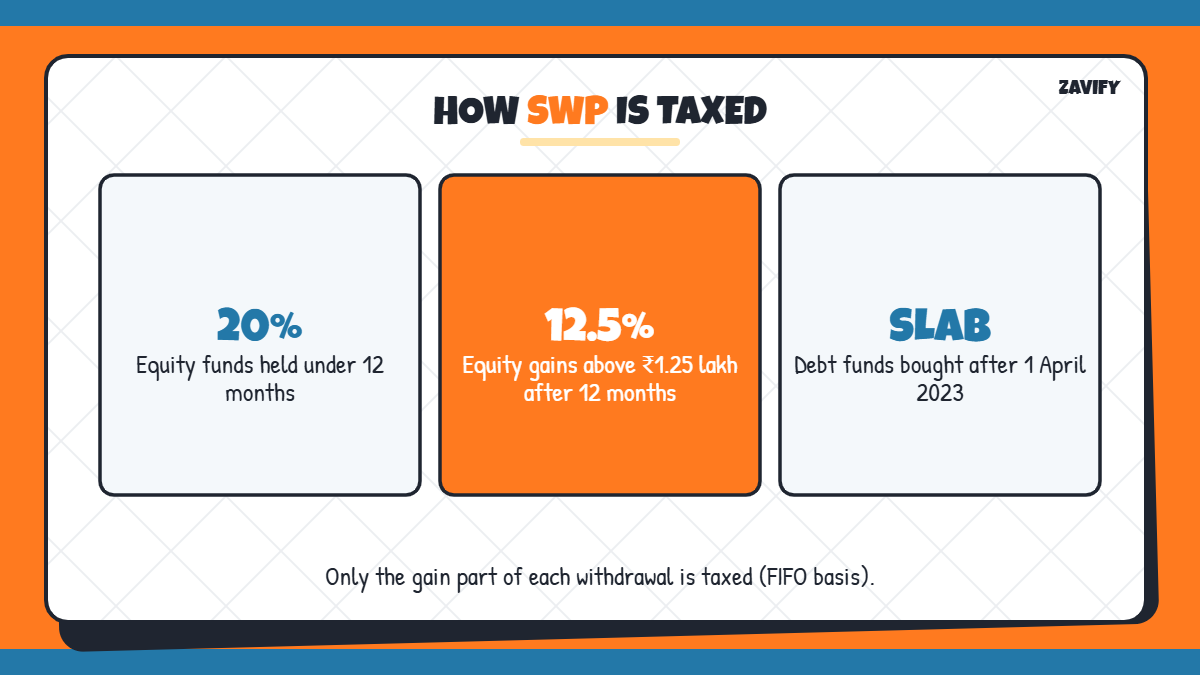
Each SWP withdrawal redeems units, and only the gain part is taxed. Units are redeemed on a first-in, first-out basis. For FY 2026-27:
- Equity funds held under 12 months: 20% short-term capital gains tax.
- Equity funds held 12 months or more: 12.5% on gains above ₹1.25 lakh a year.
- Debt funds bought after 1 April 2023: gains taxed at your income tax slab rate.
Most online tools show pre-tax figures, so keep tax in mind when you plan your income.
Who Should Use an SWP?
An SWP suits people who already have a lump sum and need regular cash flow. Common examples include retirees replacing a salary, parents funding school or college fees, and freelancers smoothing an uneven income. It is less useful if you still need to grow your savings aggressively, because every withdrawal reduces the money left to compound.
- Retirees who want a monthly pension-like income.
- Parents planning fixed education payments.
- Investors moving from a SIP to regular income.
SWP vs SIP
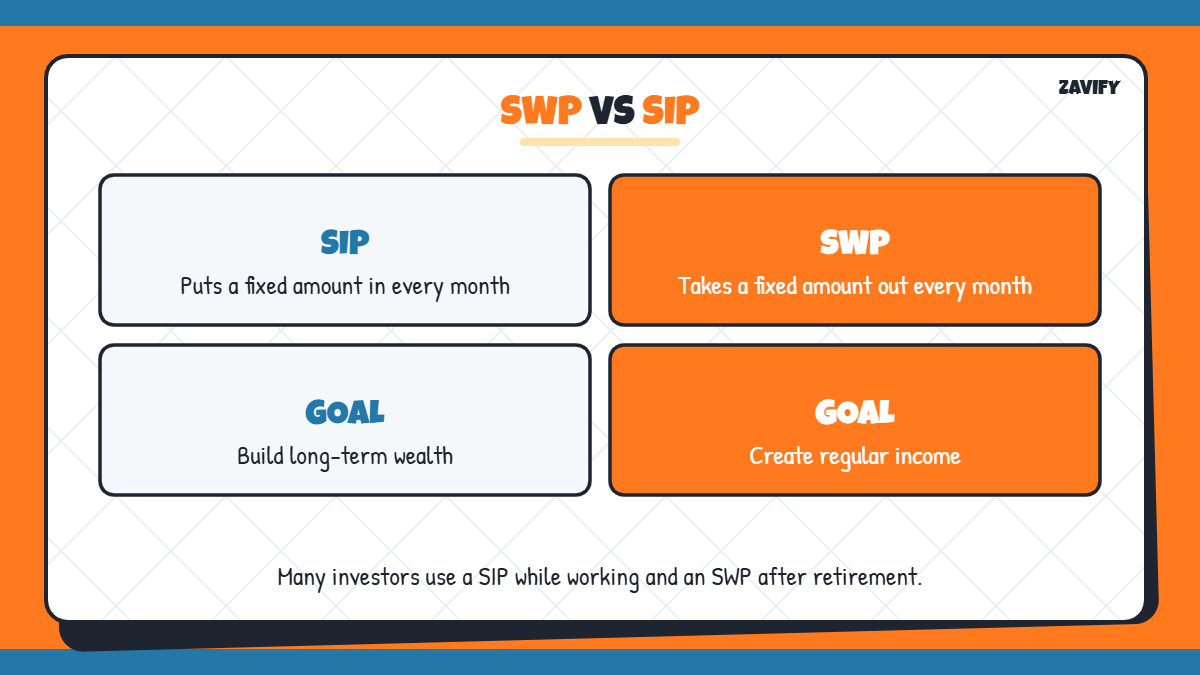
A SIP (Systematic Investment Plan) puts a fixed amount into a fund every month to build wealth. An SWP does the opposite and takes a fixed amount out to create income. Many investors use a SIP while working and an SWP after retirement.
Common Mistakes When Using an SWP Calculator
Any calculator is only as good as the numbers you enter. Avoid these mistakes:
- Assuming very high returns every year.
- Ignoring inflation for long plans.
- Withdrawing more than the fund can sustain.
- Forgetting capital gains tax and exit loads.
- Starting an SWP from a volatile fund without a buffer.
Frequently Asked Questions
What does an SWP calculator do?
An SWP calculator estimates your final balance and total withdrawals based on your investment, monthly withdrawal, expected return and time period.
What is the full form of SWP?
SWP stands for Systematic Withdrawal Plan, a facility to withdraw a fixed amount from a mutual fund at regular intervals.
How much can I withdraw safely every month?
A common rule is to keep your yearly withdrawal below your expected return. Test different amounts in an SWP calculator to find a comfortable level.
Is SWP income taxable?
Only the capital gain part of each withdrawal is taxable, at rates based on the fund type and holding period.
Does an SWP calculator include inflation?
Basic tools do not. Use an SWP calculator with inflation, or raise your withdrawal each year manually, to plan for rising costs.
Conclusion
An SWP calculator turns a big question, “How long will my money last?”, into clear numbers. Enter your investment, monthly withdrawal, expected return and period, and you can compare plans in seconds.
Use realistic returns, plan for inflation and tax, and keep your withdrawal rate sensible. With these steps, an SWP calculator can help you build a steady monthly income that lasts.