Introduction
Students at SRM Institute of Science and Technology (SRMIST) receive grades instead of raw marks, so knowing how to work out your average is important for placements, internships and higher studies. An SRM CGPA calculator turns your grades and credits into one clear number that shows your overall academic performance.
In this guide, you will learn the SRM grade point scale, the SGPA and CGPA formulas, a full worked example and how to convert CGPA into a percentage.
- SRM uses a 10-point credit-based grading system.
- SGPA is your semester average; CGPA is your overall average.
- Credits decide how much each subject counts.
Table of Contents
What Is an SRM CGPA Calculator?
An SRM CGPA calculator is a tool that multiplies each subject’s grade point by its credits, adds them up and divides by the total credits. It gives the same result as doing the maths by hand, but faster and with fewer errors.
You can use our CGPA calculator for quick results, or follow the manual method below to understand exactly how your score is built.
- Grade point: the number linked to your letter grade.
- Credits: the weight of each subject.
- CGPA: the credit-weighted average across all semesters.
How Does the SRM CGPA Calculator Work?
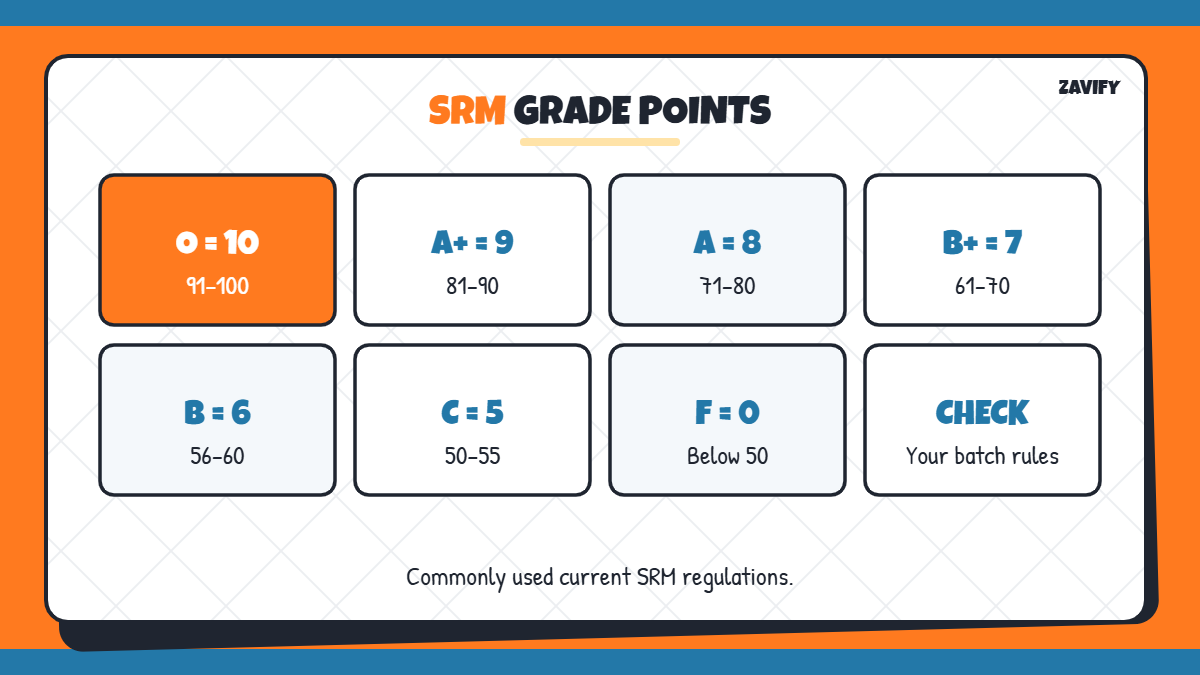
Under the commonly used current SRM regulations, grades map to grade points as follows. Always confirm with your own regulation booklet, because older batches used different scales.
| Grade | Marks Range | Grade Points |
|---|---|---|
| O (Outstanding) | 91–100 | 10 |
| A+ (Excellent) | 81–90 | 9 |
| A (Very Good) | 71–80 | 8 |
| B+ (Good) | 61–70 | 7 |
| B (Above Average) | 56–60 | 6 |
| C (Average) | 50–55 | 5 |
| F (Fail) | Below 50 | 0 |
Now let us go through the SRM CGPA calculator method step by step.
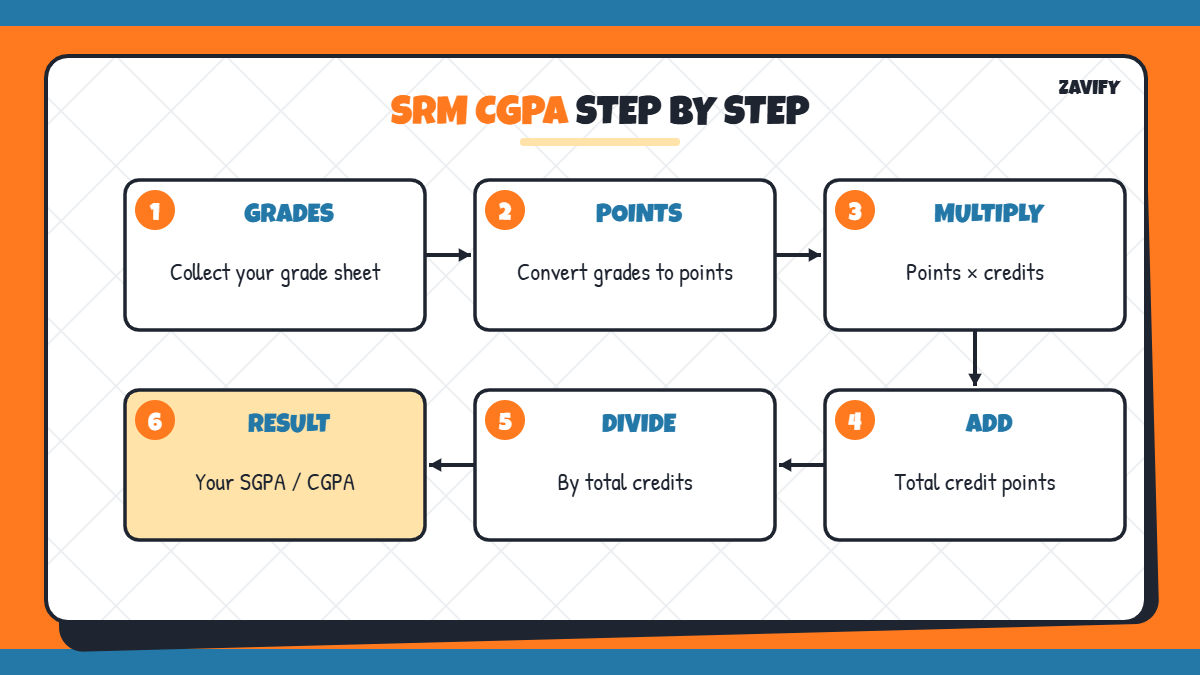
1. Collect Your Grade Sheet
Log in to the SRM student portal and open your semester grade sheet. Note every subject, its credits and the grade you received.
2. Convert Each Grade Into Grade Points
Use the table above to change each letter grade into its grade point. For example, O becomes 10, A+ becomes 9 and B+ becomes 7.
3. Multiply Grade Points by Credits
For each subject, multiply the grade point by the credits. A 4-credit subject with grade A+ gives 4 × 9 = 36 credit points.
4. Add All Credit Points
Add the credit points of every subject in the semester. This total shows your weighted performance.
5. Add All Credits
Add the credits of all subjects in the same semester. Include every subject that counts towards your GPA.
6. Calculate Your SGPA
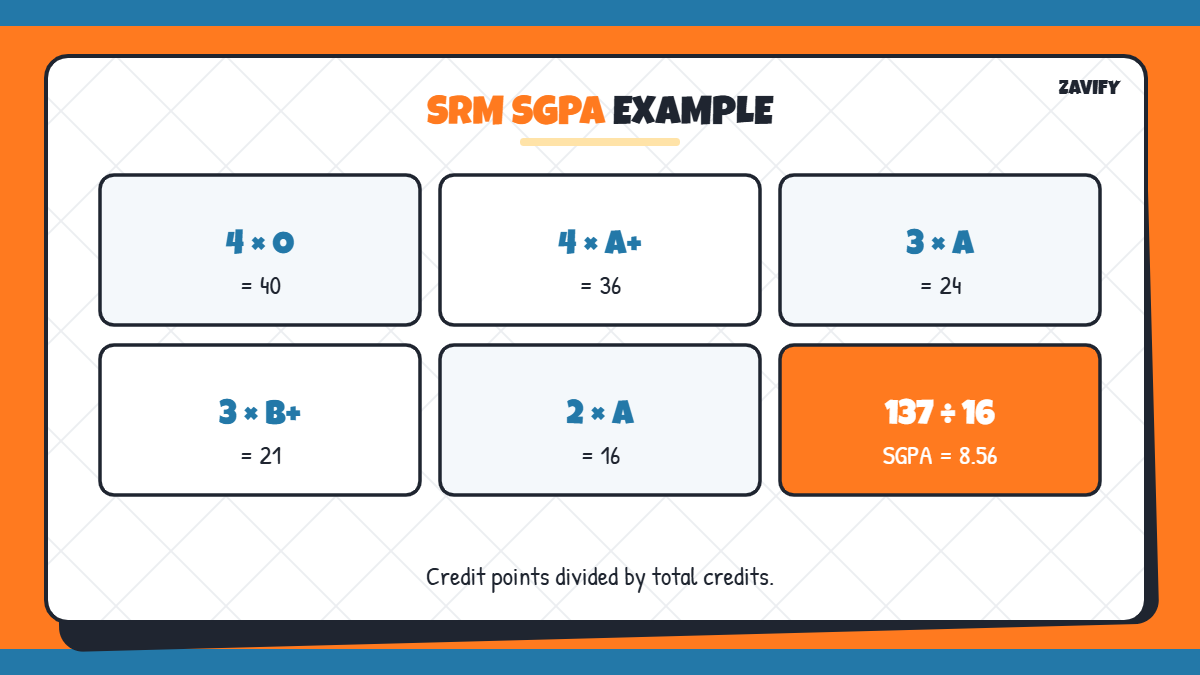
Divide total credit points by total credits: SGPA = Σ(Credits × Grade Points) ÷ Σ Credits.
Worked example: subjects of 4, 4, 3, 3 and 2 credits with grades O, A+, A, B+ and A give (40 + 36 + 24 + 21 + 16) ÷ 16 = 8.56.
7. Calculate Your CGPA
To find CGPA, repeat the same weighted method across all semesters: add credit points from every semester and divide by all credits earned. This is exactly what an SRM CGPA calculator does automatically.
8. Convert SRM CGPA to Percentage
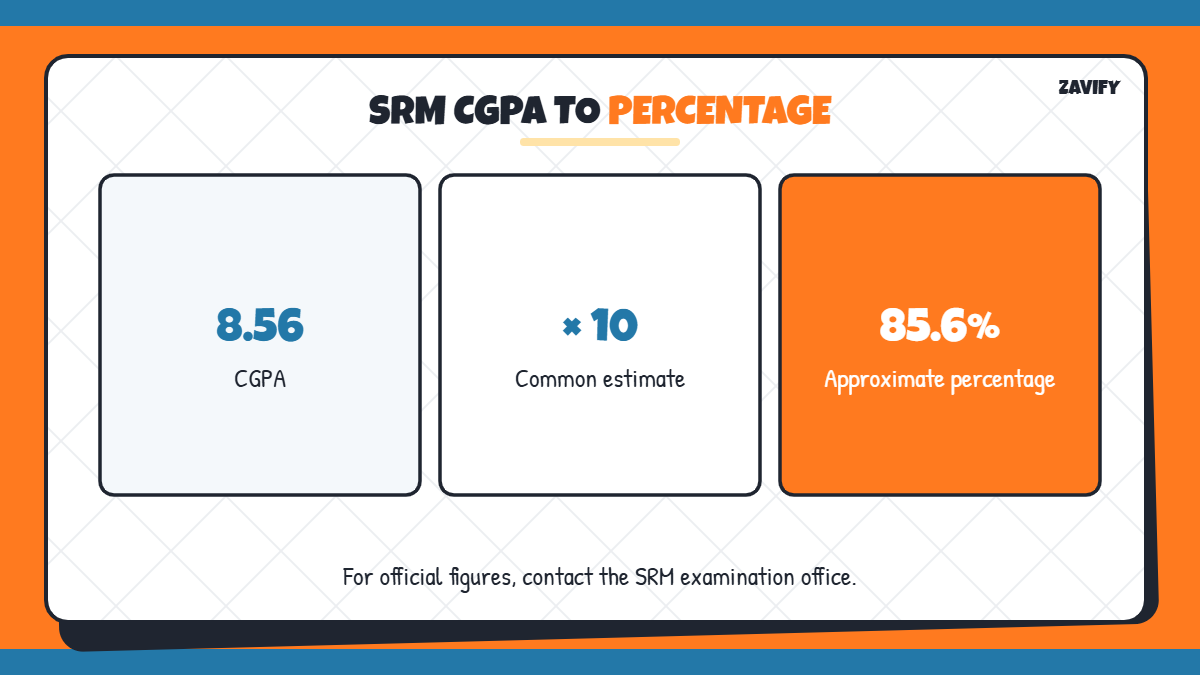
SRM does not publish one universal conversion formula for every programme. Many students use Percentage = CGPA × 10 as an estimate, so a CGPA of 8.56 is about 85.6%. If an employer or university needs an official figure, request it from the SRM examination office. Our CGPA to percentage converter shows other common formulas.
9. Track Your CGPA Every Semester
Record your SGPA after every result. Tracking lets you see which semesters pulled your average up or down and plan how much you need to improve.
SRM CGPA Calculator Example Across Two Semesters
Suppose you earned 20 credits in Semester 1 with an SGPA of 8.2, and 22 credits in Semester 2 with an SGPA of 8.8. An SRM CGPA calculator does not simply average 8.2 and 8.8. Instead, it weights each semester by credits: (20 × 8.2 + 22 × 8.8) ÷ 42 = (164 + 193.6) ÷ 42 = 8.51. A simple average would give 8.5, which is close here but can be quite different when credit totals vary more.
- Always weight semesters by credits.
- Keep a record of credits for every semester.
- Use an SRM CGPA calculator to avoid manual errors.
How to Raise Your SRM CGPA
Because CGPA is credit-weighted, high-credit subjects matter most. Scoring an O in a 4-credit subject lifts your average far more than the same grade in a 2-credit subject. Focus on attendance, internal assessments and lab work, since they add to your final marks.
- Prioritise high-credit subjects.
- Clear arrears quickly, as F grades pull down CGPA.
- Use internal marks to secure higher grades.
SGPA vs CGPA at SRM
SGPA measures one semester, while CGPA measures your whole programme so far. Placement cells usually ask for CGPA, while scholarships may look at a specific semester’s SGPA. For more on semester scores, see our SGPA to percentage guide.
Common Mistakes When Using an SRM CGPA Calculator
Students often get the wrong result because of these errors:
- Taking a simple average instead of a credit-weighted one.
- Using the wrong grade scale for their batch.
- Leaving out zero-credit or audit courses incorrectly.
- Forgetting to include failed subjects before clearing them.
- Rounding too early in the calculation.
Frequently Asked Questions
How is CGPA calculated at SRM?
Multiply grade points by credits for every subject, add them, and divide by the total credits across all semesters.
What is the grade point for O grade at SRM?
Under the commonly used current regulations, O grade carries 10 grade points.
How do I convert SRM CGPA to percentage?
Many students use CGPA × 10 as an estimate. For an official figure, contact the SRM examination office.
Is an SRM CGPA calculator accurate?
Yes, if you enter the correct grades, credits and grade scale for your batch.
What is a good CGPA at SRM?
A CGPA above 8 is generally considered strong for placements, although company cut-offs vary.
Conclusion
An SRM CGPA calculator makes it easy to understand your academic standing. Convert grades to points, multiply by credits, add them up and divide by total credits to get your SGPA and CGPA.
Use the correct grade scale for your batch, track your results every semester and focus on high-credit subjects to raise your score.