Introduction
This is an excellent GPA, but when a form asks you to turn it into a percentage, the answer is not as obvious as it seems. Different formulas give different results, and choosing the wrong one can understate or overstate your work.
This guide explains what percentage a 3.8 GPA equals, how each conversion method works, how a 3.8 compares nationally and what it means for college and scholarships.
- A 3.8 GPA is roughly 91–93% on the standard US scale.
- It sits between an A- (3.7) and an A (4.0), closer to the A-.
- State the method you used whenever you convert.
Table of Contents
What Percentage Is a 3.8 GPA?
On the common US chart, an A- (3.7) covers 90–92% and an A (4.0) covers 93–100%. A 3.8 is just above an A-, so it corresponds to about 91–93%. That is the most accurate everyday answer.
The simple proportional formula gives 95%, and some converters give 96%. These higher numbers are common online, but they do not match how US letter grades are actually assigned, so use them only if an institution asks for that formula.
- Letter grade: A- to A.
- Chart-based percentage: about 91–93%.
- Simple formula: 95%.
How Do You Convert a 3.8 GPA to Percentage?
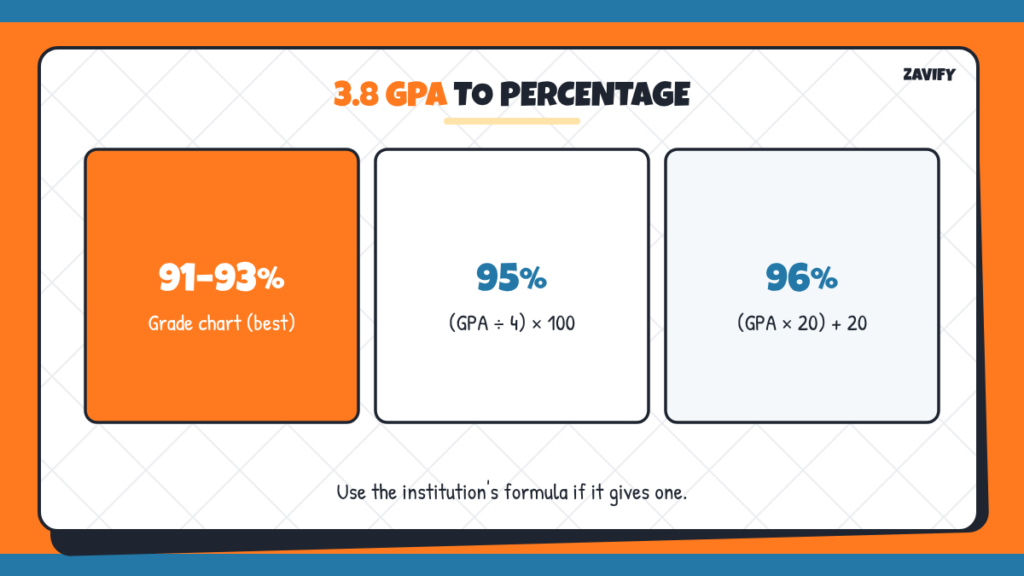
| Method | Formula | Result for 3.8 GPA |
|---|---|---|
| Grade chart (most common) | Match GPA to letter-grade ranges | About 91–93% |
| Simple proportion | (GPA ÷ 4) × 100 | 95% |
| Linear scale used by some converters | (GPA × 20) + 20 | 96% |
When in doubt, write “3.8/4.0 GPA, approximately 91–93%.” It is honest and easy to verify. Our study abroad GPA converter gives quick estimates.
What Grades Make a 3.8 GPA?
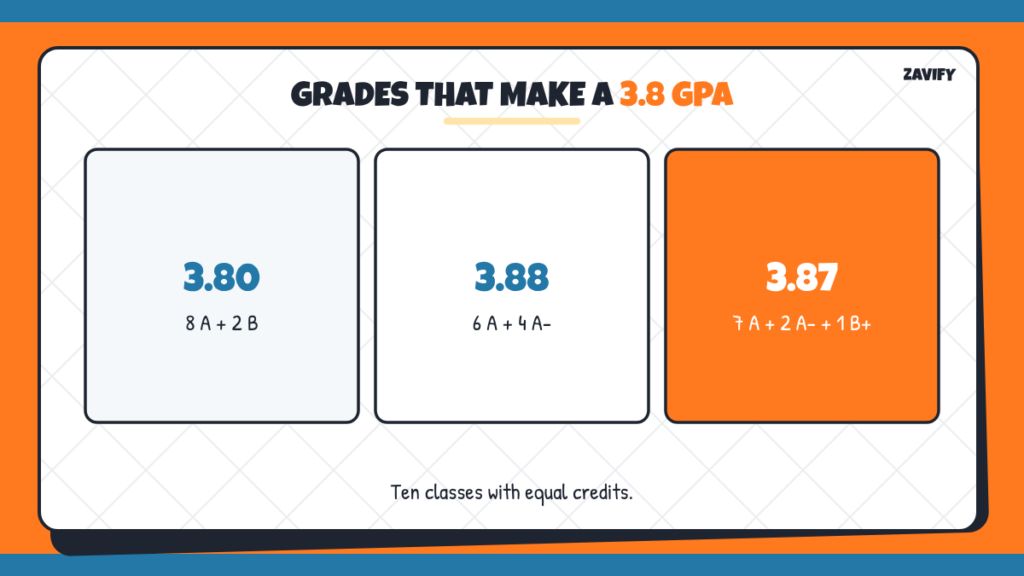
It usually means mostly As with a few A- or B+ grades. For example, across ten classes of equal credit:
| Grades | Calculation | GPA |
|---|---|---|
| 8 A, 2 B | (8 × 4 + 2 × 3) ÷ 10 | 3.8 |
| 6 A, 4 A- | (6 × 4 + 4 × 3.7) ÷ 10 | 3.88 |
| 7 A, 2 A-, 1 B+ | (28 + 7.4 + 3.3) ÷ 10 | 3.87 |
You can check your own mix with our college GPA calculator or high school GPA calculator.
Is a 3.8 GPA Good?
Yes, it is excellent. It is well above the US high school average of about 3.1 and places you near the top of most classes. In college, it typically qualifies for the dean’s list, honors programs, competitive scholarships and strong graduate school applications.
At the most selective universities, many admitted students also have GPAs at this level, so it puts you in the competitive range. Your course rigor, essays, activities and recommendations then decide the outcome.
Weighted or Unweighted?
An unweighted 3.8 out of 4.0 is outstanding. A weighted 3.8 on a 5.0 scale is good but less impressive, because advanced classes add extra points. Make sure you know which one you have before converting or comparing.
Example: Reporting Your GPA as a Percentage
Priya graduates with an unweighted GPA of 3.8 and applies to a master’s program in India that asks for a percentage. The university’s form says to use its own formula, (GPA ÷ 4) × 100, so she enters 95% as instructed. On a separate job application with no formula, she writes “3.8/4.0 GPA (approximately 91–93%).”
Keeping Your GPA High
- Plan your workload so hard courses are spread across semesters.
- Start assignments early and review regularly instead of cramming.
- Ask for feedback before major exams and projects.
- Use our final grade calculator to know what you need on finals.
Why Conversion Methods Differ
Each letter grade covers a range of percentages, and a GPA averages letters, not raw scores. When you convert a GPA back to a percentage, you have to estimate where inside each range the grades fell. Simple formulas such as (GPA ÷ 4) × 100 assume that 0 to 4 maps evenly onto 0 to 100%, but in the US an F already covers everything below about 60–65%. That is why simple formulas tend to give higher numbers for strong GPAs than the actual letter-grade chart does.
Chart-based conversion follows real grading practice, so it is the safest choice unless an institution tells you otherwise.
Scholarships at This Level
A GPA at this level meets the academic requirement for most merit scholarships, including many full-tuition awards. Because many strong applicants also have high GPAs, the deciding factors are usually essays, leadership, service and recommendations. If your scholarship requires you to keep a minimum GPA, such as 3.5, a 3.8 gives you a healthy buffer for a tough semester.
Latin Honors
Many colleges award Latin honors at graduation based on GPA. Cutoffs vary widely, but a common pattern is cum laude around 3.5, magna cum laude around 3.7 and summa cum laude around 3.9. Some schools instead give honors to a top percentage of the class. Check your college catalog to see where your GPA lands.
Reporting It on Applications
Enter your GPA exactly as it appears on your transcript, with its scale, such as 3.8 / 4.0. Convert only when asked, and use the institution’s formula if it provides one.
Common Mistakes
- Claiming 95% as the official equivalent. If a university needs an evaluation, services such as World Education Services (WES) provide official ones.
- Comparing a weighted 3.8 with unweighted GPAs.
- Converting without stating the method.
- Ignoring an institution’s own conversion rules.
Frequently Asked Questions
What percentage is a 3.8 GPA?
About 91–93% on the standard US chart, or 95% using the simple formula.
What letter grade is a 3.8 GPA?
An A- to A average.
Is a 3.8 GPA good?
Yes, it is excellent and competitive at most colleges and scholarship programs.
Is it good enough for Ivy League schools?
It is in the competitive range, but admission also depends on rigor, essays, activities and recommendations.
What is a 3.8 GPA on a 10-point scale?
Roughly 9.5 using a simple proportion, but universities often apply their own rules.
Is a 3.8 GPA summa cum laude?
It depends on the college; many set cum laude honors between 3.5 and 3.9.
Conclusion
A 3.8 GPA is an excellent result, roughly 91–93% on the common US scale. Use the institution’s formula if it has one, and always say how you converted.
For related conversions, read 3.5 GPA to percentage and our letter grade scale guide.