Introduction
Traditional advertising, like a billboard or TV commercial, is hard to measure. You pay upfront and hope people notice. A results-based approach flips that idea: you focus on actions you can track, such as clicks, sign-ups and purchases, and judge every dollar by the results it brings.
This guide explains what performance marketing is, the main channels and pricing models, the metrics that matter, real-world style examples and nine easy steps to run your first campaign. It is aimed at marketing students, small business owners and new digital marketers.
- Performance marketing focuses on measurable actions.
- Common channels: search ads, social ads, affiliates and shopping ads.
- Key metrics: cost per acquisition (CPA) and return on ad spend (ROAS).
Table of Contents
What Is Performance Marketing?
Performance marketing is a type of digital marketing where advertisers pay for, or optimise toward, specific measurable outcomes such as clicks, leads, app installs or sales. Every campaign is tracked closely, and budgets move toward what produces results.
The term covers both a pricing approach (paying per click or per sale) and a mindset: setting clear goals, measuring everything and improving continuously. It contrasts with brand marketing, which builds long-term awareness and is harder to measure directly. Most successful companies use both.
- Advertiser: the business paying for results.
- Publisher or platform: where ads appear.
- Conversion: the action you want, such as a purchase or sign-up.
How Does Performance Marketing Work?
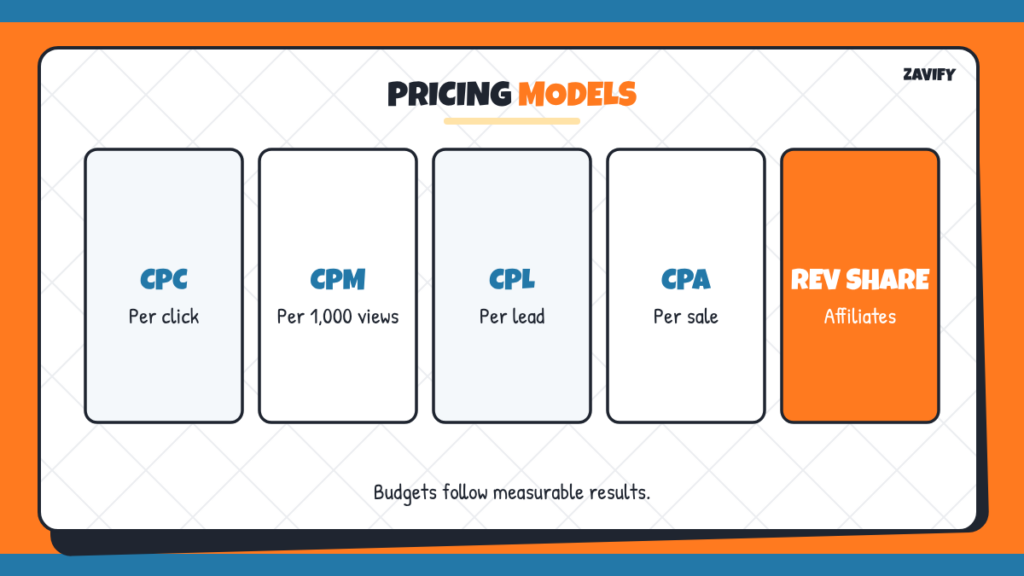
Campaigns are usually priced and measured using one of these models:
| Model | You Pay For | Common Use |
|---|---|---|
| CPC (cost per click) | Each click on an ad | Search and social ads |
| CPM (cost per thousand impressions) | Every 1,000 views | Awareness campaigns, often optimised for actions |
| CPL (cost per lead) | Each sign-up or form fill | B2B and education |
| CPA (cost per acquisition) | Each sale or key action | E-commerce and apps |
| Revenue share | A percentage of each sale | Affiliate marketing |
Tracking tools, such as pixels, conversion tags and UTM links, connect each ad to what happens next, so you can see which campaigns actually drive results.
1. Set a Clear, Measurable Goal
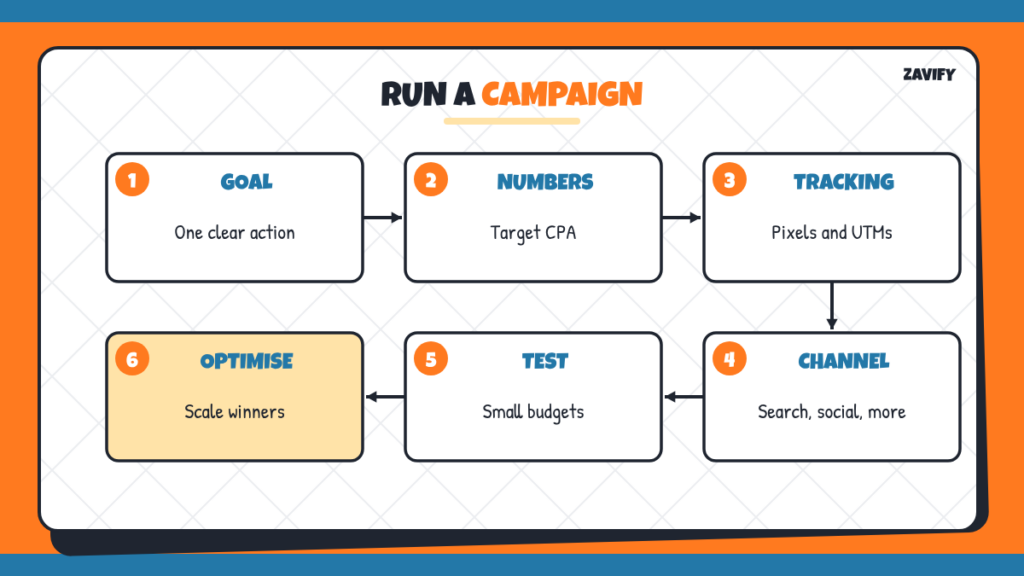
Decide exactly what counts as success: purchases, free trial sign-ups, booked calls or app installs. One clear goal per campaign keeps measurement simple.
2. Know Your Numbers First
Work out how much a customer is worth to you, your profit margin and how much you can afford to pay to win one customer. This becomes your target cost per acquisition.
3. Set Up Tracking
Install conversion tracking on your website and use UTM links on every ad. Without reliable tracking, performance marketing turns into guesswork.
4. Choose the Right Channels
Search ads reach people actively looking for a solution. Social ads reach people based on interests and behaviour. Shopping ads suit product businesses. Affiliates and partners can work well once you have proven demand.
5. Define Your Audience
Target the people most likely to buy, based on search terms, interests, location or past website visits. Narrow, relevant targeting usually beats broad reach for performance campaigns.
6. Create Ads and Landing Pages That Match
Your ad and the page it links to should make the same promise. A clear value proposition, a simple form and fast loading make a big difference to conversion rates.
7. Start Small and Test
Begin with a modest budget and test a few versions of ads, audiences and offers. Let each test gather enough data before deciding.
8. Optimise Toward Results
Move budget from weak campaigns to strong ones. Pause ads with high costs and few conversions, and expand what works.
9. Report and Learn
Review results weekly and monthly. Track not just cost per acquisition but also customer quality, repeat purchases and profit.
Key Performance Marketing Metrics
- Click-through rate (CTR): clicks divided by impressions.
- Conversion rate: conversions divided by clicks.
- Cost per acquisition (CPA): ad spend divided by conversions.
- Return on ad spend (ROAS): revenue from ads divided by ad spend.
- Customer lifetime value (LTV): total revenue expected from a customer over time.
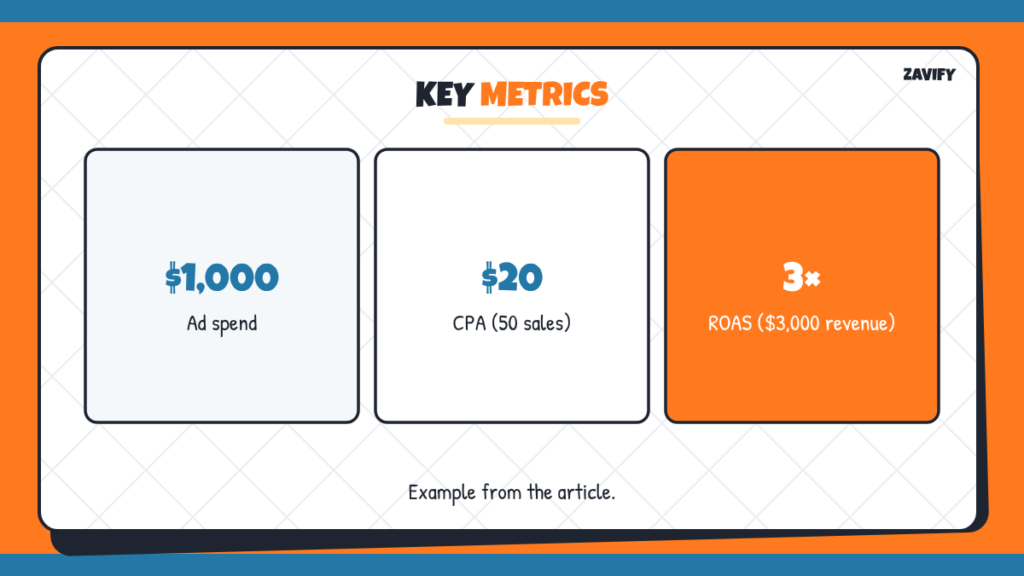
For example, if you spend $1,000 and get 50 sales worth $3,000, your CPA is $20 and your ROAS is 3 (or 300 percent).
Performance Marketing Examples
Here are simplified performance marketing examples:
- Online tutoring company: runs search ads for “SAT tutor near me,” paying per click, and tracks how many clicks become booked trial sessions.
- Clothing brand: uses social ads optimised for purchases and measures ROAS by product category.
- Software startup: pays per lead for webinar sign-ups and tracks how many leads become paying customers.
- Book retailer: pays affiliate websites a commission for each sale they refer.
Performance Marketing vs Brand Marketing
| Feature | Performance Marketing | Brand Marketing |
|---|---|---|
| Goal | Immediate measurable actions | Long-term awareness and trust |
| Measurement | Clicks, leads, sales, ROAS | Awareness, recall, sentiment |
| Time frame | Short term | Long term |
| Example | Search ad with “Buy now” | Sponsorship or brand video |
The two work together. Strong brands often see lower costs in performance campaigns, because people already recognise and trust them.
Rules and Privacy
Performance marketing relies on data, so privacy matters. Follow platform policies, respect consent rules for cookies and tracking, and keep ad claims truthful. The FTC’s advertising and marketing guidance covers US rules, and affiliates must clearly disclose paid relationships.
Careers in Performance Marketing
Common roles include performance marketing specialist, paid search specialist, paid social manager and growth marketer. Employers value analytical skills, comfort with spreadsheets, an understanding of ad platforms and clear communication. Many platforms offer free certifications that help beginners stand out. For the bigger career picture, read our guide to what a marketing manager does.
Understanding Attribution
Customers rarely buy after seeing a single ad. They might see a social ad, search for the brand a few days later, read reviews and then click an email before purchasing. Attribution is the method of deciding which touchpoints get credit for the sale. “Last click” gives all credit to the final interaction, while other models share credit across several steps.
No model is perfect, so compare results across channels, run simple tests such as pausing a campaign in one region and watch overall sales, not just platform reports. Ad platforms tend to credit themselves generously, so cross-check their numbers with your own website analytics and sales data.
Building a Testing Habit
The best campaigns improve through constant testing. Keep a simple log of each test: what you changed, why, how long it ran and what happened. Test one thing at a time, such as the headline, image, audience or offer. Over months, this record becomes one of your most valuable assets, showing what reliably works for your audience.
Common Performance Marketing Mistakes
These mistakes waste budget:
- Launching ads without conversion tracking.
- Judging results too quickly with little data.
- Sending ads to slow or confusing landing pages.
- Focusing only on cheap clicks, not real sales.
- Ignoring profit and customer lifetime value.
Frequently Asked Questions
What is performance marketing?
Digital marketing focused on measurable actions, such as clicks, leads and sales, where budgets follow results.
What are some performance marketing examples?
Search ads paid per click, social ads optimised for purchases, pay-per-lead campaigns and affiliate programs.
What is a good ROAS?
It depends on your margins. A business with high margins can be profitable at a lower ROAS than one with thin margins.
Is affiliate marketing part of performance marketing?
Yes. Affiliates are usually paid only when they deliver a sale or lead.
How much budget do I need to start?
You can start small, but you need enough to gather meaningful data before judging results.
Is performance marketing a good career?
Yes, for people who enjoy data, testing and digital channels. Demand for these skills is strong.
Conclusion
Performance marketing focuses on measurable results, so every dollar can be judged by what it delivers. Clear goals, reliable tracking and constant testing are the keys to success.
Start small, measure carefully and balance it with brand building. For related guides, read sales funnel and AI in marketing.