Introduction
Opening an email that says you have been placed on academic probation is stressful. Many students assume it means they are about to be expelled. It does not. It is a warning, and most colleges design it to give you time and support to recover.
This guide explains what the status means in US colleges, the GPA that usually triggers it, how it affects financial aid and sports, and seven practical steps to return to good standing.
- It usually starts when your cumulative GPA falls below 2.0.
- It is a warning period, not a dismissal.
- You normally have one or two semesters to raise your GPA.
Table of Contents
What Is Academic Probation?
Academic probation is a formal status a college gives to students whose grades fall below the minimum required for good academic standing. At most US colleges that minimum is a 2.0 cumulative GPA, a C average, although some programs such as nursing, engineering or honors colleges set a higher bar.
While you are on probation you can usually keep taking classes, but with conditions. If your grades improve enough, you return to good standing. If they do not, the next step is usually academic suspension or dismissal.
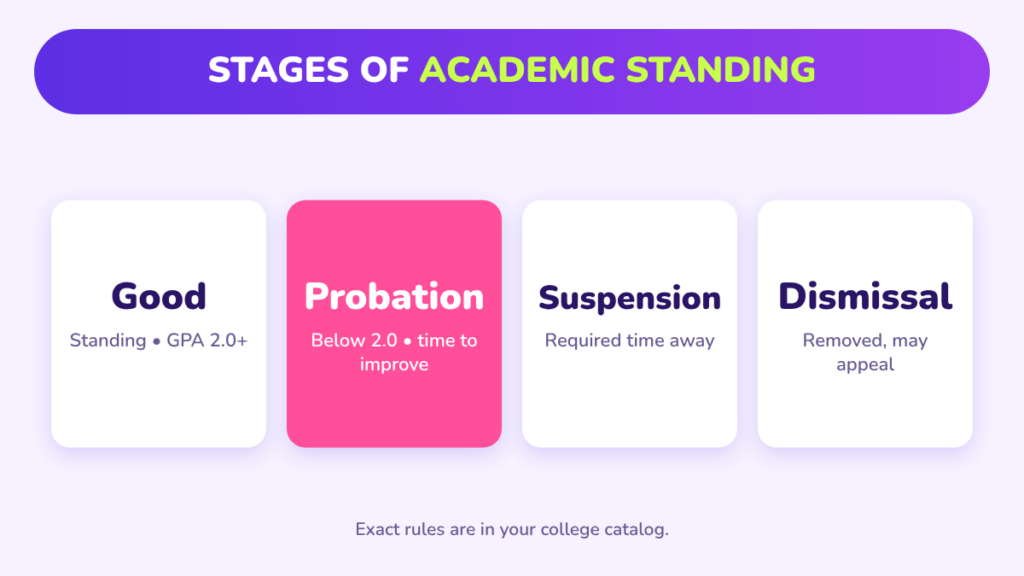
- Good standing: cumulative GPA at or above the minimum.
- Probation: below the minimum, with a set time to improve.
- Suspension or dismissal: required time away, or removal from the college, if grades do not recover.
How Does Academic Probation Work?
Policies differ between colleges, but most follow a similar path:
| Stage | Typical trigger | What usually happens |
|---|---|---|
| Academic warning | First semester below 2.0 (at some colleges) | A notice and advice, few restrictions |
| Probation | Cumulative GPA below 2.0 | Required advising, possible credit limits, a GPA target |
| Continued probation | Semester GPA improves but cumulative is still low | More time, as long as you keep meeting term targets |
| Suspension | Targets not met while on probation | One or more semesters away, then an appeal or readmission process |
| Dismissal | Repeated failure to meet standards | Removal from the college, sometimes with a path to reapply |
Your college catalog or registrar’s website lists the exact GPA thresholds, how many semesters you get and whether summer classes count. Read it carefully; it is the rule that applies to you.
What Happens While You Are on Probation?
- Advising: many colleges require a meeting with an academic advisor and a written success plan.
- Credit limits: you may be limited to 12–15 credits.
- Activities: some schools restrict athletics, student government or Greek life.
- Transcript: the status may appear on your internal record; policies on official transcripts vary.
- Scholarships: awards with a GPA requirement may be paused or lost.
Academic Probation and Financial Aid
Academic probation and financial aid rules are related but separate. To keep federal aid you must meet your school’s Satisfactory Academic Progress (SAP) policy, which usually includes a minimum GPA (a C average by the end of your second year), completing enough of the credits you attempt and finishing within a maximum time frame. See Federal Student Aid’s guide to staying eligible.
If you miss SAP, many schools give one warning term. After that, aid can be suspended, but you can usually appeal if illness, a family emergency or another serious circumstance affected your grades. Talk to the financial aid office as early as possible; they handle these cases every semester.
How to Get Off Academic Probation
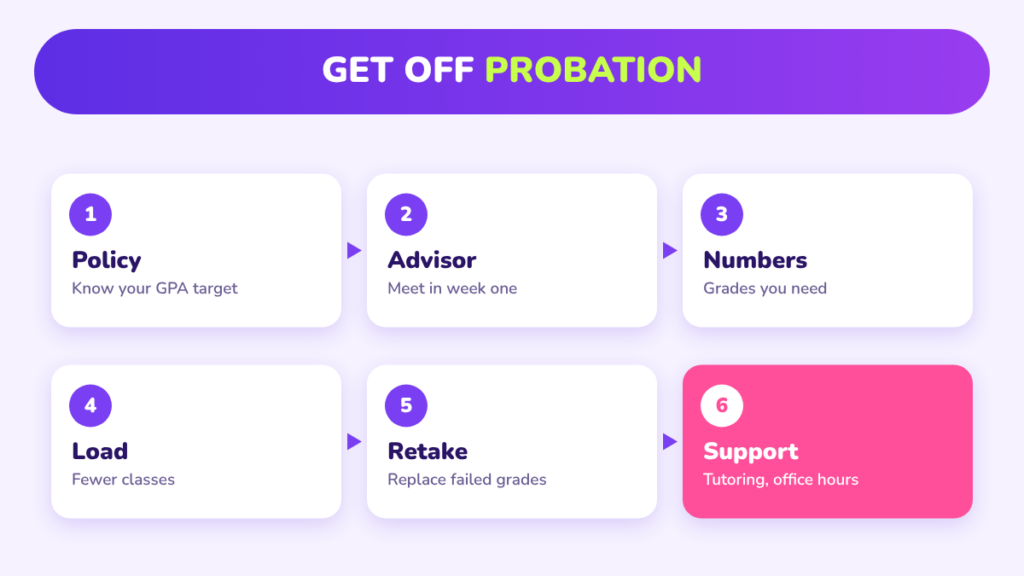
- 1. Read your notice and the policy. Know your exact GPA target and deadline.
- 2. Meet your advisor in the first week. Build a realistic schedule together.
- 3. Calculate the grades you need. Use our required GPA calculator.
- 4. Lighten your course load. Fewer classes done well beat many done poorly.
- 5. Retake failed courses. Many colleges replace the old grade in your GPA.
- 6. Use tutoring, office hours and study groups. They are usually free.
- 7. Fix the cause. Work hours, health, housing or the wrong major all affect grades; campus services can help.
Example: Getting Back to a 2.0
Sam has a 1.8 GPA after 30 credits, which is 54 quality points. To reach a 2.0 after taking 15 more credits, Sam needs 2.0 × 45 = 90 quality points in total, so 36 more. That is 36 ÷ 15 = a 2.4 semester GPA, roughly a mix of Bs and Cs. If Sam retakes a failed 3-credit class and the college replaces the F, the target becomes even easier. Check your own numbers with our cumulative GPA calculator.
Academic Probation vs Suspension vs Dismissal
| Status | Can you take classes? | Is it permanent? |
|---|---|---|
| Probation | Yes, with conditions | No, it ends when your GPA recovers |
| Suspension | No, for a set period | No, you can usually return after the break |
| Dismissal | No | Sometimes; many colleges allow an appeal or reapplication |
Does Academic Probation Affect Your Future?
A semester on probation rarely defines a college career. Employers mainly look at your final GPA, skills and experience, and graduate schools pay attention to upward trends. What matters most is what you do next. Students who recover often describe it as the semester they learned how to study properly. Our guides to a 2.0 GPA and a 1.2 GPA explain where different GPAs stand.
How to Talk to Your Family and Professors
Telling people is uncomfortable, but it helps. With family, be direct: explain what the status means, your GPA target and your plan. With professors, visit office hours early in the term, say you are working to improve and ask how to succeed in their class. Most instructors respond well to students who ask for help before problems grow.
Withdrawing, Repeating and Grade Forgiveness
Three policies can make a big difference to your recovery. A withdrawal (W) removes a class from your GPA calculation if you drop before the deadline, though too many Ws can hurt your completion rate for financial aid. Repeating a course often replaces the old grade in your GPA, which is the fastest way to remove an F. Some colleges also offer academic forgiveness or a fresh start after time away. Ask your advisor which of these your college offers and how many times you may use them.
Getting Support Beyond Academics
Low grades are often a symptom rather than the real problem. Long work hours, money stress, health issues, trouble sleeping or feeling isolated can all show up as missed classes and late assignments. Most campuses offer counselling, disability services, emergency aid and food or housing support. Using them is not a sign of failure; it is how many students get off academic probation and stay off it. If you have a diagnosed condition, registering with disability services can provide accommodations such as extra test time.
A Simple Weekly Plan While on Probation
- Attend every class and sit near the front.
- Block two hours of study for each hour of class.
- Visit office hours for your hardest class every week.
- Check your grades online every Friday and act on any slip.
- Meet your advisor at least twice during the term.
Common Mistakes
- Ignoring the notice or missing the advising deadline.
- Taking a heavy course load to “catch up.”
- Avoiding the financial aid office.
- Withdrawing from classes without checking how it affects SAP.
- Not using free tutoring and support services.
Frequently Asked Questions
What GPA puts you on academic probation?
Usually a cumulative GPA below 2.0, though some programs set a higher minimum.
How long does academic probation last?
Typically one or two semesters, until your cumulative GPA is back above the minimum.
Can you get financial aid on academic probation?
Often yes at first, but you must meet your school’s Satisfactory Academic Progress rules to keep it.
Does academic probation show on your transcript?
It depends on the college. Some list it on official transcripts and others keep it internal.
Can you transfer while on academic probation?
It is possible but harder. Many colleges want transfer applicants to be in good standing with at least a 2.0.
What happens if you fail while on probation?
You may be suspended or dismissed, usually with the right to appeal.
Conclusion
Academic probation is a warning and a second chance. Learn your college’s rules, calculate the grades you need, lighten your load and use the support on campus.
Most students who act early return to good standing. To plan your recovery, use our college GPA calculator and read what counts as a passing grade.