
Introduction
Your GPA tells colleges how you performed. Your class rank tells them how that performance compares with everyone else in your grade. A 3.7 can be near the top at one high school and in the middle at another, and rank is one way to show the difference.
This guide explains what the number means, how schools calculate it, what “top 10 percent” really is, which schools no longer report it and how much it matters for college admissions and scholarships.
- It orders students in a grade by GPA, from highest to lowest.
- It is often shown as a number (25 of 400) or a percentile (top 10%).
- Many high schools no longer report it, and colleges adjust for that.
Table of Contents
What Is Class Rank?
Class rank is your position in your graduating class when all students are ordered by GPA. If you are ranked 25th in a class of 400, 24 students have a higher GPA than you and 375 have a lower one.
Schools report it in different ways. Some give an exact number, some give a percentile or decile (top 10 percent, top 20 percent), and some only name the top students such as the valedictorian and salutatorian.
- Exact rank: 25 of 400.
- Percentile: top 6 percent.
- Decile or quartile: first decile, top quarter.
How Is Class Rank Calculated?
Most schools follow these steps:
- 1. Calculate each student’s cumulative GPA, usually from 9th grade onward.
- 2. Decide weighted or unweighted. Many schools rank by weighted GPA so students are not penalised for taking honors or AP classes.
- 3. Order students from highest to lowest GPA.
- 4. Handle ties. Students with the same GPA usually share a rank.
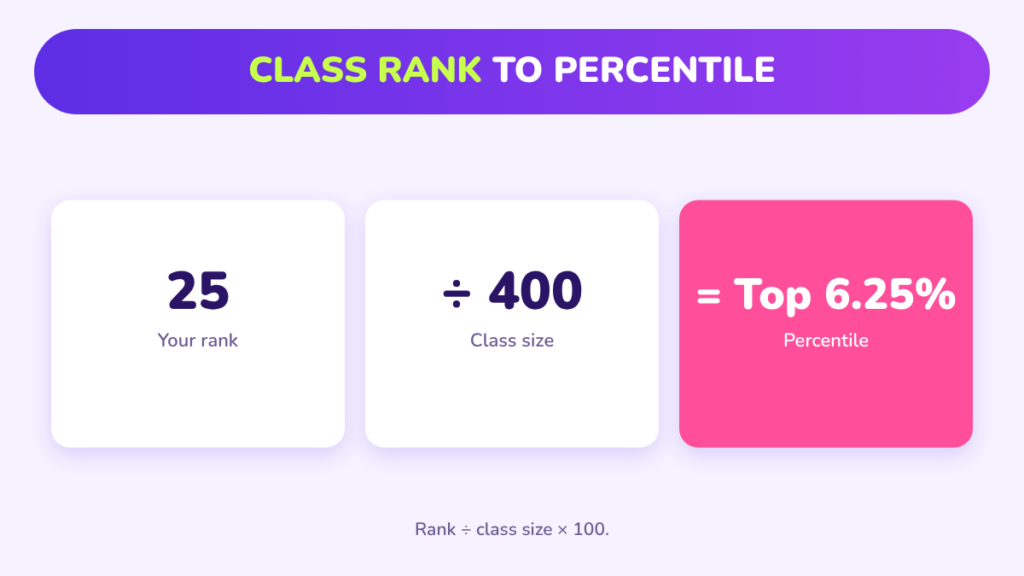
To turn rank into a percentile, divide your rank by the class size and multiply by 100. Rank 25 of 400 is 25 ÷ 400 × 100 = 6.25, so you are in the top 6.25 percent.
| Class size | Top 5% | Top 10% | Top 25% |
|---|---|---|---|
| 100 | Rank 5 or better | Rank 10 or better | Rank 25 or better |
| 250 | Rank 12 or better | Rank 25 or better | Rank 62 or better |
| 400 | Rank 20 or better | Rank 40 or better | Rank 100 or better |
| 600 | Rank 30 or better | Rank 60 or better | Rank 150 or better |
Weighted vs Unweighted Rank
A weighted system gives extra GPA points for honors, AP or IB classes, so a student with a B in AP Chemistry may outrank a student with an A in a regular class. An unweighted system treats all classes the same. Your student handbook says which one your school uses. Our guide to weighted vs unweighted GPA explains the difference, and our high school GPA calculator shows both.
Does Class Rank Matter for College?

It matters less than it used to, but it can still help. Colleges mainly look at your grades in core subjects and the difficulty of your courses. Rank adds context when a school provides it. Where it carries real weight:
- Automatic admission programs: some public university systems guarantee admission to students who graduate near the top of their class. Texas is the best-known example, with a top 10 percent rule for most public universities; individual campuses may set a stricter cutoff.
- Scholarships: some merit awards ask for a rank or percentile.
- Highly selective colleges: most admitted students who report a rank are in the top 10 percent of their class.
On the Common App, your counselor reports your rank if your school has one. If it does not, the field is simply marked as not reported, and you are not penalised. See the Common App for how applications are submitted.
Why Many Schools Stopped Ranking
A growing number of US high schools, especially competitive ones, no longer rank students. In a strong school, tiny GPA differences can separate dozens of places, which can make excellent students look average. Ranking can also discourage students from taking classes they are curious about if those classes are not weighted. Schools that stop ranking usually send colleges a profile showing the grade distribution instead.
Valedictorian and Salutatorian
The valedictorian is traditionally the student ranked first, and the salutatorian is second. Some schools now name several valedictorians, for example everyone above a set GPA, or use Latin honors such as cum laude instead. The titles are an honour worth listing on applications, but colleges care far more about your transcript than the title itself.
Example: Finding Your Percentile
Maya has a 4.1 weighted GPA and is ranked 38th in a class of 520. Her percentile is 38 ÷ 520 × 100 = 7.3, so she is in the top 8 percent. A state university that auto-admits the top 10 percent would include her. Her friend Leo has the same GPA at a different school that does not rank; his counselor’s school profile shows that a 4.1 falls in the top tenth there, which gives colleges similar information.
How to Improve Your Class Rank
- Raise your GPA steadily; rank follows GPA.
- Take weighted classes you can do well in if your school ranks by weighted GPA.
- Start early: 9th and 10th grade count as much as later years.
- Use our final grade calculator to protect borderline grades.
- Do not overload on hard classes just for rank; a lower grade can cost more than the weight adds.
Class Rank in College
Most colleges do not rank undergraduates individually. They recognise top students through the Dean’s List and Latin honors at graduation. Some professional schools, such as law schools, do rank students, and employers in those fields often ask for it.
What If Your School Does Not Rank?
You lose nothing. Colleges are used to reading applications without class rank and rely on the school profile your counselor sends, which shows the range of GPAs in your grade and the courses available. On applications, never estimate or invent a rank; leave the field blank or choose the option that says your school does not rank. If a scholarship form requires one, ask your counselor whether the school can provide a percentile or a letter explaining its policy.
Class Rank and Scholarships
Some scholarships, especially from state programs and local organisations, set a minimum such as the top 10 or top 25 percent of the class. Others use GPA and test scores instead. Read the eligibility rules early in junior year, because your position at the end of that year is usually what gets reported. If you are close to a cutoff, a strong junior spring can make the difference.
How Rank Can Change Over Time
Your position is recalculated as new grades arrive, usually every semester. Because everyone’s GPA moves, you can rise by improving, or slip while standing still if classmates improve faster. Larger classes tend to see more movement in the middle and less at the very top. Ask your counselor when the official calculation for college applications is made; at many schools it is the end of junior year or the first semester of senior year.
Common Mistakes
- Assuming a lower rank at a competitive school will hurt you; colleges see the school profile.
- Choosing easier classes only to protect rank.
- Confusing percentile with percentage grade.
- Reporting a rank your school does not officially provide.
Frequently Asked Questions
What is a good class rank?
Top 25 percent is solid for many colleges; top 10 percent is competitive at selective schools.
How do I find my class rank?
Check your transcript or student portal, or ask your school counselor.
Is class rank based on weighted GPA?
Often yes, but it depends on your school. Check the student handbook.
Do colleges require class rank?
No. Many high schools do not report it, and colleges evaluate those students without it.
What does top 10 percent mean?
Your rank divided by class size is 0.10 or less, for example rank 40 or better in a class of 400.
Does class rank matter more than GPA?
No. Grades and course rigor matter most; rank only adds context.
Conclusion
Class rank shows where your GPA stands among your classmates. It can help with automatic admission and some scholarships, but colleges care most about your grades and the classes you chose.
Focus on steady GPA growth and challenging courses. For more, read GPA scale reporting and our guide to a 3.0 GPA.