GPA Calculator for College Students: Step-by-Step Guide + Free Tool

In the high-stakes world of higher education, your Grade Point Average (GPA) is more than just a numberโ€”itโ€™s a key that unlocks scholarships, graduate school admissions, and competitive job offers. Yet, for many students, the math behind that number remains a mystery.

Are you wondering how a single “C” will impact your financial aid? Or how many “A’s” you need this semester to hit a 3.5? Using a GPA calculator for college isn’t just about looking backward at your performance; itโ€™s about strategically planning your future.

How Does a College GPA Calculator Work?

At its simplest, your GPA is the average of your course grades relative to the number of credits each class is worth. Most colleges use a standard 4.0 scale, where:

  • A = 4.0
  • B = 3.0
  • C = 2.0
  • D = 1.0
  • F = 0.0

The Formula

To calculate your GPA manually, you follow these steps:

  1. Multiply the point value of your grade by the number of credit hours for the course (this gives you “Quality Points”).
  2. Total all the Quality Points from your courses.
  3. Divide the total Quality Points by the total number of credit hours attempted.

$$GPA = \frac{\sum (\text{Grade Points} \times \text{Credits})}{\sum \text{Credits}}$$

Using a digital calculator automates this, preventing the simple arithmetic errors that can lead to a false sense of security or unnecessary panic.

Weighted vs. Unweighted GPA: Whatโ€™s the Difference?

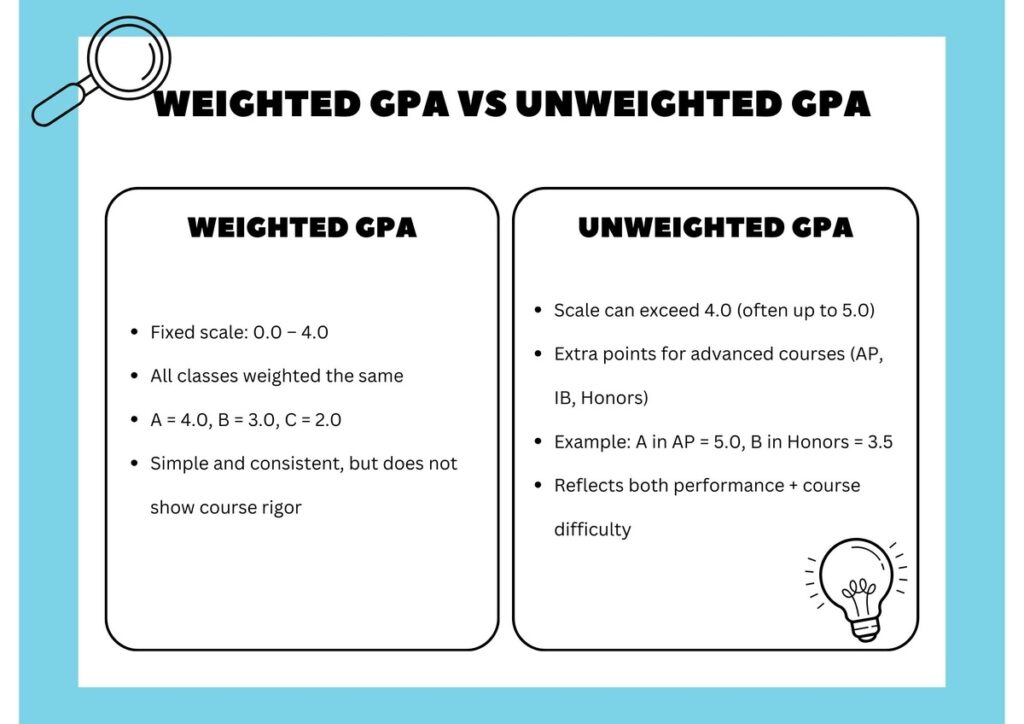
Weighted vs. Unweighted GPA

When using a GPA calculator for college, youโ€™ll often see options for “Weighted” and “Unweighted” scores. Understanding the difference is crucial for accurate tracking.

Unweighted GPA (The Standard)

An unweighted GPA treats every class equally, regardless of difficulty. Whether you are taking “Introduction to Film” or “Organic Chemistry,” an A is worth a 4.0. This is the most common metric used by university registrars to determine academic standing.

Weighted GPA (The Challenge Factor)

Weighted GPAs give extra “weight” to more difficult courses, such as Honors or advanced graduate-level seminars. On a weighted scale, an A in an advanced class might be worth a 4.5 or 5.0. This rewards students for taking on a more rigorous curriculum.

Why You Should Use a GPA Calculator Regularly

1. “What-If” Scenario Planning

The most powerful feature of a GPA calculator is the ability to run “what-if” scenarios. You can input projected grades for your current finals to see exactly what you need to maintain your eligibility for the Deanโ€™s List.

2. Early Warning System

By inputting your mid-term grades, you can identify which classes are dragging down your average. This allows you to seek tutoring or adjust your study habits before the semester ends.

3. Graduation Tracking

Most majors have a minimum GPA requirement for graduation. Frequent check-ins ensure you aren’t met with a nasty surprise during your senior year audit.

Tips for Maintaining a High College GPA

  • Prioritize High-Credit Courses: A 4-credit lab science impacts your GPA more than a 1-credit elective. Allocate your study time accordingly.
  • Understand Your School’s Policy: Does your college use plus/minus grades (like a B+ being 3.3)? Ensure your calculator is set to your schoolโ€™s specific grading scale.
  • Protect Your “Buffer”: It is much easier to maintain a high GPA than it is to pull a low one up. Aim high in your first year to create a safety net for harder upper-division courses.

The Verdict

Your educational life is a marathon and not a sprint. College GPA Calculator is your GPS and it tells you where you are and how far you have to go to get to your destination. You will be able to study less about the math and more about the learning when the guesswork is eliminated off of your grades.

Frequently Asked Questions

Does a 0.0 for an ‘F’ really hurt that much?

Yes. Because the GPA is an average, a single 0.0 requires multiple 4.0s to balance out. This is why many students choose to “Withdraw” (W) from a class rather than risk an “F,” as a “W” usually doesn’t affect the GPA.

Do transfer credits count toward my GPA?

In most cases, no. While transfer credits count toward your total hours needed to graduate, your GPA is usually calculated only from the courses you take at your current institution.

How often should I calculate my GPA?

At a minimum, check it at the start, middle, and end of every semester. This keeps your goals fresh and your academic strategy on point.
College GPA Calculator โ€“ Free Online Tool With Letter Grade Support

In the high-stakes world of higher education, your Grade Point Average (GPA) is more than just a numberโ€”itโ€™s a key that unlocks scholarships, grad school admissions, and competitive job offers. Yet, for many students, the math behind that number remains a mystery.

Are you wondering how a single “C” will impact your scholarship? Or how many “A’s” you need this semester to hit a 3.5? Using a college GPA calculator isn’t just about looking backward at your performance; itโ€™s about strategically planning your future.

How Does a College GPA Calculator Work?

At its simplest, your GPA is the average of your course grades relative to the number of credits each class is worth. Most colleges use a standard 4.0 scale, where:

  • A = 4.0
  • B = 3.0
  • C = 2.0
  • D = 1.0
  • F = 0.0

The Formula

To calculate your GPA manually, you follow these steps:

  1. Multiply the point value of your grade by the number of credit hours for the course (this gives you “Quality Points”).
  2. Total all the Quality Points from your courses.
  3. Divide the total Quality Points by the total number of credit hours attempted.

GPA=โˆ‘Creditsโˆ‘(Grade Pointsร—Credits)โ€‹

Using a digital calculator automates this, preventing the simple arithmetic errors that can lead to a false sense of security or unnecessary panic.

Weighted vs. Unweighted GPA: Whatโ€™s the Difference?

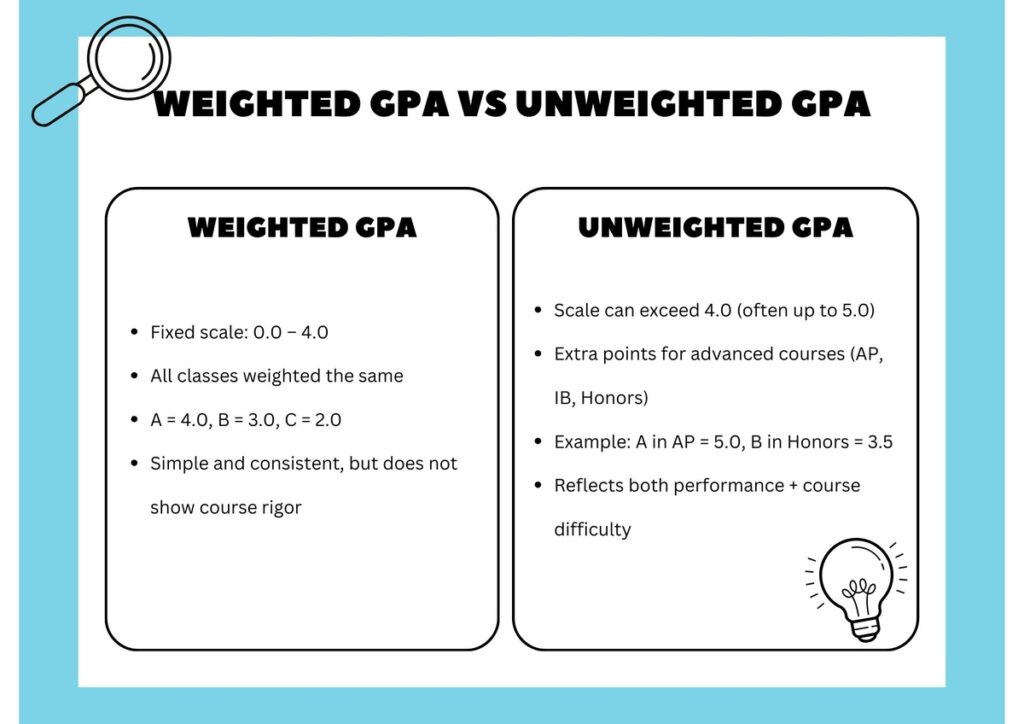
Weighted vs. Unweighted GPA: Whatโ€™s the Difference?

When using a college GPA calculator, youโ€™ll often see options for “Weighted” and “Unweighted” scores. Understanding the difference is crucial for accurate tracking.

Unweighted GPA (The Standard)

Unweighted GPA does not differentiate between the difficulty of classes. A 4.0 is equivalent to an A whether you are taking Introduction to Film or Organic Chemistry. It is the most popular measure that university registrars apply to identify the academic status.

Weighted GPA (The Challenge Factor)

Weighted GPAs give extra “weight” to more difficult courses, such as Honors, AP, or advanced graduate-level seminars. On a weighted scale, an A in an advanced class might be worth a 4.5 or 5.0. This rewards students for taking on a more rigorous curriculum.+1

Why You Should Use a GPA Calculator Regularly

1. “What-If” Scenario Planning

The most powerful feature of a GPA calculator is the ability to run “what-if” scenarios. You can input projected grades for your current finals to see exactly what you need to maintain your financial aid eligibility or stay on the Deanโ€™s List.

2. Early Warning System

By inputting your mid-term grades, you can identify which classes are dragging down your average. This allows you to seek tutoring or adjust your study habits before the semester ends.

3. Graduation Tracking

Most majors have a minimum GPA requirement for graduation. Frequent check-ins ensure you aren’t met with a nasty surprise during your senior year audit.

Tips for Maintaining a High College GPA

  • Prioritize High-Credit Courses: A 4-credit lab science impacts your GPA more than a 1-credit physical education elective. Allocate your study time accordingly.
  • Understand Your School’s Policy: Does your college use plus/minus grades (like a B+ being 3.3)? Ensure your calculator is set to your schoolโ€™s specific grading scale.
  • Protect Your “Buffer”: It is much easier to maintain a high GPA than it is to pull a low one up. Aim high in your freshman year to create a safety net for harder upper-division courses.

The Verdict

Your academic journey is a marathon, not a sprint. A college GPA calculator is your GPS, showing you exactly where you are and how far you need to go to reach your destination. By taking the guesswork out of your grades, you can focus less on the math and more on the learning.

Frequently Asked Questions

Does a 0.0 for an ‘F’ really hurt that much? Yes. Because the GPA is an average, a single 0.0 requires multiple 4.0s to balance out. This is why many students choose to “Withdraw” (W) from a class rather than risk an “F,” as a “W” usually doesn’t affect the GPA.

Do transfer credits count toward my GPA? In most cases, no. While transfer credits count toward your total hours needed to graduate, your GPA is usually calculated only from the courses you take at your current institution.

How often should I calculate my GPA? At a minimum, check it at the start, middle, and end of every semester. This keeps your goals fresh and your academic strategy on point.

Cumulative GPA Calculator: Calculate Your Overall College GPA Instantly

A cumulative GPA calculator is used to compute the cumulative Grade Point Average (GPA) of the student over several semesters or courses. A cumulative GPA calculator helps to easily keep track of academic performance and see where you are compared to instead of doing it manually and calculating your grades.

Whether you’re in college, university, or high school, calculating your cumulative GPA helps you:

  • Track academic progress ๐Ÿ“ˆ
  • Apply for scholarships ๐ŸŽ“
  • Meet graduation requirements ๐ŸŽฏ
  • Improve future academic performance

What Is Cumulative GPA?

Cumulative GPA is the average of all your grades across multiple semesters or academic years.

Unlike semester GPA, which only covers one term, cumulative GPA includes:

  • Previous semesters
  • Current semester
  • All completed courses

This gives a complete picture of your academic performance.

Cumulative GPA Formula

To calculate cumulative GPA, use this formula:

Cumulative GPA = Total Grade Points รท Total Credit Hours

Where:

  • Grade Points = Grade value ร— Credit hours
  • Credit Hours = Weight of each course

Example of Cumulative GPA Calculation

Let’s say:

Previous Semester

  • GPA: 3.2
  • Credit Hours: 15

Current Semester

  • GPA: 3.6
  • Credit Hours: 18

Step-by-Step Calculation:

  1. Convert GPA to grade points
  • 3.2 ร— 15 = 48
  • 3.6 ร— 18 = 64.8
  1. Add total grade points
  • 48 + 64.8 = 112.8
  1. Add total credit hours
  • 15 + 18 = 33
  1. Calculate cumulative GPA
  • 112.8 รท 33 = 3.42 cumulative GPA

Standard GPA Scale

Most institutions use a 4.0 GPA scale:

GradeGPA
A4.0
A-3.7
B+3.3
B3.0
B-2.7
C+2.3
C2.0
D1.0
F0.0

However, some universities may use:

  • 5.0 scale
  • percentage system
  • CGPA system

Always check your university grading system.

Why Cumulative GPA Matters

Your cumulative GPA affects:

1. Scholarships

Many scholarships require minimum GPA requirements.

2. Job Opportunities

Employers often ask for GPA, especially for fresh graduates.

3. Graduate School Admission

Higher GPA increases chances of:

  • Master’s programs
  • PhD programs
  • International scholarships

Tips to Improve Your Cumulative GPA

If your GPA is low, you can improve it:

  • Focus on high-credit courses
  • Retake low-grade subjects
  • Improve study schedule
  • Ask professors for help
  • Practice past papers

Even small improvements can raise your cumulative GPA significantly.

Final Thoughts

A cumulative GPA calculator is one of the easiest ways to track academic success. By calculating your grades regularly, you can stay motivated, set academic goals, and improve performance over time.

Use the calculator above to quickly compute your GPA and monitor your academic progress.