
Introduction
Every spring, high school students face the same question when choosing next year’s schedule: should I take the harder class? AP classes are more work, and a lower grade feels risky. But they can also raise your GPA and strengthen your college applications.
This guide explains how AP classes and honors courses affect your GPA, how weighting works, whether a B in an AP course beats an A in a regular one, and how many advanced courses colleges expect.
- On a weighted scale, an A in an AP course is usually worth 5.0 instead of 4.0.
- Your unweighted GPA does not change because a class is AP.
- Your AP exam score does not affect your GPA.
Table of Contents
What Are AP Classes?
AP classes (Advanced Placement) are college-level courses taught in high school, created by the College Board. There are courses in subjects from Calculus and Biology to U.S. History and Psychology. Each ends with an optional national exam in May, scored from 1 to 5.
Two separate numbers come out of AP classes: your class grade, which your teacher assigns and which counts in your GPA, and your exam score, which colleges may use for credit or placement. See the College Board’s AP score scale for what each score means.
How Do AP Classes Affect Your GPA?
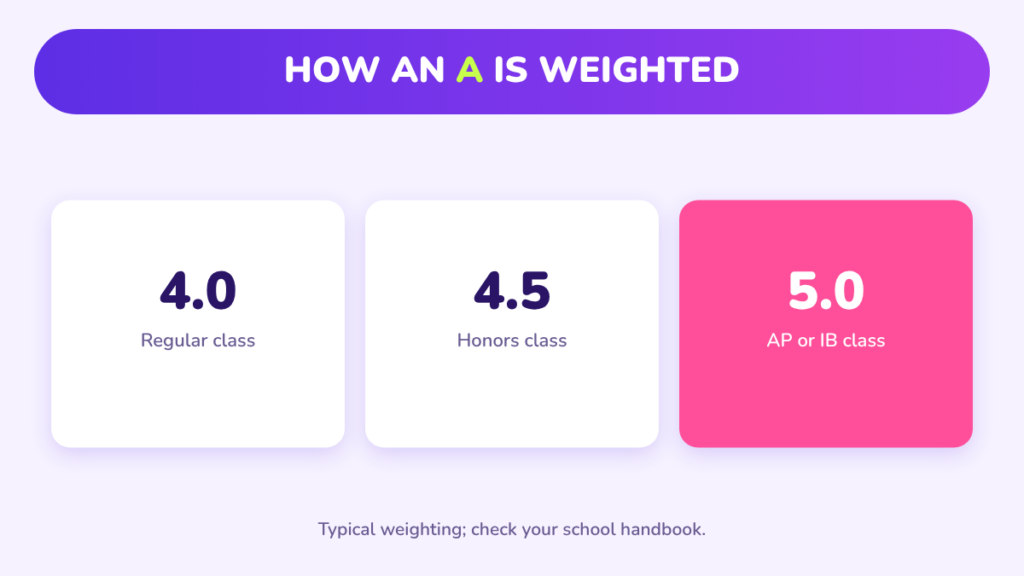
Most US high schools use a weighted GPA that adds extra points for advanced courses. A common system looks like this:
| Letter grade | Regular class | Honors class | AP or IB class |
|---|---|---|---|
| A | 4.0 | 4.5 | 5.0 |
| B | 3.0 | 3.5 | 4.0 |
| C | 2.0 | 2.5 | 3.0 |
| D | 1.0 | 1.5 | 2.0 |
| F | 0.0 | 0.0 | 0.0 |
Schools differ. Some add 0.5 for AP instead of 1.0, some do not weight at all, and some give no extra points for a D. Your student handbook or school profile has the exact rules. On an unweighted scale, an A is 4.0 no matter how hard the class is.
Is a B in AP Better Than an A in a Regular Class?
On a typical weighted scale they are worth the same: both are 4.0. For college admissions, many counselors say a B in an AP course shows more than an A in an easier one, because it proves you chose a challenge. The honest answer from most admissions offices is that they would like to see both: strong grades in demanding courses.
A C in an AP class is a different story. It is worth 3.0 weighted, the same as a B in a regular class, and it lowers your unweighted GPA. If you expect to struggle badly in a subject, an honors or regular section may serve you better.
Example: The Same Student, Two Schedules
| Schedule | Grades | Unweighted GPA | Weighted GPA |
|---|---|---|---|
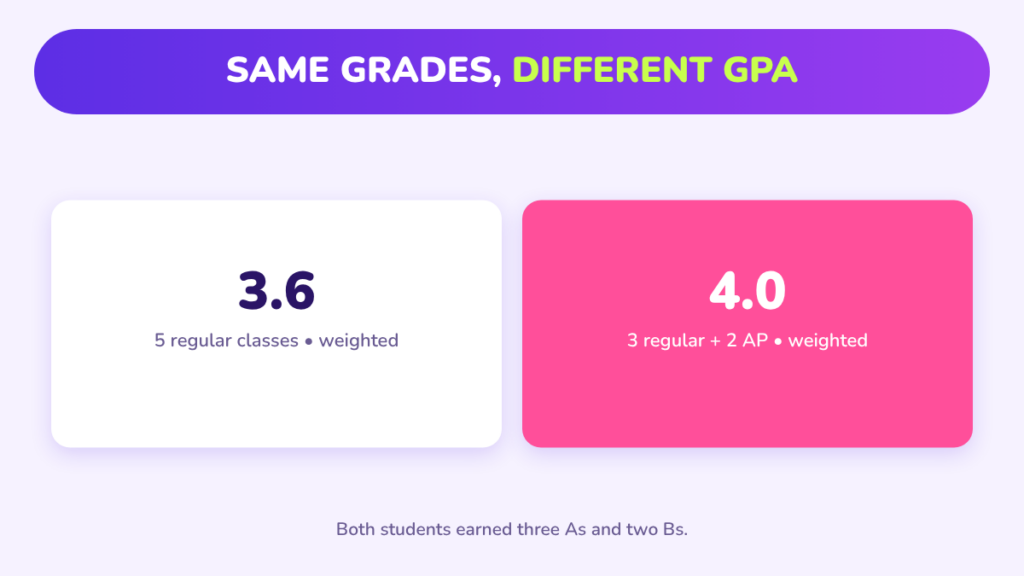
| 5 regular classes | A, A, A, B, B | 3.6 | 3.6 |
| 3 regular + 2 AP | A, A, B (regular); A, B (AP) | 3.6 | 4.0 |
Both students earned three As and two Bs. The unweighted GPA is identical, but the student with two AP classes has a weighted GPA 0.4 higher, and a transcript that shows more rigor. Try your own schedule in our high school GPA calculator.
Does the AP Exam Score Affect Your GPA?
No. Your GPA uses only the grade your teacher gives for the course. The exam score is reported separately. A score of 3 or higher may earn college credit or let you skip an introductory class, but each college sets its own policy, so check the websites of the colleges you are considering.
How Colleges Look at AP Classes
Admissions officers read your transcript alongside your school’s profile, which lists the advanced courses your school offers. They ask whether you took a challenging program compared with what was available to you. A student who took four of the five AP classes offered at a small school can look as strong as one who took eight at a school offering twenty.
Many colleges also recalculate GPA with their own rules, sometimes removing weighting entirely. That is why rigor shows up in two places: the weighted GPA and the course list itself. Our guide to GPA scale reporting explains how to report your GPA on applications.
How Many AP Classes Should You Take?
- 9th grade: usually none or one; focus on strong grades.
- 10th grade: one or two in your best subjects.
- 11th grade: two to four, the year colleges look at most closely.
- 12th grade: keep the rigor; colleges see your senior schedule.
These are common patterns, not rules. The right number is the most you can handle while keeping mostly As and Bs, sleeping enough and keeping the activities you care about.
AP vs Honors vs Dual Enrollment
| Option | What it is | GPA weight (typical) | College credit |
|---|---|---|---|
| Honors | Faster-paced high school course | +0.5 | No |
| AP | College-level course with a national exam | +1.0 | Possible with a qualifying exam score |
| IB | International Baccalaureate courses | +1.0 | Possible with qualifying scores |
| Dual enrollment | A real college course taken in high school | +0.5 to +1.0 | Usually, if the college accepts the transfer |
AP Classes and Class Rank
If your school ranks by weighted GPA, AP classes can move you up the list. Read our guide to class rank to see how percentiles work. Our comparison of weighted vs unweighted GPA covers the two scales in more depth.
When AP Classes Are Not the Right Choice
AP classes are valuable, but they are not automatically the best option. If a subject is a real weakness, a heavy AP load can pull down several grades at once, because the extra work spills into your other classes. Students with demanding jobs, family responsibilities or intense sports seasons may do better with one or two AP classes and solid grades than with five and constant stress. Colleges notice a pattern of Cs more than they notice one fewer AP course.
A good test: look at how you did in the previous course in that subject. An A or a strong B in honors chemistry suggests you are ready for AP Chemistry. A hard-earned C suggests the regular or honors level is the smarter step.
How AP Classes Can Save Money in College
Qualifying exam scores can turn into college credit, which may let you skip introductory courses, take a lighter semester or even graduate early. Policies vary a lot: some colleges give credit for a 3, others require a 4 or 5, and some only offer placement without credit. Before you choose your senior-year AP classes, look up the credit policies of two or three colleges on your list so your effort counts where you are likely to enroll.
Common Mistakes
- Taking too many advanced courses and letting every grade drop.
- Assuming the exam score changes your GPA.
- Choosing AP only for the weight, in subjects you dislike.
- Dropping rigor in senior year after applying.
- Comparing your weighted GPA with another school’s unweighted one.
Frequently Asked Questions
Do AP classes boost your GPA?
They raise your weighted GPA at most schools, usually by adding one point per grade. Unweighted GPA is not affected.
How much does an AP class raise your GPA?
One AP course among five classes, with the same letter grade, raises a weighted GPA by about 0.2 for that term.
Is an A in AP a 5.0?
Yes, on the common 5.0 weighted scale. Some schools use a different weight.
Does failing the AP exam hurt your GPA?
No. Exam scores are separate from your course grade and GPA.
Do colleges prefer AP or honors?
Both show rigor. AP is standardised nationally, so it is easier for colleges to compare.
Can a weighted GPA be higher than 4.0?
Yes. Students with many As in honors and AP courses often have weighted GPAs between 4.0 and 5.0.
Conclusion
AP classes raise your weighted GPA and show colleges that you can handle challenging work. A B in an advanced course is usually worth as much as an A in a regular one, but balance matters more than volume.
Choose the hardest schedule you can do well in, and track the results with our high school GPA calculator and final grade calculator.