Introduction
Every business owner, sales rep and marketing team eventually asks the same question: how do we sell more? The answer is rarely one big trick. It is usually a set of small, practical improvements that add up over time.
This guide explains how to increase sales using a simple framework, with nine easy steps, a worked example and the numbers to watch. It is written for small business owners, new salespeople and students working on business projects.
- Sales grow through more customers, bigger orders or more repeat purchases.
- Fixing your weakest step often brings the fastest results.
- Track a few simple numbers to know what is working.
Table of Contents
What Does It Mean to Increase Sales?
To increase sales means growing the revenue a business earns from selling its products or services. It can come from attracting new customers, convincing more of them to buy, getting each customer to spend more or encouraging them to come back more often.
A useful way to think about it is a simple formula: sales = number of customers × average order value × number of purchases per customer. Improving any one of these raises total sales; improving all three multiplies the effect.
- More customers: reach and convert more people.
- Bigger orders: raise average order value.
- More purchases: improve retention and repeat buying.
How Do You Increase Sales?
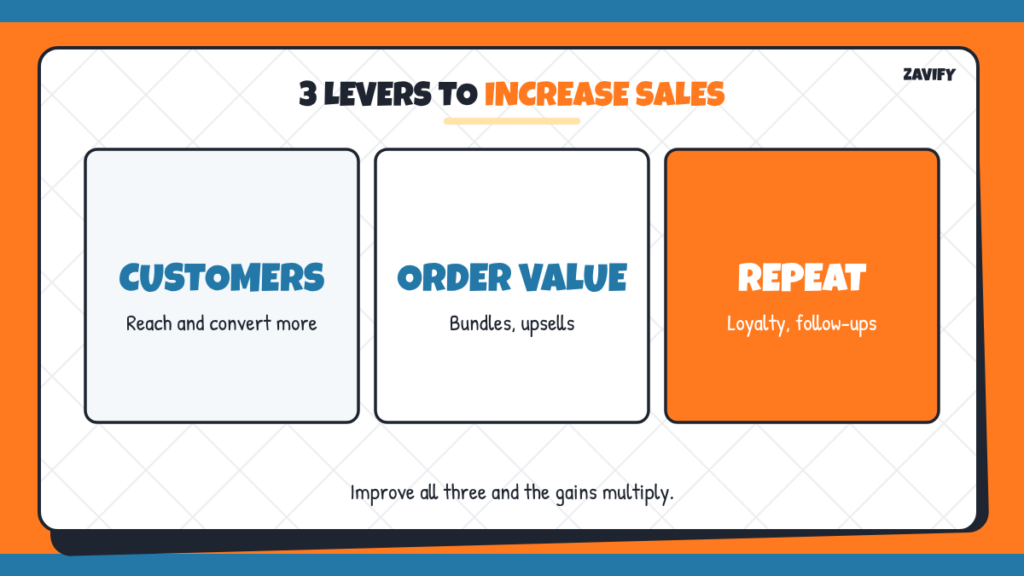
Here is how the three levers work, with examples of actions for each:
| Lever | Ways to Improve It | Example |
|---|---|---|
| More customers | Better marketing, referrals, higher conversion | Simpler checkout raises completed orders |
| Bigger orders | Bundles, upsells, free shipping thresholds | “Free shipping over $50” |
| More purchases | Loyalty programs, follow-ups, subscriptions | Reminder email when supplies run low |
Because the levers multiply, a 10 percent improvement in each one increases total sales by about 33 percent, not 30 percent.
1. Know Your Numbers
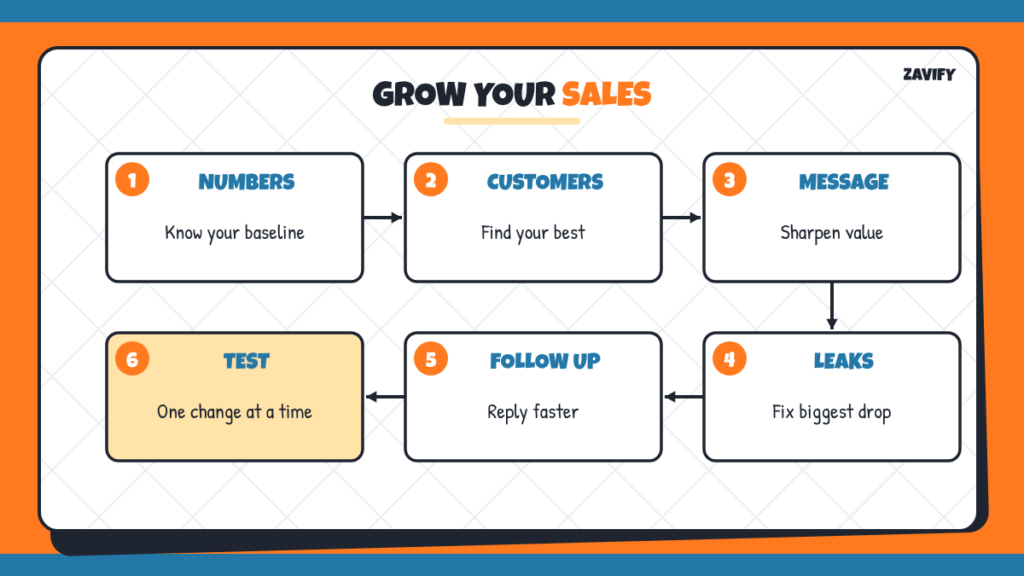
Start with the basics: how many visitors or leads you get, how many become customers, average order value and how often customers return. Our guide on how to track sales progress explains a simple way to do this.
2. Understand Your Best Customers
Look at who buys the most and returns most often. What do they have in common? Focusing marketing on people like them usually brings better results than trying to reach everyone.
3. Sharpen Your Value Proposition
Make it instantly clear who you help and why you are the better choice. A confusing message loses customers before they start. Read our guide to writing a value proposition.
4. Fix Your Biggest Drop-Off
Find where most potential customers give up: the website, a slow quote process, a confusing checkout or slow follow-up. Fixing that one step often increases sales faster than spending more on ads. Our sales funnel guide shows how to spot leaks.
5. Follow Up Faster
Respond to enquiries as quickly as possible, ideally the same day. Many sales are lost simply because a competitor replied first.
6. Raise Average Order Value
Offer helpful bundles, add-ons and upgrades. A free shipping threshold slightly above your average order often encourages customers to add one more item. Only suggest things that genuinely help the customer.
7. Keep Customers Coming Back
Thank customers, ask for feedback and send useful follow-ups. Loyalty programs, subscriptions and reminders encourage repeat purchases, which are often cheaper than winning new customers.
8. Ask for Referrals and Reviews
Happy customers are your best salespeople. Ask for reviews after a good experience and make it easy to refer friends, perhaps with a small reward for both people.
9. Test, Measure and Repeat
Try one change at a time, such as a new offer, headline or follow-up email, and compare results. Keep what works and drop what does not.
Worked Example: A Small Online Store
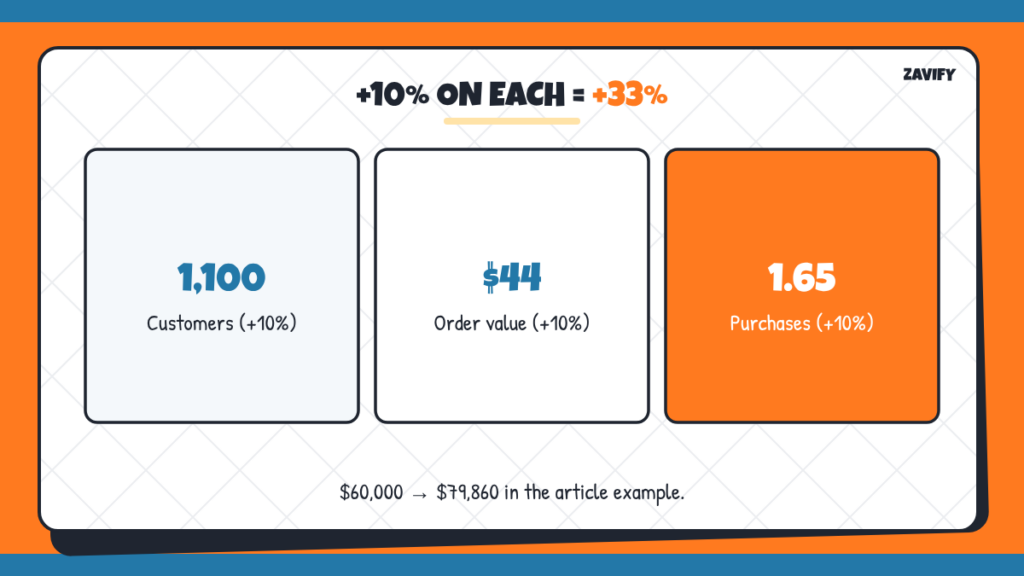
An online store wins 1,000 customers in a month. Each spends an average of $40 per order and buys 1.5 times over the following year, giving $60,000 in sales from that group of customers. The owner simplifies checkout, raising customers to 1,100 (+10%). A bundle offer lifts the average order to $44 (+10%). A reminder email programme increases purchases to 1.65 per year (+10%). New total: 1,100 × $44 × 1.65 = $79,860, about 33 percent more than the $60,000 starting point.
Ways to Increase Sales for Salespeople
If you work in sales, the same ideas apply to your own pipeline. Prospect consistently, qualify leads carefully, run strong discovery calls, send clear proposals quickly and follow up reliably. Our guides to managing a sales pipeline, handling objections and writing a sales proposal cover each step.
Pricing and Promotions
Discounts can boost short-term sales but may reduce profit and train customers to wait for deals. When people ask how to increase sales, discounts are often the first idea. Before cutting prices, try adding value instead: bundles, better service, faster delivery or a guarantee. If you do run promotions, set clear goals and end dates, and keep advertising honest; the FTC’s advertising guidance explains US rules on truthful claims.
Getting Help as a Small Business
Free advice is available. The US Small Business Administration’s local assistance page lists free counselling and training from organisations such as SCORE and Small Business Development Centers, which can help with marketing and sales plans.
Ways to Increase Sales Online
For online businesses, a few changes make a big difference. Speed up your website, because slow pages lose buyers. Use clear product photos, honest descriptions and visible reviews. Simplify checkout by offering guest checkout and popular payment methods. Recover abandoned carts with a friendly reminder email. Keeping a small set of email templates for cart reminders, reorder nudges and seasonal offers means those messages stay consistent and take minutes to send. Show related products on product and cart pages, and make shipping costs clear early to avoid surprises at the last step.
Ways to Increase Sales in a Physical Store
In a shop, small details matter too. Train staff to greet customers and ask helpful questions, place popular items and add-ons near the checkout, keep displays tidy and well lit, and collect email addresses at checkout so you can invite customers back. Local partnerships, such as discounts for nearby college students or cross-promotions with neighbouring businesses, can also bring in new customers at low cost. Our guide to the sales associate role covers in-store selling skills.
Using Customer Feedback
Some of the best ideas come directly from customers. Short surveys, review comments and conversations with your team reveal why people buy, what almost stopped them and what they wish you offered. Act on the most common themes and tell customers when you have made a change; it builds loyalty and often brings them back.
Common Mistakes When Trying to Increase Sales
These mistakes waste effort and money:
- Spending more on ads before fixing conversion problems.
- Relying on constant discounts.
- Ignoring existing customers.
- Making several changes at once and not knowing what worked.
- Not tracking basic numbers.
Frequently Asked Questions
How can I increase sales quickly?
Fix your biggest drop-off point, follow up faster with leads and contact past customers with a relevant offer.
What are the main ways to increase sales?
Win more customers, increase average order value and encourage more repeat purchases.
Is lowering prices a good way to increase sales?
Sometimes, but it can hurt profit. Adding value or improving conversion is often better.
How do small businesses increase sales without a big budget?
Improve their website and follow-up, ask for referrals and reviews, and focus on their best customers.
How do salespeople increase their sales?
Prospect consistently, qualify leads, run good discovery, send proposals quickly and follow up reliably.
How long does it take to see results?
Some fixes, like faster follow-up, work within weeks. Others, like building loyalty, take months.
Conclusion
To increase sales, focus on three levers: more customers, bigger orders and more repeat purchases. Small improvements in each multiply into big results.
Know your numbers, fix your weakest step and keep testing. For more, read our guides to the sales funnel and value proposition.