Introduction
“It’s too expensive.” “Now isn’t a good time.” “We already use someone else.” Every salesperson hears these lines, usually several times a day. New sellers often treat them as rejection. Experienced sellers treat them as information.
This guide explains what sales objections are, why buyers raise them, a simple framework for responding and nine easy steps with real example responses you can adapt to your own calls and meetings.
- An objection is a concern, not always a final “no.”
- Most objections fall into a few common types.
- Listening and asking questions work better than arguing.
Table of Contents
What Are Sales Objections?
Sales objections are the concerns, doubts or reasons a potential customer gives for not buying, or not buying yet. They might be about price, timing, trust, need or a competitor. Sometimes they are genuine deal-breakers; often they are signs that the buyer needs more information or reassurance.
An objection is actually a good sign in many cases. A buyer who raises concerns is still engaged. The bigger risk is silence, where a buyer stops responding without explaining why.
- Real objection: a genuine concern that must be addressed.
- Smoke screen: a polite excuse hiding the real concern.
- Condition: a true blocker, such as no budget at all, that cannot be solved now.
How Does Objection Handling Work?
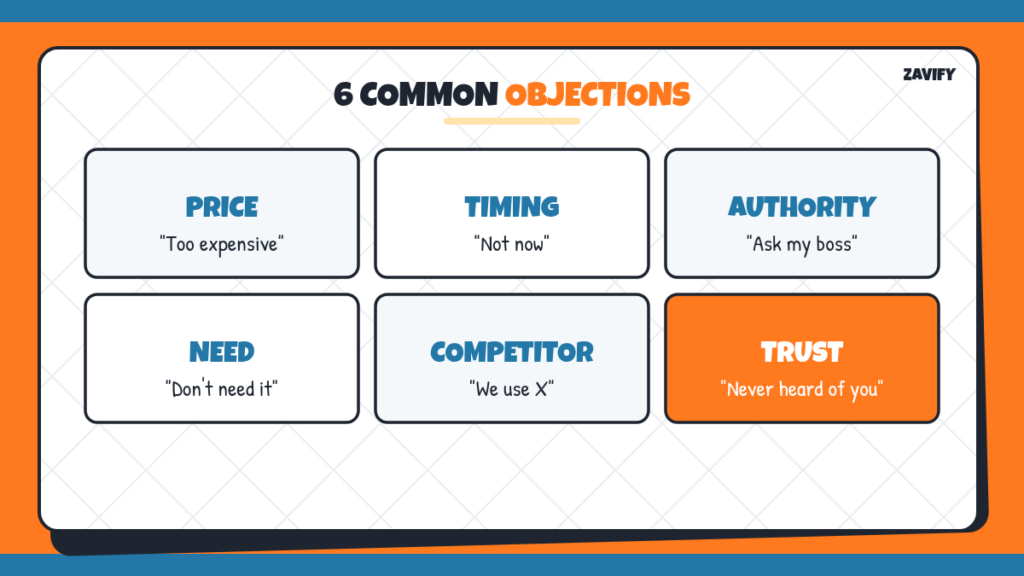
Most common sales objections fit into a handful of categories:
| Type | What the Buyer Says | What It Often Means |
|---|---|---|
| Price | “It’s too expensive.” | They do not yet see enough value |
| Timing | “Now isn’t a good time.” | Other priorities or no urgency |
| Authority | “I need to check with my boss.” | They are not the final decision-maker |
| Need | “We don’t really need this.” | The problem is not clear or not painful enough |
| Competitor | “We already use X.” | Switching feels risky or effortful |
| Trust | “I’ve never heard of you.” | They need proof and reassurance |
Identifying the type of sales objections you hear helps you choose the right response instead of reacting with a generic pitch.
1. Listen Fully
Let the buyer finish without interrupting. Many sellers jump in after the first few words and miss the real concern. A short pause after they finish also signals that you are taking them seriously.
2. Acknowledge the Concern
Show you heard them: “That’s a fair point; price is a big decision.” Acknowledging is not agreeing; it lowers tension and keeps the conversation open.
3. Ask a Clarifying Question
Explore what sits behind the objection: “When you say it’s expensive, is that compared to another option or to your budget?” The answer tells you what to address.
4. Identify the Real Objection
Sometimes the first objection is a smoke screen. Ask, “Besides price, is there anything else holding you back?” This often reveals the real concern, such as risk or a colleague’s doubts.
5. Respond With Relevant Value
Answer the specific concern with facts, examples or a clear explanation. For a price objection, connect the cost to the result they told you they want, such as time saved or revenue gained.
6. Use Proof
Case studies, reviews, references and data reduce perceived risk. “A similar clinic cut no-shows by a third in two months” is more convincing than “Our product is great.”
7. Check if You Have Answered It
Ask, “Does that address your concern?” If not, keep exploring. Moving on before the buyer is satisfied usually brings the objection back later.
8. Agree on a Next Step
Turn the conversation into action: a demo with their boss, a pilot, a follow-up call or a proposal. A clear next step keeps momentum.
9. Learn From Every Objection
Write down the sales objections you hear most and the responses that work. Share them with your team. Over time, you will build a playbook that makes difficult conversations much easier.
Example Responses to Common Objections
Adapt these to your product and voice. Notice that most start with a question rather than an argument.
- “It’s too expensive.” “I understand. Can I ask what you’re comparing it to? Earlier you mentioned losing about ten hours a week to manual reports; how much is that time worth to the team?”
- “Now isn’t a good time.” “That makes sense. What’s going on right now? When would be a better time to revisit, and what would need to change by then?”
- “We already use X.” “Good to hear you have something in place. What do you like most about it, and is there anything you wish it did better?”
- “Send me some information.” “Happy to. So I send something useful, what’s the main thing you’d want to understand?”
- “I need to talk to my manager.” “Of course. What do you think will matter most to them? Would it help if I joined a short call with both of you?”
How to Handle Sales Objections Over Email
Not every concern comes up live. When a buyer raises one by email, reply quickly, acknowledge it in the first sentence and ask one clarifying question rather than sending a long defence. Offer a short call if the topic is complex. Written answers should be brief and specific, with a link to a relevant case study if you have one. Learning how to handle sales objections in writing is just as useful as handling them on the phone.
The LAER Framework
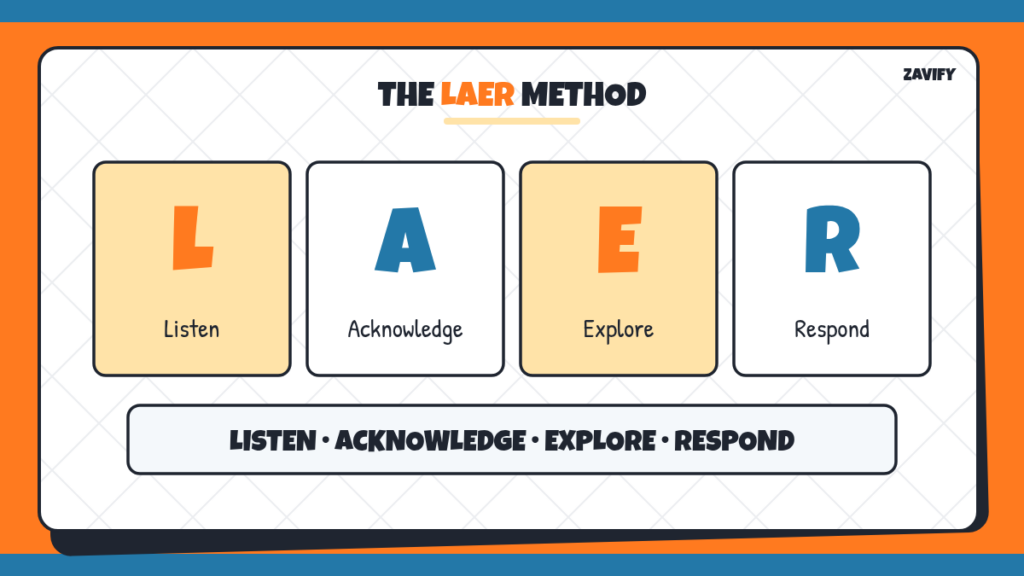
A simple way to remember the process is LAER: Listen, Acknowledge, Explore and Respond. Listen fully, acknowledge the concern, explore with questions and respond with relevant value. Many sales trainers teach a version of this because it keeps you calm and focused on the buyer.
How to Prevent Objections Early
Many sales objections can be avoided through good discovery. If you understand the buyer’s goals, budget, decision-makers and timeline early, you can address concerns before they become objections. Our guide to B2B sales explains discovery in more detail, and our cold calling guide covers objections on first calls.
When to Walk Away
Not all sales objections should be overcome. If the product genuinely does not fit the buyer’s needs or budget, the honest move is to say so. Walking away politely protects your reputation, and buyers often come back or refer others when the timing or fit is right.
Objection Handling in Job Interviews
Sales interviews often include role-play where the interviewer raises objections on purpose. They want to see that you stay calm, ask questions and avoid arguing. Practising the LAER framework with a friend before your interview can make a big difference. Handling objections is a core part of most sales jobs; the US Bureau of Labor Statistics describes how sales representatives answer customer questions and negotiate to close deals. Read our sales careers guide for more interview tips.
Building a Sales Objections Playbook
A playbook is a shared document where a team records the sales objections they hear and the responses that work best. Start simple: a table with the objection, the likely real concern behind it, two or three questions to ask and one piece of proof, such as a case study or statistic. Review it every month and add new examples from recorded calls.
Playbooks are especially helpful for new team members, who can learn from years of experience in a few hours. They also keep messaging consistent, so customers hear accurate, honest answers no matter who they talk to.
Sales Objections in Different Types of Selling
The same categories appear everywhere, but the details change. In software sales, buyers often worry about implementation time and whether their team will actually use the product. In high ticket consumer sales, such as coaching or home improvement, the biggest concerns are usually cost and trust. In retail, shoppers might hesitate over price, quality or whether they will find a better deal elsewhere.
Understanding the typical sales objections in your industry lets you prepare better questions and proof in advance, which makes every conversation calmer and more productive.
Common Mistakes When Handling Sales Objections
Avoid these mistakes:
- Interrupting before the buyer finishes.
- Arguing or getting defensive.
- Offering a discount immediately.
- Answering the wrong objection.
- Ending the conversation without a next step.
Frequently Asked Questions
What are sales objections?
They are concerns or reasons a buyer gives for not buying, such as price, timing, need, authority, competitors or trust.
What is the most common sales objection?
Price is usually the most common, though it often hides a concern about value or risk.
How do you handle sales objections?
Listen, acknowledge the concern, ask questions to understand it and respond with relevant value and proof.
Should I offer a discount when a buyer says it is too expensive?
Not straight away. First understand what the buyer is comparing and whether they see enough value.
What is the LAER method?
Listen, Acknowledge, Explore and Respond: a simple framework for handling objections calmly.
Are objections a bad sign?
Not necessarily. They often show the buyer is still engaged and considering the purchase.
Conclusion
Sales objections are a normal part of every sales conversation. Treat them as information, not rejection: listen, acknowledge, explore and respond with value.
Build your own list of common objections and responses, and practise them until they feel natural. To keep learning, read our guides to high ticket sales and inside sales.