Introduction
Ask any sales manager what they look at first each morning and many will say the same thing: the pipeline. It shows every potential deal, how close each one is to closing and whether the team is on track to hit its target.
This guide explains what a sales pipeline is, the typical stages, the metrics teams track and nine easy steps to build and manage one. If you are starting an SDR or account executive job, understanding the pipeline will help you from day one.
- A sales pipeline is a visual list of active deals by stage.
- It helps sellers prioritise and managers forecast revenue.
- Healthy pipelines need regular updates and honest stages.
Table of Contents
What Is a Sales Pipeline?
A sales pipeline is an organised view of all the deals a salesperson or team is working on, grouped by how far each deal has progressed toward closing. It is usually managed in a CRM and displayed as columns, with each deal moving from left to right as it advances.
It differs from a sales funnel. A funnel shows the overall journey and conversion rates from awareness to purchase. A pipeline focuses on specific deals and the actions needed to move each one forward.
- Deal: a potential sale with a company or person.
- Stage: where the deal is in the process.
- Value: how much the deal is expected to be worth.
How Do Sales Pipeline Stages Work?
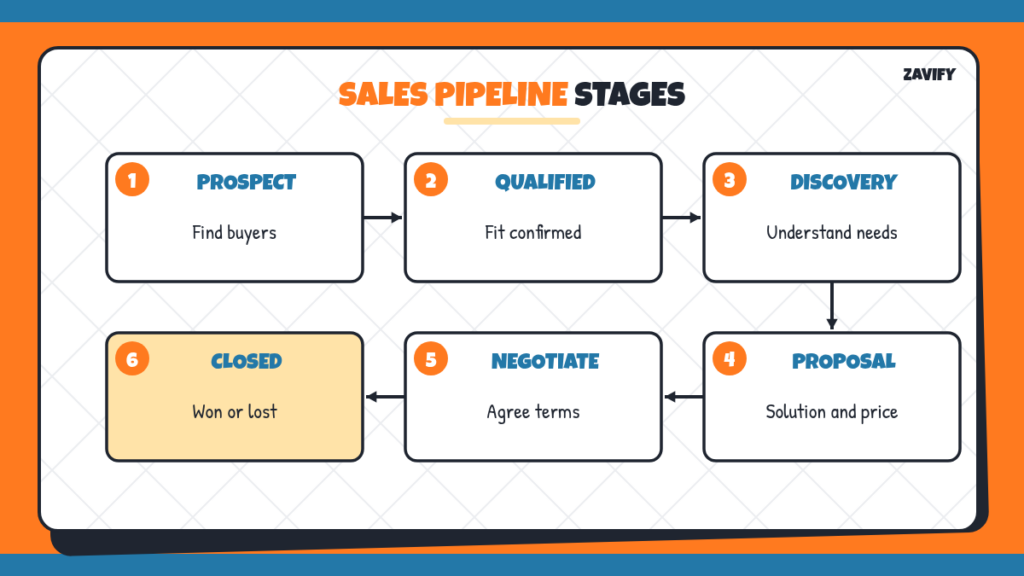
Stage names vary between companies, but most pipelines look something like this:
| Stage | What Happens | Exit Criteria |
|---|---|---|
| Prospecting | Identify possible buyers | Contact made |
| Qualified | Confirm fit, need and budget | Meeting booked |
| Discovery | Understand problems in depth | Clear use case agreed |
| Proposal / demo | Present solution and pricing | Proposal sent |
| Negotiation | Agree terms with decision-makers | Verbal agreement |
| Closed won / lost | Deal signed or lost | Contract signed or reason recorded |
“Exit criteria” are the conditions a deal must meet before moving to the next stage. They keep the pipeline honest, so deals are not marked as further along than they really are.
1. Define Your Stages
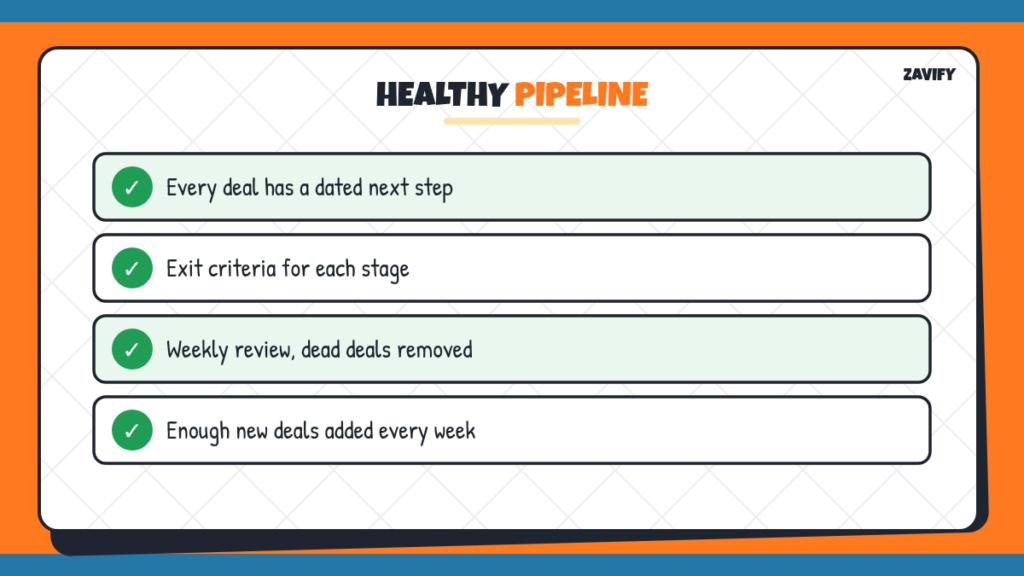
Agree on five to seven stages that match how your customers actually buy. Too few stages hide problems; too many make updates tedious.
2. Set Clear Exit Criteria
For each stage, write down what must happen before a deal moves on, such as “decision-maker attended demo.” This makes stages consistent across the team.
3. Fill the Top With Qualified Leads
A healthy pipeline needs a steady flow of new opportunities. Use prospecting, referrals and marketing leads, and qualify them early. Our guide to sales leads explains qualification.
4. Add Every Deal to the CRM
Record each deal with its value, stage, contacts and next step. If it is not in the CRM, it does not exist for forecasting.
5. Always Set a Next Step
Every deal should have a specific next action with a date, such as “send proposal Thursday.” Deals without next steps tend to stall.
6. Review the Pipeline Weekly
Set a regular time to update stages, values and dates. Many teams hold a weekly pipeline review with their manager.
7. Remove Dead Deals
Close out deals that have gone silent for a long time or no longer fit. A smaller, honest pipeline is more useful than a large, unrealistic one.
8. Track Pipeline Metrics
Watch the numbers below to understand pipeline health and spot problems early.
9. Forecast and Plan
Use stage-based probabilities and past win rates to estimate likely revenue. Compare the forecast with your target to decide whether you need more prospecting.
Key Sales Pipeline Metrics
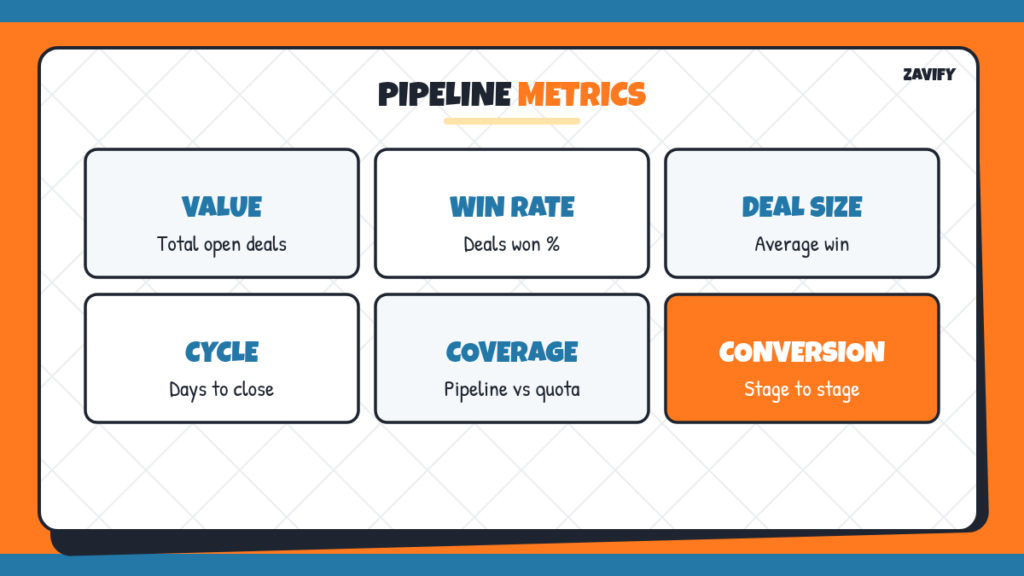
- Pipeline value: total value of all open deals.
- Win rate: share of deals that close successfully.
- Average deal size: typical value of a won deal.
- Sales cycle length: average time from first contact to close.
- Pipeline coverage: pipeline value compared with the sales target; many teams aim for several times their quota.
- Stage conversion rate: how many deals move from one stage to the next.
Example: A Simple Pipeline Forecast
Imagine an account executive with three deals: $20,000 in proposal stage (estimated 50 percent chance), $30,000 in discovery (25 percent) and $10,000 in negotiation (80 percent). A weighted forecast would be $10,000 + $7,500 + $8,000 = $25,500. If the monthly target is $40,000, the rep knows they need more opportunities or faster progress.
How the Pipeline Connects Marketing and Sales
Marketing fills the top with leads, sales development representatives qualify them, and account executives move them through the later stages. A shared pipeline view helps everyone see where deals get stuck. Read our guides to inside sales and outbound sales to see how different roles contribute.
How to Run a Weekly Pipeline Review
A good weekly review takes 20 to 30 minutes. Start with deals expected to close this month and confirm the next step for each one. Then look at deals that have not moved for two weeks or more and decide whether to push, pause or close them. Finally, check whether there are enough new opportunities entering the top of the pipeline to support future targets.
Managers often ask simple questions during these reviews: “What happens next?”, “Who is the decision-maker?” and “What could stop this deal?” Preparing answers before the meeting makes the review faster and helps you spot risks early.
Pipeline Management for New Reps
If you are new to sales, your pipeline will feel small at first. Focus on activities you can control: researching accounts, reaching out consistently and booking first meetings. Keep your CRM accurate from day one, even when it feels like admin. Most sales jobs combine salary with commission or bonuses tied to results, according to the US Bureau of Labor Statistics, so an accurate pipeline directly affects your pay. Managers trust reps whose pipeline reflects reality, and that trust often leads to better accounts and leads over time.
Signs of a Healthy Pipeline
- New opportunities are added every week.
- Deals move through stages at a steady pace.
- Every deal has a clear next step and date.
- Win rates are stable or improving.
- Total pipeline value comfortably exceeds the target.
Pipeline vs Forecast vs Quota
These three terms are related but different. The pipeline is the full list of open deals. The forecast is the share of that pipeline a rep or manager realistically expects to close in a given period, based on stage and judgment. The quota is the target the rep is expected to hit. A strong pipeline makes an accurate forecast possible, and an accurate forecast tells the team early whether it is on track to meet quota.
Tools for Managing Your Pipeline
Most companies use a CRM to manage deals. Popular options include Salesforce, HubSpot, Pipedrive and Zoho CRM. Smaller teams sometimes start with a spreadsheet or a simple board tool. Whatever you use, the principles are the same: clear stages, accurate values and a next step for every deal. Many CRMs also show charts of pipeline value by stage, which make weekly reviews much quicker.
Common Sales Pipeline Mistakes
These mistakes make pipelines unreliable:
- Keeping dead deals open to make the pipeline look bigger.
- Moving deals forward without meeting exit criteria.
- Not recording next steps.
- Updating the CRM only at the end of the month.
- Relying on a few large deals instead of a steady flow.
Key Takeaways
- Keep stages simple and tied to how customers actually buy.
- Use exit criteria so deals are not marked further along than they are.
- Give every deal a dated next step.
- Review weekly and remove dead deals.
- Watch win rate, cycle length and coverage to judge health.
A pipeline is only as useful as the information in it. Treat it as a daily working tool rather than a report you update for your manager, and it will help you prioritise your time and close more deals.
Frequently Asked Questions
What is a sales pipeline?
An organised view of all active deals, grouped by stage, showing where each potential sale stands.
What are the sales pipeline stages?
Common stages include prospecting, qualified, discovery, proposal, negotiation and closed won or lost.
What is the difference between a sales pipeline and a sales funnel?
A pipeline tracks individual deals and actions; a funnel shows the overall buyer journey and conversion rates.
How often should I update my pipeline?
After every important interaction, with a full review at least once a week.
What is pipeline coverage?
The ratio of open pipeline value to the sales target, showing whether there are enough deals to hit the goal.
Which tools are used to manage a sales pipeline?
Most teams use a CRM such as Salesforce, HubSpot or Pipedrive. Our sales CRM guide explains the options.
Conclusion
A sales pipeline shows every deal and where it stands, helping sellers prioritise and managers forecast. Clear stages, honest exit criteria and regular reviews keep it useful.
Start with simple stages, set a next step for every deal and track a few key metrics. For more, read our guides to the sales funnel and how to track sales progress.