Introduction
When a company reports how much it sold, the headline number is rarely the full story. Some customers return products, some get price reductions for damaged items, and some pay early in exchange for a discount. One figure accounts for all of that.
This guide explains what net sales means, the net sales formula, how to calculate net sales step by step with examples and how it differs from gross sales, revenue and profit. It is written for students, small business owners and anyone starting a sales or finance job.
- Net sales = gross sales − returns − allowances − discounts.
- It shows the sales a company actually keeps.
- It appears near the top of the income statement.
Table of Contents
What Are Net Sales?
Net sales is the total revenue a company earns from selling its products or services after subtracting returns, allowances and sales discounts. It reflects the money a business can realistically expect to keep from its sales, before subtracting the cost of goods sold or operating expenses.
On an income statement, gross sales often appear first, followed by deductions, then net sales. Many companies simply report this figure as “revenue.”
- Returns: products customers send back for a refund.
- Allowances: price reductions for issues like minor damage, where the customer keeps the item.
- Sales discounts: reductions for early payment or similar terms.
How Does the Net Sales Formula Work?
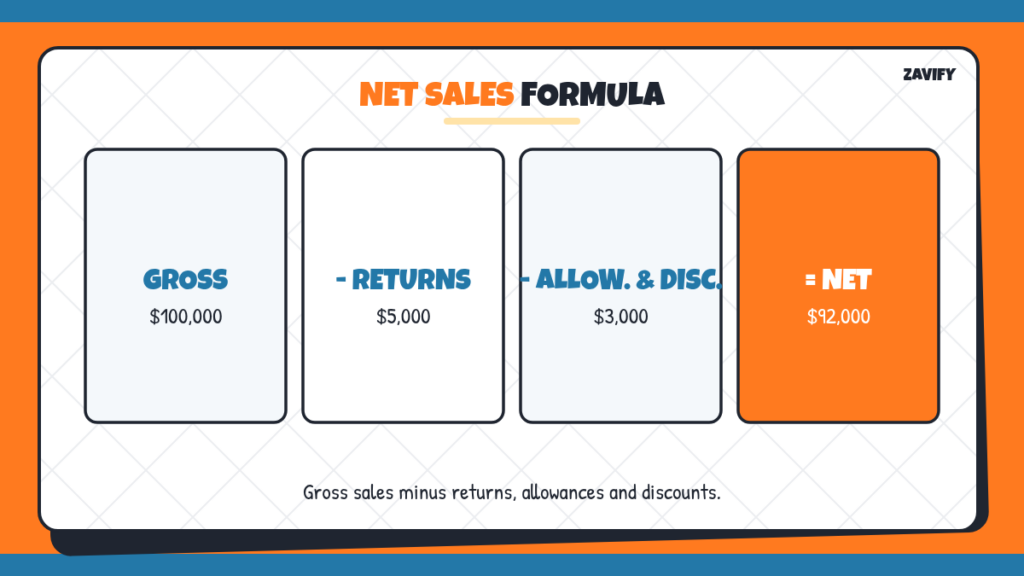
The net sales formula is simple:
| Item | Amount (Example) |
|---|---|
| Gross sales | $100,000 |
| − Sales returns | $5,000 |
| − Sales allowances | $2,000 |
| − Sales discounts | $1,000 |
| = Net sales | $92,000 |
In this example, the business sold $100,000 worth of products but kept $92,000 after returns, allowances and discounts.
1. Find Total Gross Sales
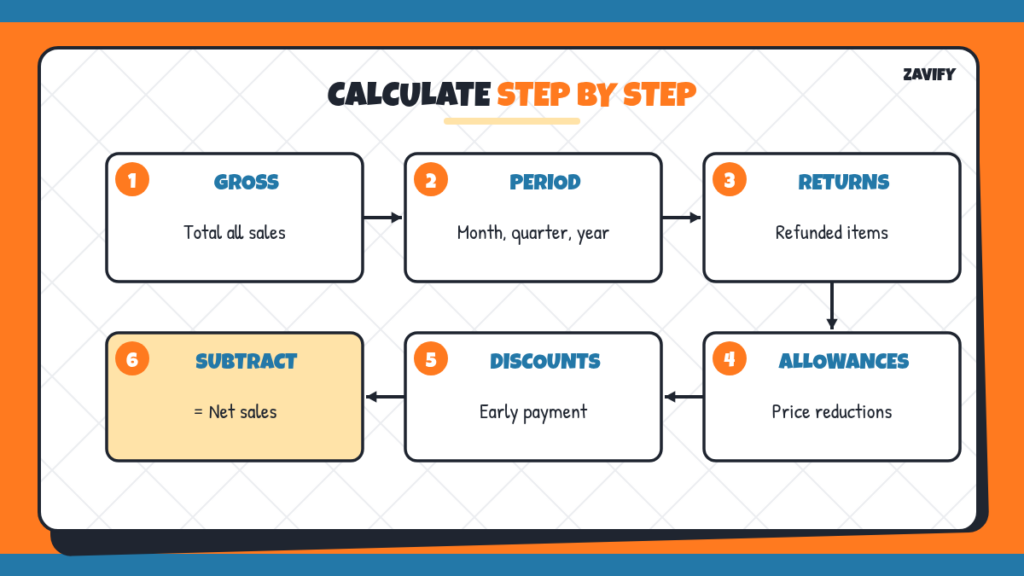
Add up all sales made during the period, before any deductions. This includes cash and credit sales.
2. Choose the Time Period
Decide whether you are calculating for a month, quarter or year. Use the same period for every figure.
3. Add Up Sales Returns
Total the value of all products customers returned for a refund during the period.
4. Add Up Sales Allowances
Total the price reductions given to customers who kept items with minor problems.
5. Add Up Sales Discounts
Total any discounts given for early payment or similar terms. Some businesses also include promotional discounts here, depending on their accounting method.
6. Subtract the Deductions
Subtract returns, allowances and discounts from gross sales. The result is your figure for the period.
7. Check Your Records
Compare your result with your accounting software or sales reports to catch errors, such as returns recorded in the wrong period.
8. Compare With Previous Periods
Look at the result over time to see whether the business is growing. Also watch the gap between the gross and adjusted figures; a growing gap may signal quality problems or too many discounts.
9. Use It in Further Analysis
This number feeds into other key figures, such as gross profit (net sales − cost of goods sold) and profit margins.
Worked Example: A Small Online Store
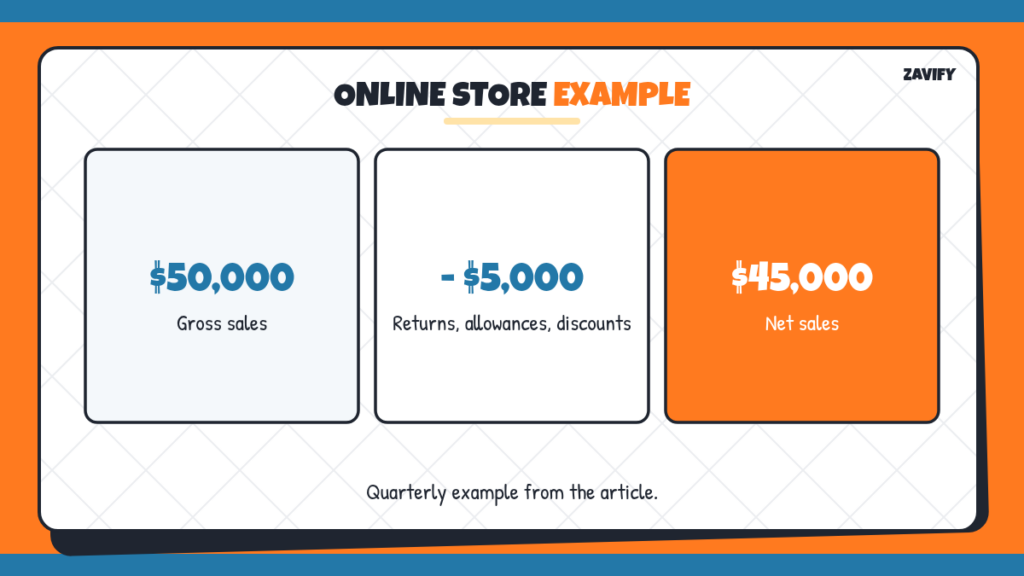
An online clothing store sells $50,000 of products in a quarter. Customers return items worth $3,500. The store gives $500 in allowances for small defects, and $1,000 in discounts to wholesale customers who paid early.
Net sales = $50,000 − $3,500 − $500 − $1,000 = $45,000. If the cost of goods sold was $22,500, gross profit would be $22,500, giving a gross margin of 50 percent. Our guide to the margin maths behind a small online store explores this further.
Net Sales vs Gross Sales vs Revenue vs Profit
| Term | What It Means |
|---|---|
| Gross sales | All sales before any deductions |
| Net sales | Gross sales minus returns, allowances and discounts |
| Revenue | Often the same as net sales; may include other income |
| Gross profit | Net sales minus cost of goods sold |
| Net income (profit) | What remains after all expenses and taxes |
These terms are often confused. A company can have high gross sales but a weak adjusted figure if many products are returned, or strong sales but low profit if costs are high.
Why Net Sales Matter
Investors, managers and lenders use this figure to judge a company’s real sales performance. Salespeople should care too: many commission plans are based on net revenue, so returns and discounts can reduce commission. Our guide to OTE meaning explains how commission plans work.
Where to Find Net Sales on Financial Statements
Public companies report this number (often labelled net revenue or simply revenue) at the top of the income statement in their quarterly and annual reports. Public company filings are available through the SEC’s EDGAR database, which is a great way for students to practise reading real financial statements.
Returns vs Allowances vs Discounts: A Closer Look
These three deductions are easy to mix up. A return happens when a customer sends a product back and gets a refund, so the sale is effectively undone. An allowance is a partial refund or price cut given when a customer keeps an item with a minor problem, such as a scratched table or a late delivery. A discount, in this context, usually means a reduction for paying early, for example “2/10, net 30,” which gives the buyer 2 percent off if they pay within ten days instead of thirty.
Keeping these categories separate in your records helps you understand what is happening in the business. Rising returns might point to product quality issues or misleading descriptions, rising allowances might signal shipping problems, and rising discounts might mean customers are taking advantage of generous payment terms.
How Businesses Can Improve the Figure
Because returns and allowances reduce what a company keeps, improving product descriptions, photos and sizing guides can make a real difference, especially for online stores. Better packaging reduces damage. Clear payment terms and well-designed promotions prevent discounts from eating into revenue. For salespeople, setting honest expectations with customers is one of the simplest ways to reduce returns and protect commission.
A Quick Practice Question
Try this yourself: a sports shop records $80,000 in gross sales for the month. Customers return $4,000 of goods, the shop gives $600 in allowances for faulty items and $400 in early-payment discounts to team buyers. What is the adjusted sales figure? The answer is $80,000 − $4,000 − $600 − $400 = $75,000. Working through examples like this is the fastest way to remember the formula for exams and interviews.
Why This Matters for Students and New Graduates
If you are studying accounting, finance or business, this calculation appears early and often, from introductory accounting exams to case competitions. It is also common in interviews for sales operations, finance and analyst roles, where you might be asked to read a simple income statement and explain what changed from one quarter to the next.
Being able to explain the difference between what a company sells and what it actually keeps shows that you understand how businesses really work. That kind of practical understanding often impresses employers more than memorised definitions. Practise with real annual reports from companies you know, and try explaining the results out loud as if you were presenting to a manager.
Tools That Make It Easier
Small businesses usually rely on accounting software such as QuickBooks or Xero, which records returns, allowances and discounts automatically when they are entered correctly. Online stores can pull the same information from platforms like Shopify. A simple spreadsheet with separate columns for each deduction also works well for students and very small businesses, and it makes the logic easy to check.
Common Mistakes When Calculating Net Sales
Avoid these errors:
- Subtracting cost of goods sold (that gives gross profit, not net sales).
- Mixing figures from different time periods.
- Forgetting allowances or early-payment discounts.
- Counting sales tax as part of sales.
- Recording returns in the wrong period.
Frequently Asked Questions
What are net sales?
Gross sales minus returns, allowances and sales discounts.
What is the net sales formula?
Net sales = gross sales − sales returns − sales allowances − sales discounts.
Is net sales the same as revenue?
Often, yes. Many companies report it as revenue, though revenue can sometimes include other income.
Is net sales the same as profit?
No. Profit subtracts costs and expenses; this figure only subtracts returns, allowances and discounts.
Does net sales include sales tax?
No. Sales tax is collected for the government and is not part of a company’s sales.
Why might net sales fall while gross sales rise?
If returns, allowances or discounts grow faster than sales, the adjusted figure can fall even as gross sales increase.
Conclusion
Net sales show what a business really keeps from its sales after returns, allowances and discounts. The formula is simple, but using it correctly gives a much clearer picture than gross sales alone.
Calculate it consistently, compare periods and use it alongside gross profit and margins. For related guides, read marketing maths for beginners and our sales careers guide.