Introduction
If you have looked at a sales job posting in the US, you have probably seen something like “$90,000 OTE.” It sounds like a salary, but it is not quite one. Plenty of new graduates accept an offer based on that number and are surprised when their first paycheck is much smaller than expected.
This guide explains the OTE meaning in plain terms, shows how base pay and commission fit together, and gives you nine practical steps to judge whether an OTE offer is realistic before you sign anything.
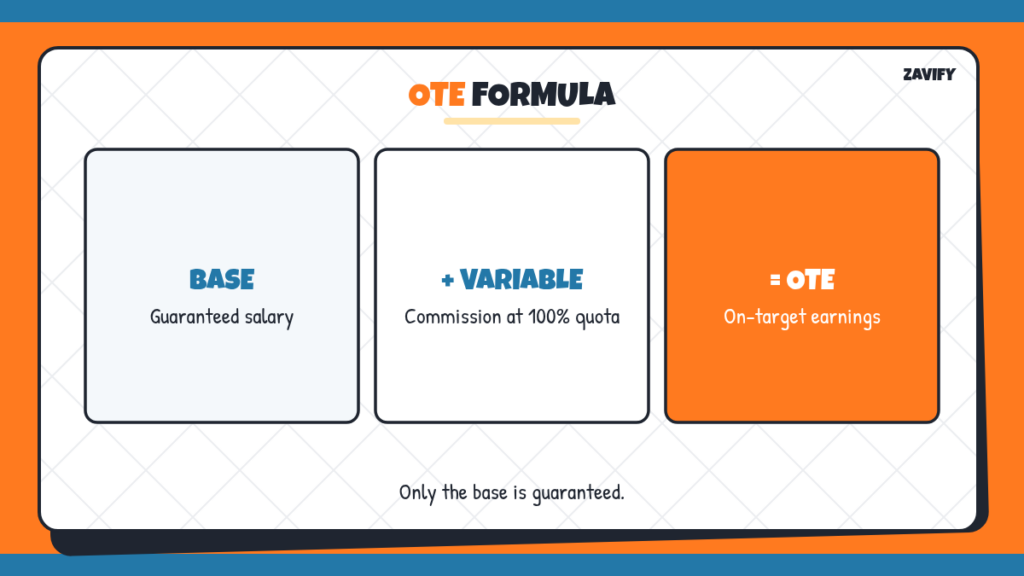
- OTE = on-target earnings.
- It is base salary plus the variable pay you earn at 100% of quota.
- It is a target, not a guarantee.
Table of Contents
What Is OTE in Sales? The OTE Meaning Explained
In short, the OTE meaning is on-target earnings: the total amount a salesperson is expected to earn in a year if they hit exactly 100 percent of their sales target, or quota. It has two parts: a fixed base salary that you receive no matter what, and variable pay, usually commission or bonuses, that depends on how much you sell.
So when someone asks what is OTE in sales, the honest answer is: it is the employer’s estimate of what an average performer earns. Strong performers can earn more than OTE. People who miss quota earn less, sometimes much less.
- Base salary: guaranteed pay, paid in regular paychecks.
- Variable pay: commission or bonus tied to results.
- Quota: the sales target that OTE is built on.
How Does OTE Work in Practice?
Once you know the OTE meaning, the next thing to understand is the “pay mix” or “split,” written as base/variable. Here is how the same $100,000 OTE looks under common splits:
| Pay Mix | Base Salary | Variable Pay at 100% | Typical Roles |
|---|---|---|---|
| 70/30 | $70,000 | $30,000 | Account managers, SDRs |
| 60/40 | $60,000 | $40,000 | SDRs, inside sales |
| 50/50 | $50,000 | $50,000 | Account executives, closers |
The higher the variable share, the more your income depends on results, and the more risk you carry. Roles that focus on keeping existing customers usually have a higher base, while roles that focus on winning new deals usually lean more on commission.
1. Find the Base Salary
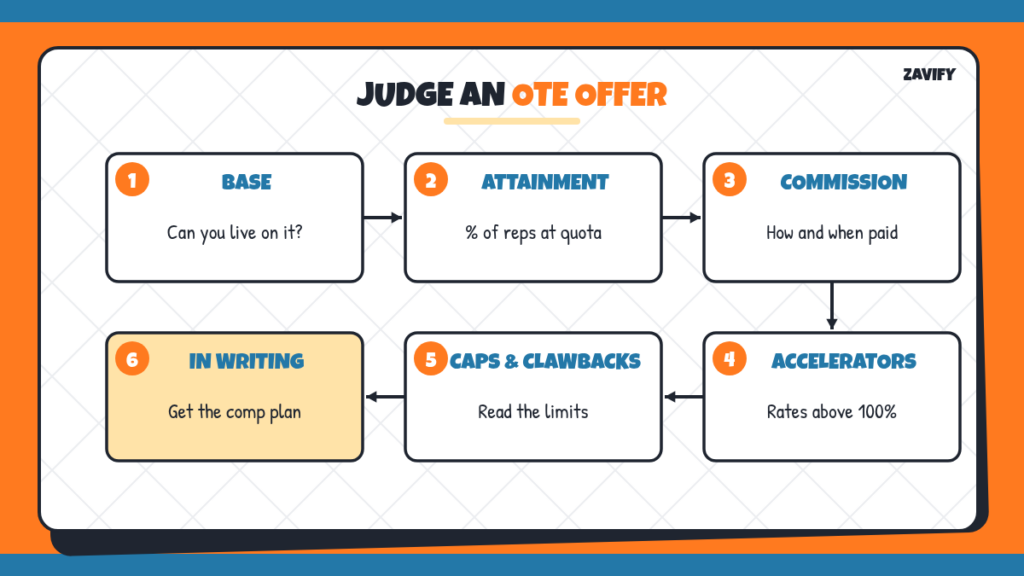
Understanding the OTE meaning starts with the guaranteed part, so always ask for the base salary on its own. This is the only part you can count on. Make sure it covers your rent, bills and loan payments, because your first months will likely include little commission while you learn the product.
2. Ask What Percentage of Reps Hit Quota
This is the most important question in any sales interview. If only 30 percent of the team reaches quota, the OTE is not a realistic estimate for most people. A healthy team usually has a clear majority of reps at or near target.
3. Learn How Commission Is Calculated
Ask whether commission is a percentage of revenue, a flat amount per deal, or a bonus for hitting a target. Ask when it is paid: monthly, quarterly or after the customer pays. Delays can make a big difference to your cash flow.
4. Check for Accelerators
Accelerators are higher commission rates once you go past 100 percent of quota. For example, you might earn 10 percent of revenue up to quota and 15 percent after it. Good accelerators make it worth over-performing.
5. Ask About Caps
Some plans cap commission at a maximum amount. A cap limits how much you can earn in a great year, which matters a lot if you are a strong seller.
6. Look for Ramp Time and Draws
New hires usually get a ramp period, often a few months, with a lower quota while they learn. Some companies also offer a draw, which is an advance on future commission. Ask whether a draw is recoverable, meaning you have to pay it back from later commission.
7. Understand Clawbacks
A clawback lets the company take back commission if a customer cancels or does not pay within a certain time. Ask how long the clawback window is and how often it happens.
8. Compare the Total Package
OTE does not include health insurance, retirement matching, equity or paid time off. A slightly lower OTE with excellent benefits can be the better deal.
9. Get Everything in Writing
Ask for the compensation plan document before you accept. It should list base pay, quota, commission rates, accelerators, caps, clawbacks and payment timing. If a company will not share it, treat that as a warning sign.
OTE Example: How Pay Changes With Performance
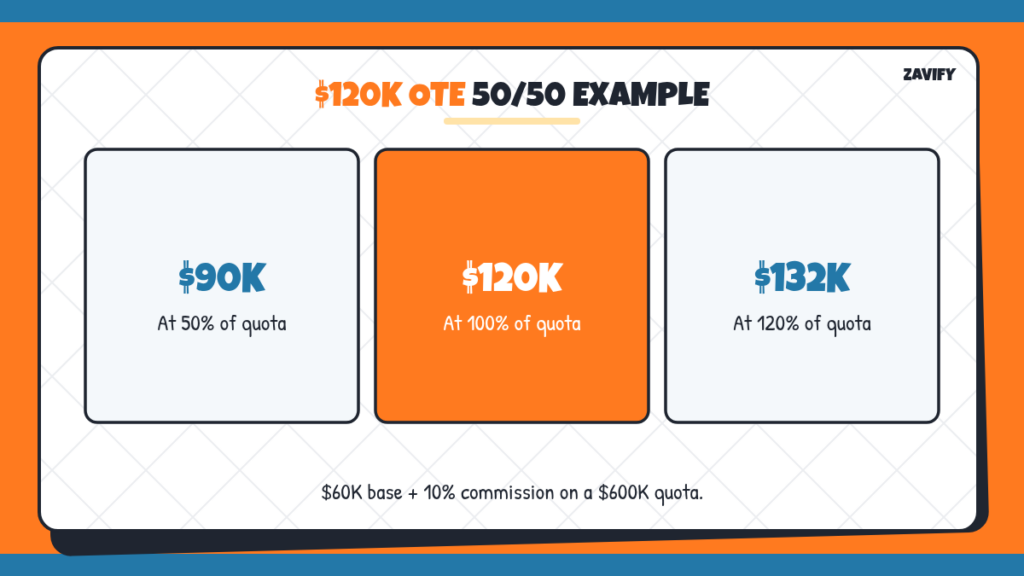
Imagine an account executive with a $120,000 OTE on a 50/50 split. Their base is $60,000, and they earn $60,000 in commission if they hit a $600,000 annual quota (a 10 percent commission rate).
| Quota Hit | Commission | Total Pay |
|---|---|---|
| 50% | $30,000 | $90,000 |
| 100% | $60,000 | $120,000 |
| 120% (no accelerator) | $72,000 | $132,000 |
This example shows the OTE meaning in real numbers. Notice how quickly total pay drops when results fall short. That is why the base salary and the share of reps who hit quota matter so much.
OTE vs Base Salary vs Total Compensation
These terms are often mixed up, which is why the OTE meaning causes so much confusion. Base salary is the guaranteed part. OTE is base plus expected variable pay at target. Total compensation usually means everything: base, commission, bonuses and sometimes the value of benefits and equity. When comparing offers, compare like with like.
Typical Sales Pay in the US
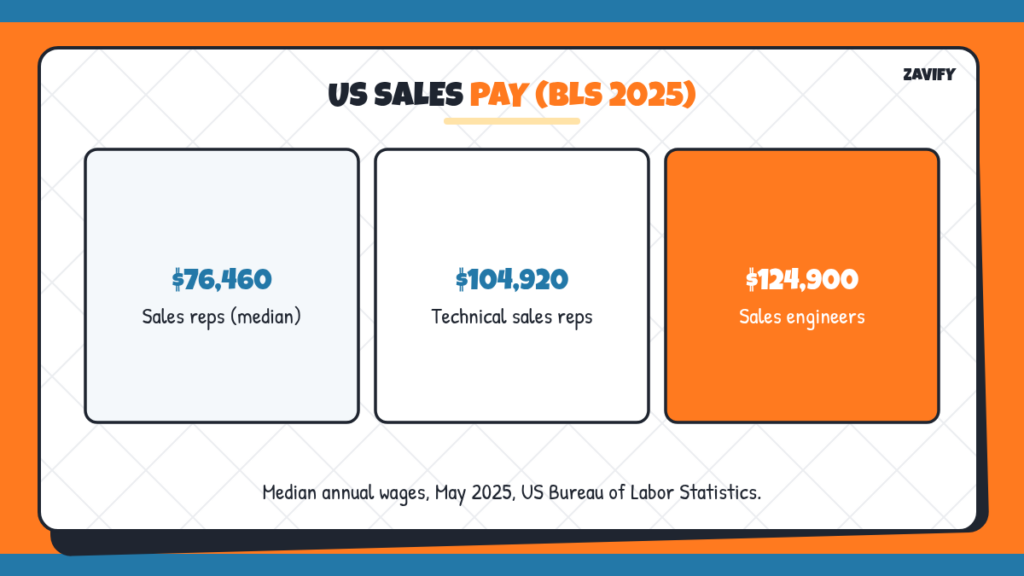
According to the US Bureau of Labor Statistics, the median annual wage for wholesale and manufacturing sales representatives was $76,460 in May 2025, and most employers pay a mix of salary and commission or bonuses. Technical sales roles pay more: sales engineers earned a median of $124,900.
Use these figures as a sense check whenever you apply the OTE meaning to a real offer. An entry-level OTE far above them, with a very small base, deserves careful questions.
OTE Meaning for Different Sales Roles
The OTE meaning stays the same across roles, but the mix changes with the job. Sales development representatives (SDRs) and business development representatives (BDRs), who book meetings rather than close deals, often have a higher base and a smaller variable share. Their commission is usually tied to meetings booked or pipeline created.
Account executives, who close deals, more often work on a 50/50 split with commission based on revenue. Account managers, who look after existing customers, tend to have higher bases with bonuses for renewals and upsells. Sales engineers, who support deals with technical expertise, usually have the highest base and a modest variable portion.
When you compare two jobs, make sure you compare the same kind of role. A $70,000 OTE for an SDR and a $140,000 OTE for an experienced account executive are not really competing offers.
How to Talk About OTE in an Interview
It is completely normal to ask about pay in a sales interview; in fact, good sales managers expect it, because it shows you understand how the role works. Ask politely and specifically: “What is the base and variable split?”, “What percentage of the team hit quota last year?” and “Can I see the comp plan?” Clear, confident questions are a small demonstration of the skills the job needs.
Red Flags in OTE Offers
Be cautious if you see a very high OTE with no base salary, a recruiter who cannot tell you how many reps hit quota, a quota that rises sharply every quarter, or a request to pay for your own “training.” Commission-only roles are legal and can work, but they suit experienced sellers far more than new graduates.
Common Mistakes With the OTE Meaning
These mistakes cost new salespeople money and stress:
- Treating OTE as a guaranteed salary.
- Not asking how many reps actually hit quota.
- Ignoring caps, clawbacks and payment delays.
- Choosing a high OTE with a base too low to live on.
- Accepting an offer without the written comp plan.
Frequently Asked Questions
What is the OTE meaning in a job description?
OTE means on-target earnings: the base salary plus the commission or bonus you would earn by hitting 100 percent of your quota.
Is OTE guaranteed?
No. Only the base salary is guaranteed. The variable part depends on your results.
What is a good OTE split?
For new salespeople, a higher base such as 60/40 or 70/30 is usually safer. Experienced closers often prefer 50/50 for higher upside.
Can you earn more than OTE?
Yes. If you exceed quota, you earn more, especially if the plan has accelerators and no cap.
Is OTE before or after tax?
OTE is quoted before tax, like a normal salary. Commission is usually taxed as regular income.
Should I negotiate base or OTE?
Often the base. A higher base reduces your risk, and companies sometimes have more flexibility there than on commission rates.
Conclusion
The OTE meaning is simple once you see the parts: base salary plus the commission you earn at 100 percent of quota. The real skill is judging whether that target is achievable.
Ask about quota attainment, read the comp plan and make sure the base covers your life. For more on starting out, read our sales careers guide and our comparison of inside sales and outside sales roles.