Introduction
If you are studying business, you will almost certainly take a course called marketing management. It is also one of the most common job areas for business graduates in the US. Yet many students finish the course able to recite definitions without really understanding how the ideas fit together in a real company.
This guide explains marketing management in plain language: what it means, the core concepts, the step-by-step process companies follow, what a marketing manager actually does and how much the role pays.
- Marketing management = planning, running and measuring marketing.
- Core tools: market research, segmentation, positioning and the 4 Ps.
- It connects customer needs with business goals.
Table of Contents
What Is Marketing Management?
Marketing management is the process of planning, organising, carrying out and controlling a company’s marketing activities so that it reaches the right customers and meets its business goals. In simple terms, it means deciding who to sell to, what to offer, how to reach them and how to check whether it is working.
It is both a field of study and a job function. In a college course, it covers theories and frameworks. Inside a company, it is the daily work of marketing teams and managers who make decisions about products, prices, campaigns and budgets.
- Analysis: understanding customers, competitors and the market.
- Planning: setting goals, strategies and budgets.
- Implementation: running campaigns and launches.
- Control: measuring results and adjusting.
How Does the Marketing Management Process Work?
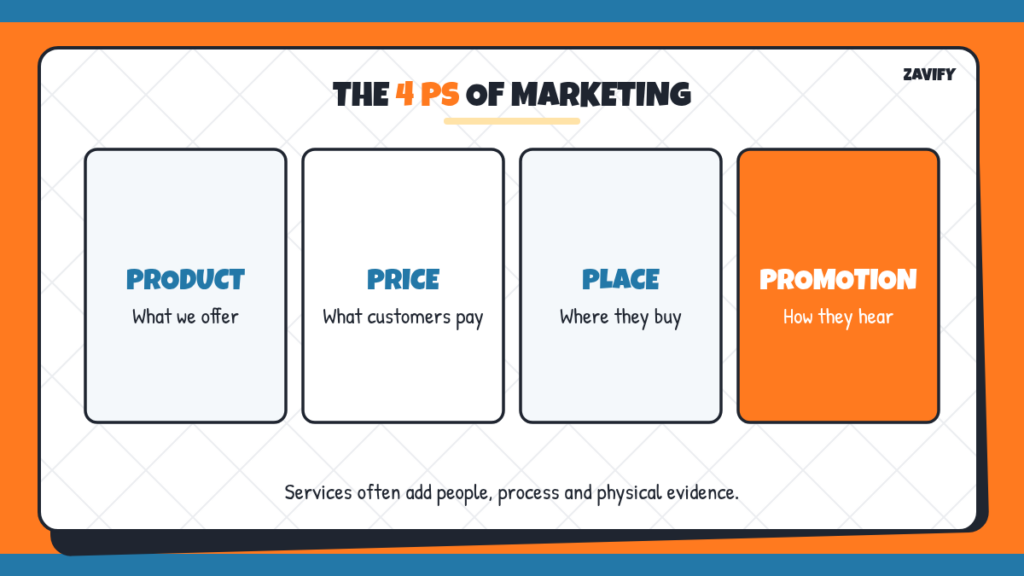
Most companies build their marketing decisions around the marketing mix, often called the 4 Ps:
| P | Key Question | Example Decisions |
|---|---|---|
| Product | What are we offering? | Features, quality, packaging, versions |
| Price | How much will customers pay? | List price, discounts, payment terms |
| Place | Where can customers buy it? | Online store, retailers, distributors |
| Promotion | How will customers hear about it? | Ads, social media, email, PR, sales team |
Service businesses often extend this to 7 Ps by adding people, process and physical evidence, because the experience of being served is part of what customers buy.
1. Research the Market
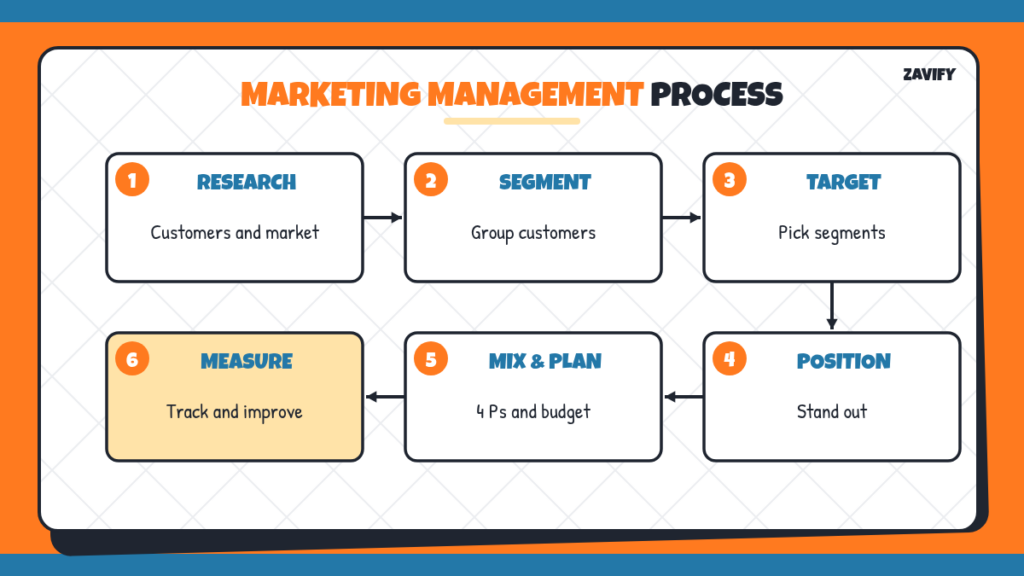
Every marketing decision starts with research. Companies study customer needs, market size, trends and competitors using surveys, interviews, sales data and online analytics. Good research reduces guesswork.
2. Segment Customers
Segmentation divides a broad market into groups with similar needs, such as by age, location, income, behaviour or industry. A sports brand might segment runners, gym users and team athletes, because each group wants different things.
3. Choose a Target Market
Next, the company decides which segments to focus on. It usually chooses groups that are large enough, reachable and a good match for what it does best.
4. Define Your Positioning
Positioning is the place you want to hold in customers’ minds compared with competitors. For example, one brand may position itself as the affordable choice, another as the premium choice. A clear position guides every other decision.
5. Set Clear Goals
Good marketing goals are specific and measurable, such as increasing website sign-ups by 20 percent in six months or launching a product in three new states this year.
6. Build the Marketing Mix
Decide the product features, price, distribution and promotion that will appeal to the target market and support your positioning. Each P should support the others; a premium price needs premium quality and messaging.
7. Create a Budget and Plan
Turn the strategy into a marketing plan with a timeline, channels, responsibilities and budget. This helps the whole team, including sales, work toward the same goals.
8. Launch and Run Campaigns
Implementation is where plans meet reality. Teams create content, run ads, train salespeople, work with partners and coordinate launches. Close teamwork with sales is especially important.
9. Measure and Improve
Track results such as leads, sales, cost per customer, customer satisfaction and return on marketing spend. Compare them with your goals and adjust. Marketing management is a continuous cycle, not a one-time plan.
What Does a Marketing Manager Do?
A marketing manager leads the planning and execution of marketing activities. According to the US Bureau of Labor Statistics, marketing managers estimate demand for products and services, identify potential markets, develop pricing strategies and plan how to win and keep customers. They work closely with product development, public relations and sales teams.
Day to day, that can include reviewing campaign results, approving creative work, managing a budget, meeting with sales leaders, briefing agencies and presenting results to senior management.
Marketing Manager Salary and Job Outlook
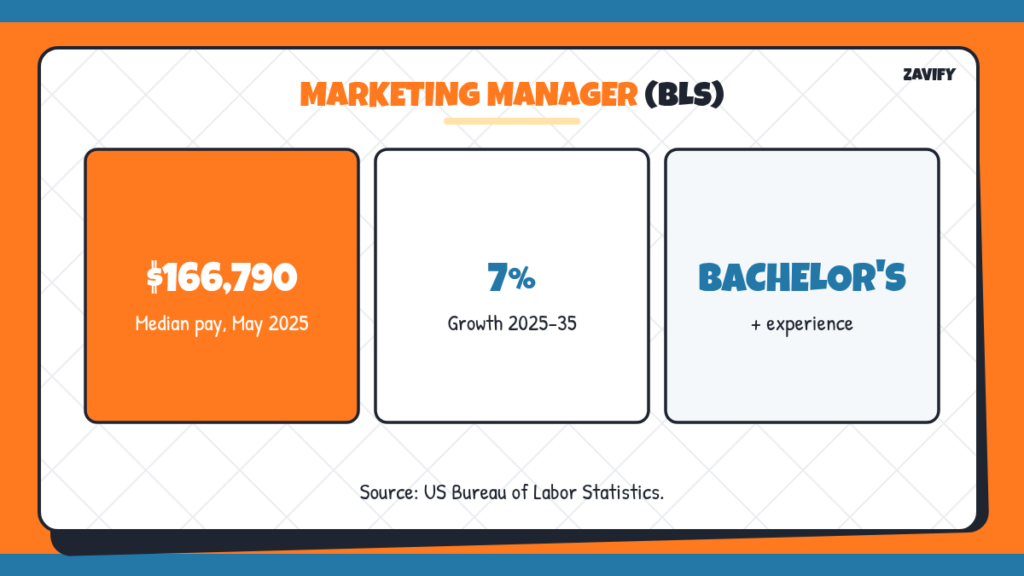
The BLS reports a median annual wage of $166,790 for marketing managers in May 2025, and projects 7 percent job growth from 2025 to 2035, faster than the average for all occupations. Most marketing managers have a bachelor’s degree plus several years of experience in roles such as sales, marketing coordination, market research or public relations.
That means marketing manager is usually not a first job. Graduates often start as marketing coordinators, analysts or sales representatives, then move up. Sales experience is valuable here; read our guides to B2B sales and inside sales to see why.
Marketing Management vs Sales Management
| Feature | Marketing Management | Sales Management |
|---|---|---|
| Focus | Creating demand and positioning | Converting demand into revenue |
| Time frame | Medium to long term | Short to medium term |
| Main tools | Research, branding, campaigns | Pipeline, quotas, coaching |
| Key metrics | Leads, brand awareness, market share | Revenue, win rate, quota attainment |
The two work best together. Marketing brings in interested buyers, and sales turns them into customers. Many companies now align both teams around shared revenue goals.
Marketing Management in the Digital Age
The core ideas have not changed, but the tools have. Today’s marketing teams use website analytics, search engine optimisation, social media, email automation and online advertising. Data makes it easier to see what works, which means marketing managers are increasingly expected to understand numbers as well as creativity.
A Simple Example: Launching a Campus Coffee Brand
Imagine a small company launching a new cold brew coffee for college students. Research shows that students want affordable caffeine that is quick to grab between classes. The company segments the market and targets undergraduates living on or near campus. It positions the drink as cheaper than café coffee but better quality than vending machine options.
For the marketing mix, it offers a single-serve can (product), prices it slightly below café drinks (price), sells through campus stores and vending machines (place) and promotes it with student ambassadors and social media (promotion). After one semester, the team reviews sales by location, drops the weakest outlets, adds a new flavour based on feedback and doubles the ambassador program on the best-performing campuses. That loop of plan, launch, measure and adjust is the whole subject in miniature.
Key Marketing Metrics to Know
Students preparing for interviews should recognise a few common measures. Customer acquisition cost shows how much it costs to win one new customer. Conversion rate shows the share of visitors or leads who buy. Customer lifetime value estimates how much revenue a customer brings over time. Return on ad spend compares advertising cost with the sales it produces. Market share shows a brand’s portion of total sales in its category.
How to Study This Subject Effectively
Instead of memorising definitions, pick a brand you know well and apply each concept to it: who its target customers are, how it is positioned and how it uses each of the 4 Ps. Case studies make the theory stick and give you strong examples for exams and interviews.
Common Mistakes in Marketing Management
These mistakes weaken marketing results:
- Skipping research and relying on assumptions.
- Trying to target everyone instead of clear segments.
- Setting vague goals that cannot be measured.
- Working separately from the sales team.
- Never reviewing results or adjusting the plan.
Frequently Asked Questions
What is marketing management?
It is the process of planning, running and measuring marketing activities to reach target customers and meet business goals.
What are the 4 Ps of marketing management?
Product, price, place and promotion, also known as the marketing mix.
What does a marketing manager do?
They research markets, plan strategies, manage budgets, oversee campaigns and work with sales and product teams.
How much does a marketing manager earn in the US?
The BLS reports a median annual wage of $166,790 for marketing managers in May 2025.
Is marketing management a good career?
For many people, yes. It offers strong pay, faster-than-average job growth and a mix of creative and analytical work.
Do I need an MBA for marketing management?
Not usually. Most roles require a bachelor’s degree and experience; an MBA can help for senior positions.
Conclusion
Marketing management is the cycle of researching, planning, launching and measuring marketing so that a company reaches the right customers. The 4 Ps, segmentation and positioning are the core tools.
Whether you are studying it or planning a career, focus on understanding how each step connects to the next. For related career guidance, read our sales careers guide and our article on OTE meaning.